Is it now forbidden to question Zionism without being branded “antisemitic”? Drawing on the words of World Zionist leader Nahum Goldmann himself, this investigation exposes a growing effort to redefine dissent as hate—while tracing the deeper roots of the conflict to Vatican II, religious liberty, and a decades-long struggle over the soul of Catholic teaching. What emerges is a striking paradox: in the name of tolerance, Catholics are increasingly told which beliefs they are no longer allowed to hold.
Over the past few years, Zionist political figures and pundits have increasingly instructed Americans that there is a category of ideas that they are no longer allowed to have. Because an accurate label for those who hold these “dangerous” ideas — like “those who disagree with some policies of the United States and Israel’ — cannot be weaponized against them, the Zionist guardians of political speech have misappropriated a label that corresponds with ideas that Catholics should not have: antisemitic ideas.
To help us understand whether this Zionist tactic is legitimate, we can consider the following statement:
“One of the great oversights in the history of Zionism is that when the Jewish homeland in Palestine was founded, sufficient attention was not paid to relations with Arabs. . . . Even Theodor Herzl’s brilliantly simple formulation of the Jewish question as basically a transportation problem of ‘moving a people without land into a land without people’ is tinged with a disquieting blindness to the Arab claim to Palestine. Palestine was not a land without people even in Herzl’s time; it was inhabited by hundreds of thousands of Arabs who, in the normal course of events, would sooner or later have achieved independent statehood, either alone or as a unit within a larger Arab context.” (p. 284)
Today’s Zionists would tell us that this is clearly antisemitic and anyone who defends it is antisemitic. But here is something interesting: the man who wrote these words was Nahum Goldman, who was the president of the World Zionist Organization and the World Jewish Congress. Not only was he not antisemitic, he was not even anti-Zionist, obviously. And yet if we were to apply the same measure used by today’s Zionist political figures and pundits, we would have to conclude that he was a vile antisemitic, deserving of severe punishment.
Because he was Zionist, he was opposed by his Orthodox Jew classmates and teachers. Translation: it has never been antisemitic to oppose Zionism, and those who tell us it is are either ignorant or lying.
Here is another quotation from Nahum Goldman’s autobiography, Sixty Years of Jewish Life:
“I attended the Orthodox school for three years. Although I was a good student, I had some trouble there, and strange as it may sound for such an early age, it was trouble of an ideological nature. Even in those days I was strongly pro-Zionist, but the teachers, like all representatives of Neo-Orthodoxy, were passionately anti-Zionist. I used to carry on a kind of Zionist propaganda among my schoolmates and was often reprimanded for this . . . .” (pp.19-20)
Because he was Zionist, he was opposed by his Orthodox Jew classmates and teachers. Translation: it has never been antisemitic to oppose Zionism, and those who tell us it is are either ignorant or lying. We know this from the words of the man who was president of the World Zionist Organization and the World Jewish Congress, who obviously knew something about the matter.
As discussed in a previous article, Mr. Goldman also played a role in influencing the Second Vatican Council. In his Augustin Bea: The Cardinal of Unity, Bea’s longtime secretary, Fr. Stjepan Schmidt, quoted a letter to Bea from Nahum Goldmann in the name of the World Conference of Jewish Organizations:
“Now that the Ecumenical Council is coming to an end and the declaration on relations with the Jewish people has been approved with such a resounding majority, I feel the need to express to you both personally and in the name of the organizations I represent our gratitude for the wise yet also courageous manner in which you and your secretariat have brought this far-from-easy declaration to success. I am sure that Your Eminence knows that we are not happy about several changes in respect to the previous draft, but in this sinful world nobody ever gets everything he wants . . . .” (p. 524)
Many Catholics understand the connection between Jewish interests and Vatican II primarily in terms of Nostra Aetate, the document relating to non-Christian religions. However, in her study on The Church and the Jews: The Struggle at Vatican Council II, Judith Hershcopf affirmed that the Jewish B’nai B’rith lobbied the Vatican on the question of the Council’s Declaration on Religious Freedom, Dignitatis Humanae:
“In March 1964 a B’nai B’rith delegation of three met with Pope Paul VI and communicated the ‘profound interest’ of the Jewish community in the proposed declaration on religious freedom and Catholic-Jewish relations.”
Support for Zionist initiatives was more likely to the extent that Catholic opposition was weakened.
At first glance, it is reasonable to wonder why Jewish groups would have cared so much about Catholic teaching on religious freedom. On this front, another quotation from Mr. Goldman can offer an important insight, this time from his The Jewish Paradox:
“As for the relations between Judaism and the Roman Catholic Church, I became involved with them fairly late in the day, just before, during and after the Second World War. . . . The World Jewish Congress had no global policy concerning various churches, but the Zionist movement made several attempts to enlist the help of the Vatican, because many of the votes in the Council of the League of Nations belonged to Catholic countries. When the time came for the Council to ratify the Balfour Declaration on the British Mandate in Palestine, we were afraid that several states would go against us because of official Catholic opposition.” (p. 183)
While this is not necessarily dispositive in identifying a Zionist motivation for promoting religious liberty, it allows us to see a plausible rationale: support for Zionist initiatives was more likely to the extent that Catholic opposition was weakened. Indeed, once Catholic teaching “evolved” at Vatican II (as discussed below), formerly Catholic states accelerated their march toward secularism, which has arguably paved the way for at least somewhat less resistance to Zionism.
We can look for two other recent indications of the Zionist motivation for promoting religious liberty from recent news items in the United States. In the first, the White House’s Religious Liberty Commission removed its only Catholic woman, Carrie Prejean Boller, because she, like Orthodox Jews, opposes Zionism. In her social media post about the incident, she suggested that the removal related to her opposition to the attack on Iran:
“The only Catholic woman who opposes Zionism was removed as a prelude to the Iran war.”
Whatever the rationale for her removal, it is obviously ironic that she was removed from the Religious Liberty Commission for exercising her religious liberty.
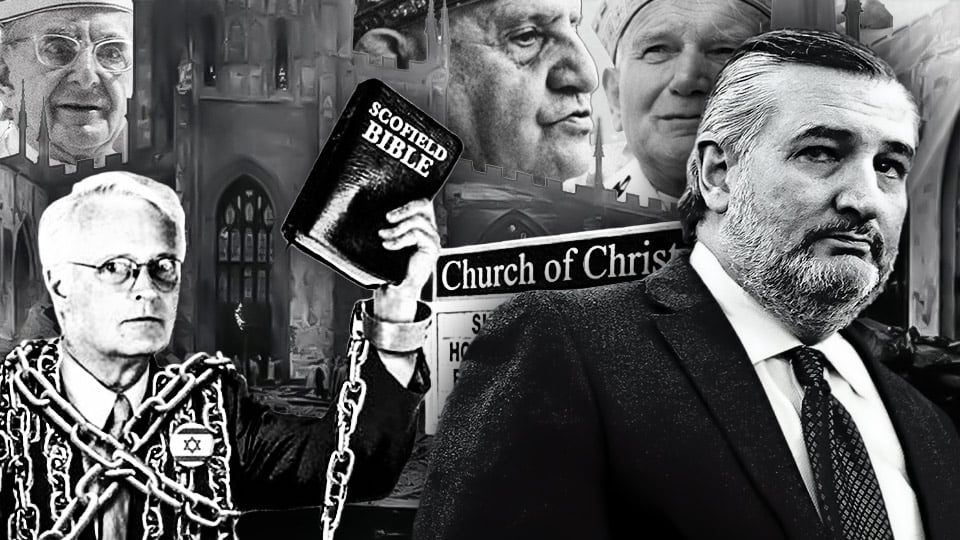
Zionist Senator Ted Cruz recently promoted a piece of anti-Catholic bigotry produced by a social media account from “Insurrection Barbie.” The hate-filled screed identified three currents of Catholic thought that must be stopped.
We can begin to approach the source of this irony more closely by examining the second incident. As reported by LifeSite, Zionist Senator Ted Cruz recently promoted a piece of anti-Catholic bigotry produced by a social media account from “Insurrection Barbie.” The hate-filled screed identified three currents of Catholic thought that must be stopped:
“What is actually being deployed is a specific ideological cocktail with three distinct ingredients, none of which represent mainstream American Catholic life. The first is integralism — a pre-Vatican II political theology that holds the Catholic Church should exercise direct authority over temporal governments, that religious liberty is a Protestant error, and that a properly ordered state must subordinate itself to Church teaching. This is not the position of the United States Conference of Catholic Bishops. It is not the position of Pope Francis. . . . The second is SSPX-adjacent traditionalism — the world of the Latin Mass hardliners, the Society of Saint Pius X, the sedevacantists and near-sedevacantists who regard the Second Vatican Council as a catastrophic betrayal and the post-conciliar Church as illegitimate or gravely compromised. . . .The third ingredient is imported European and Middle Eastern sectarianism — and this is perhaps the most important point, because it explains something that confuses many American observers: why does any this feel so foreign?”
On the side favored by Cruz, Insurrection Barbie, and the Zionists are Francis, the United States Conference of Catholic Bishops, religious liberty, and Vatican II. On the other side are Traditional Catholics and so-called integralism, which opposes religious liberty.
This latter point deserves special attention, and invites us to recall the Vatican II battle between Fr. John Courtney Murray (who advocated for liberalized religious liberty) and Monsignor Joseph Clifford Fenton (who defended the Church’s traditional teaching on religious liberty). In his 1948 review of Cardinal Emmanuel Suhard’s 1947 pastoral letter, Monsignor Fenton distinguished between Modernism and integralism:
“An incautious reader of Cardinal Suhard’s pastoral might possibly come to the dangerously false conclusion that Modernism and integralism, as we know them, are two contrary false doctrines, the one, as it were, to the left, and the other to the right, of genuine Catholic teaching. Nothing, of course, could be farther from the truth. Modernism, in the technical language of Catholic doctrine, is the name applied to the definite series of errors condemned in the decree Lamentabili sane exitu, in the encyclical Pascendi dominici gregis, and in the motu proprio, Sacrorum antistitum. Pope Pius X spoke of Modernism as ‘a conglomeration of all the heresies.’ Integralism, on the other hand, is essentially the teaching or the attitude of those who worked for the presentation of an integral Catholicism, of Catholic dogma set forth accurately and in its entirety. Most frequently the name of integralism was applied to the doctrine and the viewpoint of those Catholic writers who entered into controversy against the Modernists during the first decade of the present century. Understood in this fashion, integralism was nothing else than the contradiction of heretical Modernism. It was thus basically only the exposition of Catholic truth.”
Certainly the “integralism” described by Monsignor Fenton included the Church’s traditional teaching on religious liberty but, beyond that, it was “basically only the exposition of Catholic truth.” It was opposed not by a liberal version of Catholicism but by Modernism, a condemned heresy. For his part, Fr. Murray (a progressive) understood that he advocated for a change to the Church’s teaching on religious liberty, but he argued that the Church’s teachings were based on historical circumstances that no longer applied.
Today, in the name of religious liberty, Catholics are being told that they do not have the religious liberty to follow their consciences, whether it be in adhering to what the Church has always taught about the Faith or in opposing Zionism.
For the traditional Catholic teaching on religious liberty, we can look to Blessed Pius IX’s 1864 encyclical condemning certain errors, Quanta Cura:
“For you well know, venerable brethren, that at this time men are found not a few who, applying to civil society the impious and absurd principle of ‘naturalism,’ as they call it, dare to teach that ‘the best constitution of public society and (also) civil progress altogether require that human society be conducted and governed without regard being had to religion any more than if it did not exist; or, at least, without any distinction being made between the true religion and false ones.’ And, against the doctrine of Scripture, of the Church, and of the Holy Fathers, they do not hesitate to assert that ‘that is the best condition of civil society, in which no duty is recognized, as attached to the civil power, of restraining by enacted penalties, offenders against the Catholic religion, except so far as public peace may require.’ From which totally false idea of social government they do not fear to foster that erroneous opinion, most fatal in its effects on the Catholic Church and the salvation of souls, called by Our Predecessor, Gregory XVI, an ‘insanity,’ viz., that ‘liberty of conscience and worship is each man’s personal right, which ought to be legally proclaimed and asserted in every rightly constituted society; and that a right resides in the citizens to an absolute liberty, which should be restrained by no authority whether ecclesiastical or civil, whereby they may be able openly and publicly to manifest and declare any of their ideas whatever, either by word of mouth, by the press, or in any other way.’ But, while they rashly affirm this, they do not think and consider that they are preaching ‘liberty of perdition;’ and that ‘if human arguments are always allowed free room for discussion, there will never be wanting men who will dare to resist truth, and to trust in the flowing speech of human wisdom; whereas we know, from the very teaching of our Lord Jesus Christ, how carefully Christian faith and wisdom should avoid this most injurious babbling.’”
Following Pope Gregory XVI, Blessed Pius IX called liberty of conscience the “liberty of perdition.” He wrote that it was “insanity” for societies to proclaim liberty of worship. All of this is opposed to Vatican II’s declaration on religious liberty, Dignitatis Humanae, which was so heavily dependent upon Fr. Murray and so vigorously opposed by Monsignor Fenton and Archbishop Marcel Lefebvre.
The Catholic Church absolutely rejects antisemitism, but it also rejects Zionism, as do many Orthodox Jews.
The great irony of Dignitatis Humanae is that it has led to what we see now: the Traditional Catholicism of St. Pius X, Blessed Pius IX, Archbishop Lefebvre, and Monsignor Fenton is now despised, not only by men like Cruz but also by so many within the Vatican. As we can see from the words of Archbishop Lefebvre’s September 1965 intervention read at the Council, he tried to warn his fellow Council Fathers against this evil:
“This conception of religious liberty is that of the Church’s enemies. This very year Yves Marsaudon, the Freemason, has published the book Ecumenism as Seen by a Traditional Freemason. In it the author expresses the hope of Freemasons that our Council will solemnly proclaim religious liberty. Similarly the Protestants at their meeting in Switzerland are expecting from us a vote in favor of the declaration, without any toning down of these terms. What more information do we need? As Pope Leo XIII said, this new law tends ‘to the annihilation of all religions, notably of the Catholic religion which, being the only true religion among all of them, cannot be placed on an equal footing with the others without supreme injustice.’” (Archbishop Lefebvre, I Accuse the Council!, p. 63)
His warning was prophetic, and today, in the name of religious liberty, Catholics are being told that they do not have the religious liberty to follow their consciences, whether it be in adhering to what the Church has always taught about the Faith or in opposing Zionism. Diabolical disorientation? As it turns out, Quanta Cura was correct, even if it goes against our modern intuitions: abandoning the Church’s pre-Vatican II wisdom has led to the “liberty of perdition” and the persecution of God’s truth, even at the hands of those identifying as Catholic. All of this was desired by the Church’s enemies, including the Freemasons and Zionists.
We cannot blame Nahum Goldman or the Zionists for the problems in the Catholic Church, even if they helped push for religious liberty. However, as Catholics, we do have an obligation to educate ourselves about the religious warfare being waged against us by the Zionists. The Catholic Church absolutely rejects antisemitism, but it also rejects Zionism, as do many Orthodox Jews. While we can pray for the anti-Catholic bigots and the Zionists, God wants us to stand firm in the truths that He has given us through His Catholic Church no matter how viciously they attack us. Immaculate Heart of Mary, pray for us!