“A good tree cannot bear bad fruit.” What happens when Christ’s own test from St. Matthew 7 is applied to the SSPX—and to Rome itself? The verdict is unmistakable.
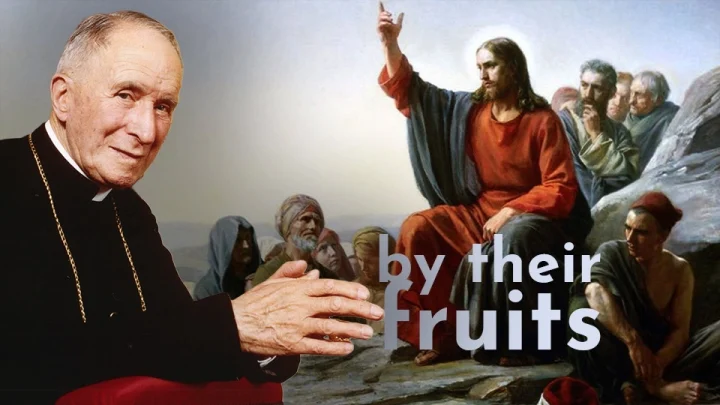
In his February 8th sermon at the Society of St. Pius X (SSPX) seminary in Ecône, Fr. Bernard de Lacoste spoke of the test that Our Lord gave us to guide our judgments in difficult situations:
“When we find ourselves in a difficult situation, hesitating about which path to take, when we don’t quite know what to do, Our Lord gives us, in the Gospel, a criterion for discernment: ‘A tree is judged by its fruit. A good tree bears good fruit, a bad tree bears bad fruit.’ So let’s look: what are the fruits of the New Theology and the New Mass? Modern seminaries are emptying; on Sundays at Mass in parishes, one finds mostly elderly people; the numbers in religious congregations are plummeting; morality is no longer respected, etc. On the contrary, the traditional Mass attracts people, and the only institutes that foster vocations today are those that preserve Tradition. Let us also look at the fruits among the faithful, among the laity. Where do we find large families? Where do we find spouses faithful to one another and who respect marital morality? Above all—not exclusively, but especially—in communities where Tradition is preserved.”
These words build upon Our Lord’s Sermon on the Mount and certainly ring true for many of us who have made sacrifices to attend the Traditional Latin Mass. Of course we can find good Catholics who do not support Traditional Catholicism or the SSPX, but a rational evaluation of fruits decisively indicates that the tree representing Traditional Catholicism is immensely better than the tree representing the “Synodal Church.”
When we look more closely at chapter seven from the Gospel of St. Matthew, we find something quite amazing: the entire chapter helps us better understand the current dynamic between the SSPX and Rome.
When we look more closely at chapter seven from the Gospel of St. Matthew — upon which Fr. de Lacoste’s words above are based — we find something quite amazing: the entire chapter helps us better understand the current dynamic between the SSPX and Rome. Whereas the battling opinions about the planned episcopal consecrations suggest that we have no way to reach consensus on discerning God’s will, the Sermon on the Mount provides us with an unmistakable verdict. We can see this by considering each of the twenty-nine verses of chapter seven from St. Matthew’s Gospel.
Judge Just Judgments (Verses 1 to 5)
“Judge not, that you may not be judged, For with what judgment you judge, you shall be judged: and with what measure you mete, it shall be measured to you again. And why seest thou the mote that is in thy brother’s eye; and seest not the beam that is in thy own eye? Or how sayest thou to thy brother: Let me cast the mote out of thy eye; and behold a beam is in thy own eye? Thou hypocrite, cast out first the beam in thy own eye, and then shalt thou see to cast out the mote out of thy brother’s eye.”
These words do not prohibit all judgments but they do counsel us to avoid unjust judgments. St. Augustine’s commentary on this passage is especially relevant to the situation today with the SSPX:
“I suppose the command here to be no other than that we should always put the best interpretation on such actions as seem doubtful with what mind they were done.” (St Augustine, Serm. in Mont. ii. 18., from Catena Aurea by St. Thomas Aquinas)
The entire justification for the SSPX’s work is based on its sincere belief that there is an actual state of necessity that justifies, for example, the consecration of bishops without Rome’s approval. In this time of unfathomable apostasy, those who condemn the SSPX for having, and acting upon, this belief do so unjustly, and thus violate Our Lord’s injunction.
The common practices of Communion in the hand and lay Eucharistic ministers have contributed to such a culture of careless desecration. It is almost as though post-Conciliar Rome has made it a core mission to multiply sacrileges.
Beyond this, the discussion of beams and motes provides us with a sure way to distinguish between the grievances that Rome and the SSPX have with each other. By actively producing and promoting diabolical evils — including Amoris Laetitia, Pachamama, Fiducia Supplicans, the Synodal Church, and Mater Populi Fidelis — Rome has a beam in its eye and effectively insists that all Catholics must place beams in their own eyes by accepting anti-Catholic errors. The “mote” in the eye of the SSPX is nothing other than a refusal to abandon the Faith by going along with this evil. As Our Lord’s words indicate, one who pertinaciously keeps a beam in his eye does not have the requisite vision or disposition to remove the mote from another’s eye.
Do Not Give What Is Holy to the Dogs (Verse 6)
“Give not that which is holy to dogs; neither cast ye your pearls before swine, lest perhaps they trample them under their feet, and turning upon you, they tear you.”
There are at least two senses in which Rome today violates this injunction. First, for decades the Blessed Sacrament has been routinely given to those who are public sinners and have no intention of following the teachings of the Catholic Church. The common practices of Communion in the hand and lay Eucharistic ministers have also contributed to such a culture of careless desecration that it is doubtless the case that the Blessed Sacrament is occasionally left on the ground, for the taking of any dog around. It is almost as though post-Conciliar Rome has made it a core mission to multiply sacrileges. Second, since Vatican II the hierarchy has essentially turned over the theology of the Church to those who would have been considered heretics prior to the Council. The result is exactly what we should expect: error has almost unfettered rights in most Catholic churches and schools, while truth is forbidden on grounds that it is unkind and backward. By making the swine to be custodians of the post-Conciliar theology, Rome has allowed the pearls of the Faith to be perpetually trampled.
Ask and You Shall Receive (Verses 7 to 11)
“Ask, and it shall be given you: seek, and you shall find: knock, and it shall be opened to you. For every one that asketh, receiveth: and he that seeketh, findeth: and to him that knocketh, it shall be opened. Or what man is there among you, of whom if his son shall ask bread, will he reach him a stone? Or if he shall ask him a fish, will he reach him a serpent? If you then being evil, know how to give good gifts to your children: how much more will your Father who is in heaven, give good things to them that ask him?”
With these words, Our Lord taught us that we should trustingly ask God for what we need. By logical extension, Catholics have a right to ask the Church to provide those things which are essential for salvation, especially the unadulterated Catholic Faith and the sacraments. When souls ask these things from Rome today, they receive stones and serpents. Consequently, Rome’s basic disagreement with the SSPX is not about bishops but about the fact that the SSPX insists on providing souls with bread and fish rather than stones and serpents. Many Catholics discovered this reality is an extraordinary way during the COVID pandemic of hysteria when their churches closed — looking for the sacraments, they turned to the SSPX chapels that remained open.
Especially within the context of our religion, we should want to help souls to better know, love, and serve God because this is what we want others to do for us. But for decades Rome has despised the unadulterated Catholic Faith and promoted the lies of false ecumenism that lead souls to remain outside the Church.
Do Unto Others As You Would Have Them Do Unto You (Verse 12)
“All things therefore whatsoever you would that men should do to you, do you also to them. For this is the law and the prophets.”
Based on Our Lord’s words, what should we want to do for others? Especially within the context of our religion, we should want to help souls to better know, love, and serve God because this is what we want others to do for us. But for decades Rome has despised the unadulterated Catholic Faith and promoted the lies of false ecumenism that lead souls to remain outside the Church. Conversely, the SSPX demonstrates true charity for souls by making great sacrifices to nourish them with the truth and graces that the Church alone offers.
Enter At the Narrow Gate (Verses 13 and 14)
“Enter ye in at the narrow gate: for wide is the gate, and broad is the way that leadeth to destruction, and many there are who go in thereat. How narrow is the gate, and strait is the way that leadeth to life: and few there are that find it!”
Here we get to the heart of what is wrong with the Church appearing to abandon its mission of leading all souls to faithfully accept and follow Catholicism. Catholics before Vatican II generally knew that they needed to keep the commandments and stay close to the sacraments to save their souls, and the SSPX still insists upon this today. What, though, do we hear from Rome? According to the Synodal Church, all baptized souls are on the path to Heaven even if they reject the Catholic Faith; and even Catholics have no real need to follow the commandments. It is entirely reasonable to conclude that many high ranking bishops believe that the only “way that leadeth to destruction” is Traditional Catholicism. This is a diabolical inversion of Our Lord’s teaching.
Beware of False Prophets (Verse 15)
“Beware of false prophets, who come to you in the clothing of sheep, but inwardly they are ravening wolves.”
Our Lord told us to beware of false prophets, with the obvious meaning that we should not follow them. There are countless indications that the highest positions of authority in Rome have been occupied by false prophets for decades, but one of the clearest signs today is the way in which so many bishops flamboyantly promote the LGBTQ agenda as though it was a source of sanctification. These false prophets naturally applaud all false religions, condemning only the immutable Catholic Faith that Traditional Catholics still safeguard.
Rather than chastising the SSPX for refusing to relocate to the sand, it seems far more consistent with the Sermon on the Mount to do all we can to encourage Rome to return to the rock.
We Must Judge a Tree By Its Fruits (Verses 16 to 20)
“By their fruits you shall know them. Do men gather grapes of thorns, or figs of thistles? Even so every good tree bringeth forth good fruit, and the evil tree bringeth forth evil fruit. A good tree cannot bring forth evil fruit, neither can an evil tree bring forth good fruit. Every tree that bringeth not forth good fruit, shall be cut down, and shall be cast into the fire. Wherefore by their fruits you shall know them.”
Here we have the indispensable test that Fr. de Lacoste applied in his sermon above. The verdict from the test is perfectly obvious for those with eyes to see: against all odds, the fruits of Traditional Catholicism are wholesome and bountiful, while the fruits of the Synodal Church are absolutely putrid and lethal. If Rome is able to crush the SSPX, then there will be little obstacle to its goal of abolishing Traditional Catholicism altogether.
Only Those Who Follow God’s Law Will Be Saved (Verses 21 to 27)
“Not every one that saith to me, Lord, Lord, shall enter into the kingdom of heaven: but he that doth the will of my Father who is in heaven, he shall enter into the kingdom of heaven. Many will say to me in that day: Lord, Lord, have not we prophesied in thy name, and cast out devils in thy name, and done many miracles in thy name? And then will I profess unto them, I never knew you: depart from me, you that work iniquity. Every one therefore that heareth these my words, and doth them, shall be likened to a wise man that built his house upon a rock, And the rain fell, and the floods came, and the winds blew, and they beat upon that house, and it fell not, for it was founded on a rock. And every one that heareth these my words, and doth them not, shall be like a foolish man that built his house upon the sand, And the rain fell, and the floods came, and the winds blew, and they beat upon that house, and it fell, and great was the fall thereof.”
These sobering words are a direct rebuke to Rome’s insidious project of encouraging souls to remain in their false religions in the name of false ecumenism. As discussed in a recent article, even Cardinal Ratzinger agreed with Archbishop Marcel Lefebvre (after the 1988 episcopal consecrations) that the new ecumenical orientation after Vatican II had led souls away from the belief that they must follow God’s law:
“In the spiritual movements of the post-conciliar era, there is not the slightest doubt that frequently there has been an obliviousness, or even a suppression, of the issue of truth: here perhaps we confront the crucial problem for theology and for pastoral work today. The ‘truth’ is thought to be a claim that is too exalted, a ‘triumphalism’ that cannot be permitted any longer. You see this attitude plainly in the crisis that troubles the missionary ideal and missionary practice. If we do not point to the truth in announcing our faith, and if this truth is no longer essential for the salvation of Man, then the missions lose their meaning. In effect the conclusion has been drawn, and it is being drawn today, that in the future we need only seek that Christians should be good Christians, Moslems good Moslems, Hindus good Hindus, and so forth. If it comes to that, how are we to know when one is a ‘good’ Christian or a ‘good’ Moslem?” (Cardinal Ratzinger, July 13, 1988 conference to bishops in Santiago, Chile, from Fr. Francois Laisney’s Archbishop Lefebvre and the Vatican, pp. 221-222)
Cardinal Ratzinger was in effect acknowledging that Archbishop Lefebvre was correct in decrying the way in which Rome’s false ecumenism led souls into rejecting God’s law (while encouraging them to still think they were good Christians).
Rome opposes the SSPX because Archbishop Lefebvre always insisted on maintaining continuity with the teachings that Our Lord authoritatively transmitted to His Apostles.
All of Our Lord’s words recounted in chapter seven of St. Matthew’s Gospel demonstrate that the SSPX has built its house upon the rock, which today’s Rome has abandoned to build upon sand. Rather than chastising the SSPX for refusing to relocate to the sand, it seems far more consistent with the Sermon on the Mount to do all we can to encourage Rome to return to the rock.
Jesus’s Words Have True Authority (Verses 28 and 29)
“And it came to pass when Jesus had fully ended these words, the people were in admiration at his doctrine. For he was teaching them as one having power, and not as the scribes and Pharisees.”
St. Matthew’s account of the Sermon on the Mount ends with this testimony that the people were in admiration of Jesus’s words because He was teaching with true authority, unlike the scribes and Pharisees. Rome opposes the SSPX because Archbishop Lefebvre always insisted on maintaining continuity with the teachings that Our Lord authoritatively transmitted to His Apostles. We can see clearly in his Open Letter to Confused Catholics:
“Firstly, I must dispel a misunderstanding so as not to have to return to it. I am not the head of a movement, even less the head of a particular church. I am not, as they never stop writing, ‘the leader of the traditionalists.’ They have come to describe certain persons as ‘Lefebvrists,’ as though it were a case of a party or a school. This is an abuse of language. I have no personal doctrine in the matter of religion. All my life I have held to what I was taught at the French Seminary in Rome, namely, Catholic doctrine according to the interpretation given it by the teaching authority of the Church from century to century, since the death of the last Apostle which marked the end of Revelation.”
This is entirely consistent with the Sermon on the Mount, which is why Our Lord’s enemies want Rome to reject the SSPX.
The situation today is far more clear than it was in 1988. When one of the most important chapters in the Gospels is entirely against Rome’s current position, and entirely for the SSPX, it seems that we do not actually have an excuse to perpetuate unjust judgments against the SSPX. Indeed, in His omniscience, Our Lord knew that the words of His sermon would apply perfectly to the tragic situation we face today —when we need His direction more than ever — so how can we remain faithful to Him if we refuse to be guided by His teachings? May God grant Leo XIV the grace to see this and act with true Catholic charity and fortitude. Immaculate Heart of Mary, pray for us!