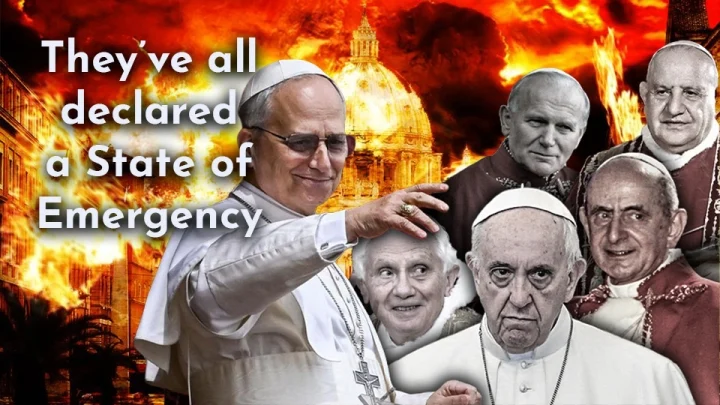
Rome claims no state of necessity exists—yet for sixty years popes have described doctrinal confusion, liturgical collapse, and loss of faith. Who, then, is denying reality?
On the one hand, the Chinese bishops who swear allegiance to the Confucio-Maoism of Xi Jinping. On the other hand, the German bishops who swear allegiance to popular sovereignty. Two different declensions of the same problem: ultimately, it is no coincidence that Francis and Xi Jinping perceived themselves as so similar to one another. Apparently, neither of the two schisms, latent but real, represents a problem for Leo XIV and his Curia. The real threat to the unity of the Church instead comes from the Priestly Society of Saint Pius X. As was foreseeable, the meeting between Fr. Davide Pagliarani, Superior of the Society, and Cardinal Fernández did not have the good outcome that had been hoped for.
How could it have been otherwise? If a Martian had attended the meeting, he would have been convinced that he was facing two people professing two different religions: on the one hand, the religion of the Syllabus and of Casti connubii; on the other hand, the religion of Dignitas infinita and Amoris Laetitia.
A legitimate question arises: how can one demonstrate that this state of necessity truly exists objectively? This problem, however, is easily resolved, since — incredible but true — the hierarchy indeed recognizes the existence of the present state of necessity and has denounced it several times, for decades now, even in important magisterial documents.
Therefore, the episcopal consecrations of the Society will take place next July 1st, barring force majeure. And there will also, in all likelihood, be the “excommunication” threatened by Fernández. In a previous analysis, I demonstrated with theological, canonical, and historical elements the reason why the possible excommunication would be null. At the origin of this demonstrative argument that I presented lies a necessary condition, namely the thesis according to which the Church would today be passing through a state of necessity.
Who declares the state of necessity?
A legitimate question arises: how can one demonstrate that this state of necessity truly exists objectively? The adverb is decisive, because subjective perception is not sufficient. In other words, the state of necessity — although visible to all — does not depend on the judgment of individual faithful, nor on that of the lower clergy, simply because judging is an act of governance, and governing belongs exclusively to the ruling and teaching Church, that is, to the Pope and to the bishops in communion with him. It is not subjective perception that creates the state of necessity.
Even though everyone may notice it, it is not individuals who “declare” it, especially if they do not in any way participate in jurisdiction: whether they be presbyters, deacons, religious, or simple laypeople.
Here the problem arises, because the state of necessity visible to all — doctrinal confusion, neo-modernist magisterium, liturgical abuses, lack of priests, progressive bishops, etc. — is caused by the very hierarchy that should officially recognize its existence.
This problem, however, is easily resolved, since — incredible but true — that same hierarchy indeed recognizes the existence of the present state of necessity and has denounced it several times, for decades now, even in important magisterial documents.
Benedict XVI began to attribute the crisis to doctrinal errors internal to the texts or interpretations of the Council itself, but this analysis never came to maturation on the part of the ruling Church, and thus did not provide a definitive diagnosis.
The judgment of the teaching Church on the state of necessity
To understand the objectivity of the current state of necessity, it is necessary to recognize that the judgment of the teaching Church on the present state of necessity is articulated in two complementary parts, both necessary but not equivalent.
The first part consists of the numerous declarations — coming from popes, bishops, synods, official documents, and the like — which, from the years immediately following the Second Vatican Council until today, have acknowledged the existence of a profound, widespread, and systemic crisis in the life of the Church. In these texts we find denunciations of doctrinal confusion and ignorance, laments over liturgical disintegration, reminders of the loss of the sense of the sacred, concerns over de-Christianization and the crisis of vocations, admissions of pastoral abuses and widespread theological deviations. All this, however, constitutes an explicit recognition of the symptoms of the disease. This level of judgment might perhaps be sufficient in itself, but it would remain incomplete, because it correctly identifies the effects of the Crisis, but does not identify its deep causes.
The post-conciliar teaching Church, in fact, only with Benedict XVI began to attribute the crisis to doctrinal errors internal to the texts or interpretations of the Council itself, but this analysis never came to maturation on the part of the ruling Church, and thus did not provide a definitive diagnosis.
The second part of the judgment comes from the infallible Magisterium of the Church, that is, from those solemn and irreformable doctrinal definitions which, insofar as they are assisted by the Holy Spirit, definitively establish what is in conformity with or contrary to the Catholic faith. This Magisterium — which for the most part precedes Vatican II and obviously always remains in force, because infallibility does not expire — provides the objective criteria for evaluating the theological and pastoral propositions of the subsequent authentic magisterium.
Now, the infallible Magisterium condemns as incompatible with the Catholic faith certain ideas which, in the post-Conciliar period, have been proposed, spread, tolerated as legitimate, or even normalized and presented as true. Such a Magisterium is for every Catholic the litmus test, because it establishes precisely which doctrines cannot be taught, which errors must be avoided, and which principles cannot be modified.
From the years immediately following the Second Vatican Council, the Pontiffs have described with notable and increasing clarity the situation of doctrinal, disciplinary, spiritual, and even liturgical disorder that has arisen and taken root in the life of the Church.
We could say, to use a medical metaphor (very important, in truth, as an analogy: the reader will understand toward the end of this study the reasons), that the infallible Magisterium does not describe the symptoms, but indicates the cause of the disease in which the Mystical Body of Christ finds itself today. The two parts together constitute the complete judgment of the teaching Church on the current state of necessity: one part declares what is happening, the other explains why it is happening.
The recognition of the ecclesial crisis does not constitute a recent polemical construction, but a datum that emerges with continuity from the pontifical magisterium of the last decades. From the years immediately following the Second Vatican Council, the Pontiffs have described with notable and increasing clarity the situation of doctrinal, disciplinary, spiritual, and even liturgical disorder that has arisen and taken root in the life of the Church. Read in chronological succession, these interventions show the existence of an objective and coherent judgment of the teaching Church regarding the existence of an anomalous and critical condition in ecclesial life.
The judgment exercised by the ruler can assume two forms. It is sanctioning when it aims to inflict a condemnation and orders the application of a penalty; it is instead declarative when it merely makes explicit, according to law, a situation already existing. The present state of necessity, as stated, is evaluated under both these aspects.
The power of governance, however, is not exhausted in judicial activity: it also includes the executive function, that is, the concrete implementation of what the competent authority has established in its judgment. The current hierarchy is deficient precisely in this respect, and this deficit contributes to amplifying and aggravating the present state of necessity.
Paul VI: the crisis immediately after the Council
The first great cycle of authoritative pronouncements comes from the Pontificate of Paul VI, who bore direct responsibility for the conclusion of the Second Vatican Council and for its first implementation. Already a few years after the closing of the Council, the Pope noted with surprise that the post-conciliar season had not produced the hoped-for flourishing. In the address to the Lombard seminarians of December 7, 1968, he explicitly spoke of a process of internal self-destruction:
“The Church is going through a moment of unrest. Some engage in self-criticism, one might even say in self-demolition. It is like an acute and complex inner upheaval, which no one would have expected after the Council. One thought of a flourishing […] but since good comes from an integral cause and evil from any defect, one notices more the painful aspect. The Church is struck also by those who are part of her.”
These words constitute one of the first official evaluations of the post-conciliar crisis. Even more famous is the address of June 29, 1972, in which Paul VI described the situation with images of extraordinary gravity: “One has the impression that through some fissure the smoke of Satan has entered the temple of God. There is doubt, uncertainty, problems, unrest, dissatisfaction, confrontation. One no longer trusts the Church; one trusts the first profane prophet who comes to speak to us from some newspaper or from some social movement.”
Awareness of this crisis accompanied Paul VI until the end of his pontificate. The final period was marked by growing concern for the situation of the Church, so much so that, in 1975, he commissioned Édouard Gagnon to conduct a delicate investigation into Masonic infiltrations in the Roman Curia.
The Pope explicitly connected this situation to the disappointed hopes of the post-conciliar period: “It was believed that after the Council there would come a day of sunshine for the history of the Church. Instead there came a day of clouds, of storm, of darkness, of searching, of uncertainty.” The picture outlined includes the crisis of faith, the influence of secular thought, confusion in schools and universities, doctrinal and pastoral disorder, and the loss of trust in Petrine authority.
Awareness of this crisis accompanied Paul VI until the end of his pontificate. The final period was marked by growing concern for the situation of the Church, so much so that, in 1975, he commissioned Édouard Gagnon to conduct a delicate investigation into Masonic infiltrations in the Roman Curia. The chroniclers of the time spoke openly of a “Pope of doubt,” tormented by uncertainty, oscillating between reform and conservation. The pontificate thus concluded with a substantially concordant evaluation: the ecclesial crisis was not a marginal phenomenon, but a general and widespread condition, which by then involved faith, discipline, and the internal life of the Church to such an extent as to cast the Pontiff into a clinical state that some went so far as to describe as depressive.
John Paul II: the crisis as anti-evangelization
This observation of the symptoms was taken up and deepened by the Pontificate of John Paul II, who interpreted the situation in terms of a true “anti-evangelization.” Already on October 20, 1979, he denounced:
“Various forms of anti-evangelization are underway which seek to oppose themselves radically to the message of Christ: […] in many Christians, a weakening of spiritual fervor, a yielding to the worldly mentality, a progressive acceptance of erroneous opinions of secularism and social and political immanentism.”
The most explicit text remains, however, the address to missionaries of February 6, 1981, in which the Pope formulated an extraordinarily direct evaluation: “Today, for effective work in the field of preaching, one must first of all know well the spiritual and psychological reality of Christians living in modern society. One must realistically admit, and with profound and painful sensitivity, that Christians today for the most part feel lost, confused, perplexed and even disappointed; ideas contrary to the revealed Truth and always taught have been spread lavishly; true and proper heresies have been disseminated, in the dogmatic and moral field, creating doubts, confusions, rebellions; even the Liturgy has been tampered with.” Here, therefore, the crisis is no longer described merely as unrest or uncertainty, but as the spread of “true and proper heresies” and as liturgical alteration.
The most solemn magisterial recognition of the post-conciliar state of necessity is found, most probably, in the encyclical Redemptoris Missio of December 7, 1990. Precisely by virtue of its doctrinal level, this text assumes particular importance:
“In this new springtime of Christianity there is an undeniable negative tendency, and the present document is meant to help overcome it. Missionary activity specifically directed to the nations (ad gentes) appears to be waning, and this tendency is certainly not in line with the directives of the Council and of subsequent statements of the Magisterium. Difficulties both internal and external have weakened the Church’s missionary thrust toward non-Christians, a fact which must arouse concern among all who believe in Christ.”
And again, a very important clarification: “For in the Church’s history, missionary drive has always been a sign of vitality, just as its lessening is a sign of a crisis of faith.”
In the following years, John Paul II returned several times to the theme. On March 5, 1992, he explicitly spoke of the “fruits of anti-evangelization,” observing that it also came “from within.” In particular, on that occasion, he denounced the pressure of those bishops who wished to admit divorced and remarried persons to the sacraments and to modify canonical discipline in this regard.
“There are these cases, these specific problems, such as for example divorced and remarried persons. All the European bishops who come — now there are the French — all speak of the same thing, as if it were a problem of very great pastoral importance. I think that the proposal made by one of the confreres is very good: this problem must be studied, the possible solutions, the arrangement of this problem, not to facilitate divorces, but seeking a deeper, broader understanding for the immaturity of engaged couples and young spouses.”
At the time, the pressure in this sense was exercised by Cardinal Carlo Maria Martini, head of the European bishops, as well as forerunner of the future St. Gallen Lobby, and — as he himself liked to define himself — the ante-pope, that is, the precursor of the “pope” who would finally revolutionize the Church, was very strong.
John Paul II considered the crisis of the Church not as a transitory phenomenon, but as a structural situation involving doctrine, morality, liturgy, and pastoral life. Precisely a state of necessity.
Again, on December 21, 1993, John Paul II denounced that “young Catholics are sensitive to the need for coherence between professed faith and lived faith,” but that “they need clearly to understand what it concretely means to be Catholic.” For this reason, the Pope exhorted the bishops to “give with new confidence and renewed zeal the response regarding the moral teaching that the Lord has entrusted to his Church,” also in view of the “widespread misunderstanding of the role of conscience, whereby conscience and individual experience are considered superior to or set against the teaching of the Church.”
On January 11, 1997, again, he described a widespread phenomenon of ecclesial disaffection: there are “various forms of impoverishment and weakening of the Church which make the episcopal mission arduous,” there are “too many people, too many baptized” who remain “outside the ecclesial community, due to a sort of rejection of the institution, to the benefit of an individualistic withdrawal: each one feels himself arbiter of his own rules of life and, if he retains a religious feeling or if the Church remains for him a distant point of reference, he does not live a personal faith in Jesus Christ and disowns its ecclesial dimension.”
On April 23, 2002, finally, he interpreted the crisis of sexual abuses as a symptom of a deeper moral crisis: “the abuses of young people are a grave symptom of a crisis that affects not only the Church, but also society as a whole. It is a crisis of sexual morality with deep roots, a crisis even of human relationships, and its principal victims are the family and young people.”
The ensemble of these interventions, certainly not made in the capacity of a private doctor, shows how John Paul II considered the crisis of the Church not as a transitory phenomenon, but as a structural situation involving doctrine, morality, liturgy, and pastoral life. Precisely a state of necessity.
Continue to Part 2, Pope Benedict XVI vs. Pope Francis.