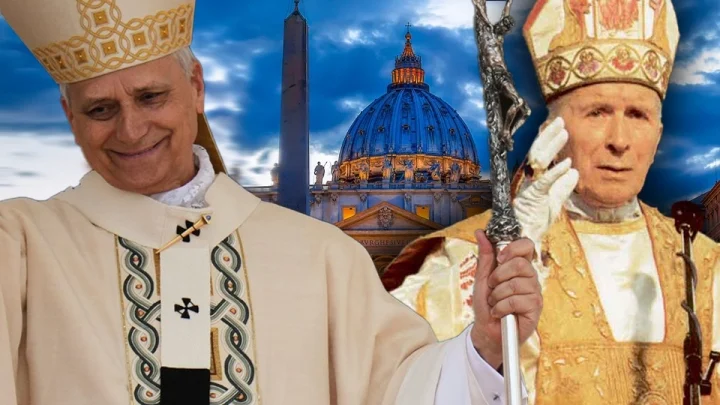
In a new catechetical series on Vatican II, Pope Leo XIV claims that God’s plan for the Church is to unite all creatures. But critics argue that this interpretation of Lumen Gentium departs radically from traditional Catholic teaching. By emphasizing unity over conversion and describing the Church as a “sign” of universal human unity, Leo XIV appears to confirm long-standing concerns raised by the Society of St. Pius X about the theological direction of Vatican II. Is this a development of doctrine—or proof that the crisis in the Church continues?
During his January 7, 2026 General Audience, Leo XIV announced his intention to dedicate a cycle of catechesis to the documents of Vatican II:
“After the Jubilee Year, during which we focused on the mysteries of the life of Jesus, we will begin a new cycle of catechesis which will be dedicated to Vatican Council II and a rereading of its Documents. It is a valuable opportunity to rediscover the beauty and the importance of this ecclesial event. . . . Although the time that separates us from this event is not so long, it is equally true that the generation of bishops, theologians and believers of Vatican II is no longer with us. Therefore, while we hear the call not to let its prophecy fade, and to continue to seek ways and means to implement its insights, it will be important to get to know it again closely, and to do so not through ‘hearsay’ or interpretations that have been given, but by rereading its documents and reflecting on their content. Indeed, it is the Magisterium that still constitutes the guiding star of the Church’s journey today.”
With these words, Leo XIV informed the world that he would be offering the authoritative interpretations of the Vatican II documents, ensuring that we would now know the mind of the Magisterium about what the documents actually mean.
Whereas Leo XIV believes that the purpose of God’s plan for the Church is to unite all men, the Catholic Church teaches that the purpose of the Church is to continue the work of Our Lord’s Redemption for all time.
The first five catechetical lessons were on Vatican II’s Dogmatic Constitution on Divine Revelation, Dei Verbum. For the following set of catechetical lessons, Leo XIV chose the Council’s Dogmatic Council on the Church, Lumen Gentium. After the first three sessions of catechesis on Lumen Gentium — on February 18, March 4, and March 11 — we now have enough of Leo XIV’s interpretation to recognize what appears to be a thoroughly heterodox vision of the Church.
We can see the essential orientation of Leo XIV’s vision of the Church from his February 18 catechesis, in which he stated that the purpose of God’s plan for the Church was to unite all creatures:
“When the Second Vatican Council, whose documents are the focus of our [series of] catechesis, wanted to describe the Church, it was concerned first and foremost with explaining where her origins lie. In order to do so, in the Dogmatic Constitution Lumen gentium, approved on 21 November 1964, it drew the term ‘mystery’ from the Letters of Saint Paul. By choosing this word, it did not intend to say that the Church is something obscure or incomprehensible, as is commonly thought when the word ‘mystery’ is heard. It is exactly the opposite: indeed, when Saint Paul uses the word, especially in the Letter to the Ephesians, he wishes to indicate a reality that was previously hidden and is now revealed. It refers to God’s plan, which has a purpose: to unite all creatures thanks to the reconciliatory action of Jesus Christ, an action that was accomplished through his death on the cross.”
Whereas Leo XIV believes that the purpose of God’s plan for the Church is to unite all men, the Catholic Church teaches that the purpose of the Church is to continue the work of Our Lord’s Redemption for all time. Dr. Ludwig Ott described this as an infallible truth of the Catholic Church in his Fundamentals of Catholic Dogma:
“Christ founded the Church in order to continue His work of redemption for all time. (De fide.) The [First] Vatican Council declares the purpose of Christ’s foundation: Christ ‘resolved to establish the Holy Church in order to give permanent duration to the work of the Redemption’ . . . Leo XIII says in the Encyclical ‘Satis cognitum’ (1896): ‘What did Christ the Lord achieve by the foundation of the Church; what did He wish? This: He wished to delegate to the Church the same office and the same mandate which He had Himself received from the Father in order to continue them.’ While Christ acquired the fruits of the Redemption by His own efficacy, the task of the Church consists in the application of the fruits of the Redemption to mankind.” (p. 274)
Because the fruits of Redemption must be applied to all souls individually (Subjective Redemption), and some souls will not be saved, the real purpose of the Church cannot be to “unite all creatures.” Indeed, this is self-evident from the words of Our Lord:
“And when the Son of Man shall come in His majesty, and all the angels with Him, then shall He sit upon the seat of His majesty. And all nations shall be gathered together before Him, and He shall separate them one from another, as the shepherd separateth the sheep from the goats.” (Matthew 25: 31-32)
Our Lord will separate the good (the faithful) from the bad (the unfaithful) at the Last Judgment, so it cannot be the purpose of the Church to unite the faithful and unfaithful today. Thus Leo XIV is, quite simply, wrong. One could more readily interpret Leo XIV’s words as merely imprecise were it not for the reality that so many errors condemned by the pre-Vatican II popes related in various ways to the anti-Catholic notion that all of mankind could be united through what would effectively be a Freemasonic One World Religion.
Leo XIV is not limiting his vision to those who share the same Faith — he is again emphasizing the supposed purpose of the Church to bring all people together, regardless of Faith.
Leo XIV continued his February 18 catechesis by turning to the Mass, saying that what truly counts in the liturgical celebration is that we are all gathered together:
“This is experienced first of all in the assembly gathered for the liturgical celebration: there, differences are relativized, and what counts is being together because we are drawn by the Love of Christ, that broke down the wall of separation between people and social groups (cf. Eph 2:14). For Saint Paul, the mystery is the manifestation of what God wanted to achieve for the whole of humanity, and it is made known in local experiences, which gradually expand to include all human beings and even the cosmos.”
This idea builds on the mistaken view of the Church’s purpose by saying that “being together” for the liturgical celebration overcomes differences between people. It seems evident that Leo XIV is not limiting his vision to those who share the same Faith — he is again emphasizing the supposed purpose of the Church to bring all people together, regardless of Faith.
Leo XIV provided another aspect of this same theme in his March 11 catechesis, in which he asserted that the Church already includes everyone:
“Even those who have not yet received the Gospel are therefore, in some way, oriented towards the people of God, and the Church, cooperating in Christ’s mission, is called upon to spread the Gospel everywhere and to everyone (cf. LG 17), so that every person may enter into contact with Christ. This means that in the Church there is, and there must be, a place for everyone, and that every Christian is called to proclaim the Gospel and bear witness in every environment in which he or she lives and works. Thus, this people shows its catholicity, welcoming the wealth and resources of different cultures and, at the same time, offering them the newness of the Gospel to purify them and to raise them up (cf. LG, 13). In this regard, the Church is one but includes everyone. A great theologian described it thus: ‘The unique Ark of Salvation must welcome all human diversity into its vast nave. The only banquet hall, the food it distributes is drawn from all of creation. The seamless garment of Christ, it is also – and it is the same thing – the garment of Joseph, with its many colours.’”
Although there is no problem with saying that the Church is open to everyone who wants to accept the truths of the Catholic Faith, there is no real sense in which the Church includes everyone. Tellingly, the “great theologian” quoted by Leo XIV in this passage is Henri de Lubac. As indicated in a December 1993 edition of Si Si No No published by the Society of St. Pius X (SSPX), Pius XII’s 1950 encyclical condemning errors threatening to undermine the foundations of Catholic doctrine, Humani Generis, was addressing the errors of de Lubac (and others) with this sentence:
“Some reduce to a meaningless formula the necessity of belonging to the true Church in order to gain eternal salvation.”
If, as Leo XIV stated, everyone is included in the Church then, as Pius XII warned, the necessity of belonging to the Church for salvation has been rendered meaningless.
Leo XIV has now offered the “Magisterial” confirmation that such a reading is erroneous: the “experience of salvation” depends upon the union of human beings, and the true role of the Church is to serve as an active sign of God’s plan.
Returning to the February 18 catechesis, Leo XIV further minimized the need to truly belong to the Church (through Baptism and Faith) by connecting the union of all human beings with the “experience of salvation”:
“The condition of humanity is one of fragmentation that human beings are unable to repair, even though the tendency towards unity dwells in their heart. Jesus Christ’s action enters into this condition, and through the Holy Spirit, he overcomes the powers of division and the Divider himself. . . . Precisely because it is brought about by God, this convocation cannot be limited to a group of people, but rather is destined to become the experience of all human beings. Thus, at the beginning of the Constitution Lumen gentium, the Second Vatican Council states: ‘The Church is in Christ like a sacrament or as a sign and instrument both of a very closely knit union with God and of the unity of the whole human race’ (no. 1). With the use of the term “sacrament” and the consequent explanation, it is intended to indicate that, in the history of humanity, the Church is an expression of what God wants to accomplish. By looking at the Church, therefore, to some extent we can grasp God’s plan, the mystery. In this sense, the Church is a sign. Moreover, the term ‘instrument’ is added to the term ‘sacrament,’ precisely to show that the Church is an active sign. Indeed, when God works in history, he involves the recipients of his action in his activity. It is through the Church that God achieves the aim of uniting people to himself and reuniting them with one another. Union with God is reflected in the union of human beings. This is the experience of salvation.”
Perhaps the most important part of this passage is Leo XIV’s interpretation of Lumen Gentium’s discussion of the Church as a “sacrament” or “sign.” Defenders of Vatican II have of course tried to read this as consistent with what the Church has always taught, which necessarily requires an insistence that it in no way impairs the need for souls to actually belong to the Church. But Leo XIV has now offered the “Magisterial” confirmation that such a reading is erroneous: the “experience of salvation” depends upon the union of human beings, and the true role of the Church is to serve as an active sign of God’s plan.
If we were looking for a confirmation that the state of necessity persists, Leo XIV has provided an unmistakable one.
In this light, the assessment of the SSPX from the March 2003 Si Si No No is entirely accurate:
“Here is an attribution of a new mission to the Holy See-to bring about human unity — which does not correspond to anything ever taught before in the Catholic Church. . . . But this does not mean unity in service of the salvation of souls, a unity that is therefore attained through conversion to Catholicism. Rather, this unity seems to result merely from the ‘intimate union with God’ of the entire human race as such. This idea was introduced into the Council’s texts thanks to a heterodox reinterpretation, typical of the ‘New Theology,’ of the dogmas of the Incarnation and the Redemption. Those texts were turned upside down to the extent of pushing them aside in order to put into place the idea of the so-called ‘objective’ Redemption being realized, thanks to the Incarnation, in all men, independently of their conscience and will, as if they were ‘anonymous’ Christians. But the Church’s mission is the one that Our Lord gave her: ‘Going therefore, teach ye all nations; baptising them . . .’ (Mt. 28:19). Thus, the Church’s ‘intimate mission’ is to convert the greatest possible number of souls to Christ before the Parousia, without caring about bringing about the unity of the human race, a chimeric ideal, and one that is intrinsically anti-Christian because it is a form of the divinization of man, exalting him and gazing upon him, an ideal imported from Illuminist philosophy and piously professed by Freemasonry.”
When the SSPX published this twenty-three years ago, detractors could wag their fingers and insist that the SSPX was wrong to rely on its own interpretation of Lumen Gentium. Thanks to Leo XIV, though, the matter is now entirely beyond debate: the SSPX was right in its objections to Lumen Gentium. If we were looking for a confirmation that the state of necessity persists, Leo XIV has provided an unmistakable one. Immaculate Heart of Mary, pray for us!