Order Jamie Glazov’s new book, ‘United in Hate: The Left’s Romance with Tyranny, Terror, and Hamas’: HERE.
March 8, 2026, marked International Women’s Day – which grew out of efforts in the early 20th century to promote women’s rights. The UN claims to be a champion of women’s rights asserting ‘gender equality is at the very heart of human rights and United Nations values. We promote women and girls’ equal enjoyment of all human rights, including freedom from violence, sexual and reproductive rights, access to justice, socio-economic equality, and participation in decision-making.’
How seriously should one take this UN commitment? Not very, as it was put to the test and found wanting.
Two years ago on March 8, 2024, 81 individuals from 17 countries (Australia, Austria, Belgium, Canada, Denmark, Germany, India, Iran, Israel, Netherlands, Philippines, Russia, South Africa, Uganda, United Kingdom and the US) submitted a joint and thoroughly documented 73-page complaint to the United Nations (UN) Human Rights Council on the gross, reliably attested, and continuing pattern of the violation of women’s human rights caused by Sharia.
The complaint based itself on accepted norms of international law contained in the Convention on the Elimination of all Forms of Discrimination against Women; the 1993 World Conference on Human Rights that recognized violence against women as a human rights violation; the 1993 Declaration on the Elimination of Violence against Women; the 1995 Beijing Platform for Action which identified ending violence as one of 12 areas for priority [1] action; the UN Secretary-General In-Depth Study on All Forms of Violence against Women; the UN General Assembly biannual resolutions on the issue of violence against women and UN Human Rights Council first resolution on accelerating efforts to eliminate all forms of violence against women in 2012.
Signatories included many prominent campaigners who drew attention to the challenge posed by Sharia, including Ayaan Hirsi Ali, Yasmine Mohammed, Christine Douglass-Williams, and Phyllis Chesler.
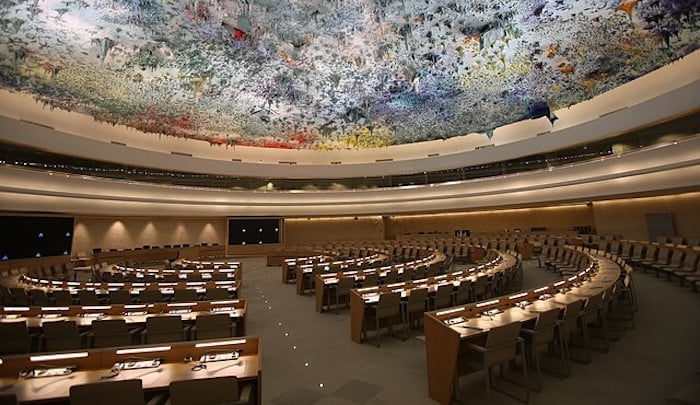
The forum for the complaint is UN Human Rights Council which is the only universal complaint procedure addressing all human rights and all fundamental freedoms in all United Nations Member States. Any individual, group of individuals, or non-governmental organization can submit a complaint against any of the 193 countries of the UN, whether or not the country has ratified any particular treaty or made reservations under a particular instrument.
Prefacing that the complaint was not ‘Islamophobic’ according to UN statements, it was lodged against the Organization of Islamic Cooperation (OIC) as it is the ‘collective voice of the Muslim world’ and therefore best placed to address the worldwide pattern of ‘gross, reliably attested, and continuing violation of women’s human rights.’ It was ‘based on extensive and irrefutable publicly available evidence, including UN documents and the lived experience of the violence suffered by women discriminated against by Sharia’ and drew ‘attention to Sharia’s incompatibility with international human rights law, especially the Convention on the Elimination of All Forms of Discrimination against Women (CEDAW) that came into force in 1981.
It addressed sharia-linked violence inflicted upon women in the Middle East, Africa, Europe, and Asia. Such violence included the extreme sexual violence committed against Israeli women in October 2023 by Hamas; the infliction of sexual slavery on Yezidi women by the Islamic State (IS); violence and killing of Iranian women for not wearing the hijab; the trafficking, kidnapping, and conversion of Coptic Christian girls in Egypt; kidnapping of girls and women in Nigeria by Boko Haram; mass attacks on women in Germany in 2015; the mass rape of girls in the UK by the so-called ‘grooming gangs’; the forced conversion and kidnapping of Hindu girls in India, Pakistan and Bangladesh; the discrimination against Christian women and the gender apartheid against Afghan Muslim women.
It noted that statistical analysis demonstrates that 71% of the Qur’an’s text gives women a lower status than men. In the Hadith, 91% of the texts about women state that women have a lower status than men. Key Qur’anic verses sanction male violence to compel a woman’s ‘obedience’; allow child marriage and polygamy, discriminate in inheritance.
The complaint also pointed out the effect of Islamic culture on women’s human rights. This includes Female Genital Mutilation (FGM) that is widespread in parts of the Islamic world, which the UN considers ‘an abhorrent human rights violation.’ Immigration from Muslim countries has increased FGM in the West. Sharia Islamic culture compels Muslim women in the West to undergo unnecessary surgery to restore their hymen. UN reports show how Islamic culture demeans women. According to the UN Arab Human Development Report 2005, most proverbs repeated in parts of Arab society… portray women as ‘lacking’ and ‘evil…’ It notes, ‘hundreds of popular proverbs imply that women should be segregated.’ Some consider ‘a woman to have only half a mind, half a creed, and half an inheritance and to be worth only half a male.’
Islamic culture impedes women’s education in some parts of the world and blocks advancement for educated Muslim women. Muslim women do not have equal opportunities to participate actively in sports and physical education, and have poorer access to mosques as compared to Muslim men. Head coverings for Muslim women are linked to complex security, health, educational, cultural, and civilizational issues. Islamic leaders have violated Muslim women’s inviolable right to freely decide on the number of their children by advocating for high birth rates, a non-military strategy to conquer non-Muslim lands. Warnings have come from Ex-Muslim women because of this worldwide and continuing pattern of Sharia violating women’s human rights.
The complaint concluded by pointing out the Convention on the Elimination of All Forms of Discrimination against Women gives “formal recognition to the influence of culture and tradition on restricting women’s enjoyment of their fundamental rights.” Sharia fosters such a culture. There is now overwhelming public evidence that it is responsible for the gross and continuing violations of women’s rights worldwide in flagrant defiance of the norms of CEDAW and other core human rights treaties. Millions of women of all religions, including Muslim women and girls, have been killed, their lives destroyed, and their human potential unrealized because of its influence. Unfortunately, many Muslim countries often fail to enforce those elements in those national laws that do not discriminate against women and are not derived from Sharia.
The complaint suggested that the Human Rights Council act as follows:
- Request a single consolidated response from the OIC, including one standardized, worldwide codification of the Sharia and an explanation as to why Sharia should not be considered a fundamental cause of violation of women’s human rights.
- Appoint two non-Muslim rapporteurs, one who is a Special Rapporteur on Freedom of Religion or Belief and the second, a Special Rapporteur on Violence against Women, to mandate them to work in a coordinated manner and report to the Human Rights Council on the following issues:
- Submit a thematic report on the elements of Sharia that discriminate against and have negatively impacted the lives of Muslim and non-Muslim women. The two rapporteurs should ensure that the views of ex-Muslim, reformist Muslim women, critics of Islam, and others impacted by these norms are the primary sources of data for this report.
- Advise the Council if the elements of the Sharia are contrary to resolution 16/18 adopted by the Human Rights Council in 2011, which related to ‘combating intolerance, negative stereotyping and stigmatization of, and discrimination, incitement to violence and violence against, persons based on religion or belief’ as they relate to non-Muslims.
- To work and assist UN Women in determining the extent to which the elements of Sharia are the root cause of inequality and violence by extremist Muslims against women.
- To determine if the word “kuffar” violates the UN definition of ‘hate speech.’
- To work closely with UN Women and the Committee on the Elimination of Discrimination against Women thereby enabling the Committee mentioned above to hold days of general discussion (DGDs) on ‘The Rights of Women and Girls to be protected against specific norms in the Sharia that violate CEDAW and other human rights treaties on women’ and to enable the Committee further to issue a General Recommendation to State parties.
- The Human Rights Council should consider the extent to which elements of Sharia have been demonstrated to cause crimes against humanity and gender apartheid against women, as recorded in its 2016 report on ISIS crimes against Yazidis, and thejoint report by the Special Rapporteur for Afghanistan and the Working Group on discrimination against women and girls. Based on these reports, it should contribute to ongoing discussions towards a universal treaty on crimes against humanity and the need to include specific elements of the Sharia as risk factors that heighten the likelihood of such crimes against women.
- The Human Rights Council should request the International Law Commission to determine the extent to which elements of Sharia should be classified as harmful practices and, therefore, null and void as being contrary to international human rights law.
Nothing was heard back from the UN beyond the initial acknowledgement of receipt of the complaint.
[1] https://www.unwomen.org/en/news/in-focus/csw59/feature-stories
Photo Credit: Creative Commons.