Order Jamie Glazov’s new book, ‘United in Hate: The Left’s Romance with Tyranny, Terror, and Hamas’: HERE.
Contrary to the popular view that portrays them as a hapless minority, Muslims are the second-largest population and the fastest-growing demographic in India, and by far the most pampered one, be it by media, politicians, or pop culture. Ramadan is a month when Muslims fast during the daytime; however, it is shocking how Muslims force their religious beliefs on non-Muslims, Hindus in particular, and stop them from going on with their regular lives and celebrating their festivities.
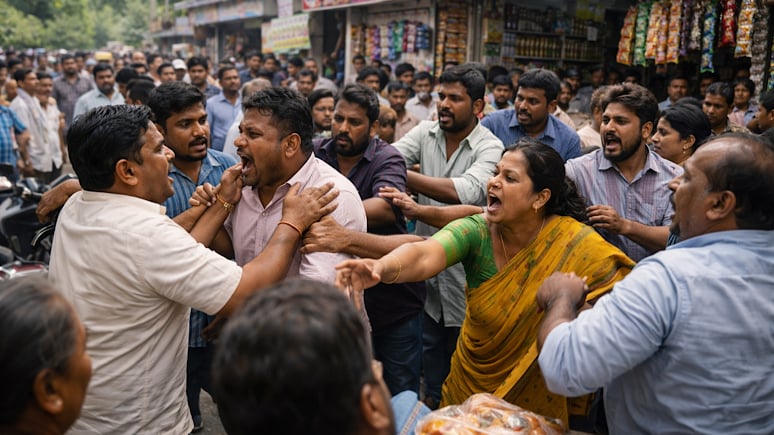
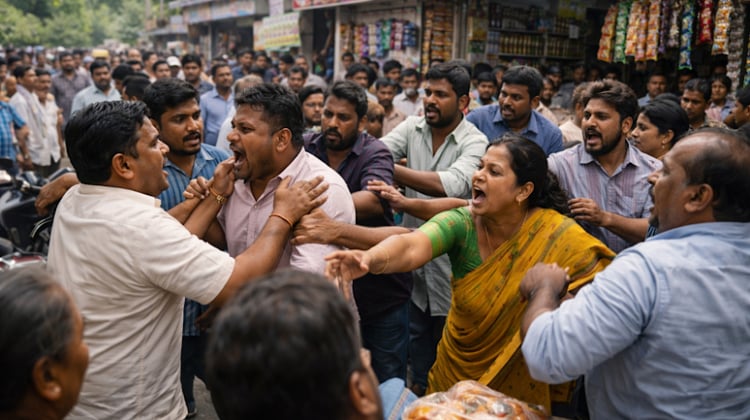
In Banswada town in Telangana, a Muslim mob gathered in front of a department store and resorted to violence. The incident occurred on February 20, when a Hindu saleswoman at the Reliance Smart Mart store played a devotional song dedicated to the Hindu deity, Goddess Durga. A Muslim customer, Muzammil, who was at the store at the time, objected to the music and asked her to stop it, as Ramadan was ongoing.
The situation quickly deteriorated, as a massive Muslim crowd gathered outside the store and began throwing stones at it. Police efforts to calm the throng were also met with stone-throwing, leaving at least two police constables injured. Police officials have confirmed that 10 to 12 individuals have been arrested in connection with the unrest. In response, additional security forces were deployed throughout the town to stop further escalation. Authorities, who are always rushing in to safeguard Muslims, their interests, and image, warned against the spread of provocative content on social media that could incite further communal tension. Efforts were reportedly made to suppress this news, or rather, the incident did not find mention in many news reports.
Another incident of Islamic entitlement during the holy month occurred in Ahmedabad, Gujarat, which again was not reported by most news agencies, lest the popular perception of Muslims be tarnished. A traditional Hindu wedding procession turned violent on Friday night, February 20, after a dispute over the music played during the celebration escalated. The incident occurred in the Rakhial area when the Hindu groom’s party was playing songs dedicated to Hindu deities associated with the ceremony, a common practice in India. Muslims formed a gathering and objected to the music, citing the ongoing observance of Ramadan, and demanded that the Hindus stop playing the songs.
The disagreement quickly turned hostile, as Muslims started throwing stones at wedding guests and nearby parked vehicles, forcing the celebration to be halted abruptly. The Hindus were holding their celebrations at their venue, and the Muslims still objected to it, claiming that they were fasting and preferred quieter gatherings.
In recent years, Muslim groups have increasingly used the month of Ramadan as an opportunity to assert their street presence, power, and influence within Indian society. Although Ramadan is a period of religious observance for Muslims, not Hindus, some Muslims expect Hindus to alter their daily routines to accommodate their practices. What should remain a matter of individual faith was, in these instances, turned into a public display of power and control. Such groups have, over time, become adept at intimidating opponents, imposing their preferences on others, and encroaching upon spaces that do not belong to them, while simultaneously being portrayed by sections of the media as victims of majoritarian dominance.
India is home to an estimated 300,000 to 500,000 active mosques, among the highest numbers in the world. Yet despite this vast religious infrastructure, public roads and open spaces routinely become makeshift prayer grounds. There have also been instances of individuals insisting on offering prayers on private property that is not designated for religious activity. When objections are raised, the issue is swiftly reframed, not as a matter of property rights or civic order, but as an attack on Muslims and their faith.
In Rudrapur, Uttarakhand, a Muslim man reportedly began offering prayers on privately owned land near a Hindu temple. Temple authorities and local residents requested that he relocate, noting that the land was neither public nor intended for religious gatherings. Despite repeated appeals, he allegedly continued the practice for three consecutive days, forcing the matter to escalate to police intervention, and the narrative quickly shifted to victimhood. What could have been resolved through basic respect for ownership and local sensitivities instead became a flashpoint.
Hindu religious processions are frequently pressured to stop music or alter their routes when passing along public roads near mosques. There have also been reports of stone-throwing from rooftops during such processions, further heightening tensions. While objections are routinely raised against Hindu celebrations taking place near mosques, demands are simultaneously made for the right to offer prayers on privately owned land situated near Hindu temples. This apparent double standard raises serious questions about reciprocity and shared respect in a plural society. A framework of mutual coexistence cannot function if accommodation is expected only from one side. Repeated episodes of such contradictions have established that many among Muslim populations are not capable of coexistence in pluralistic societies, and will remain a threat to others, while being projected as hapless victims by propagandists.