Order Jamie Glazov’s new book, ‘United in Hate: The Left’s Romance with Tyranny, Terror, and Hamas’: HERE.
“It is an heretic that makes the fire,
Not she which burns in’t.”
— William Shakespeare, The Winter’s Tale
Everyone has experienced the moment when a friend, colleague, or relative suddenly reveals something about themselves that cannot be unseen. A remark made casually, a belief expressed too openly, or a pattern of thinking that had previously been hidden emerges into view, and the relationship subtly but permanently changes. Trust is strained; admiration fades; a new clarity replaces what once felt familiar. In public life, these moments of revelation can be even more consequential.
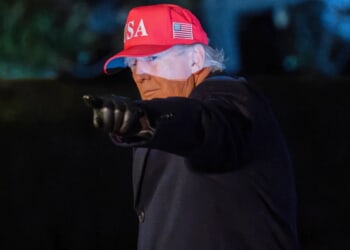
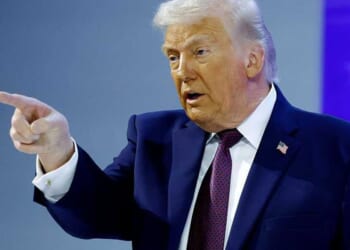
The recent decision by Donald Trump to distance himself from commentator Tucker Carlson reflects just such a moment—one in which political rhetoric crosses a line that forces former allies to reconsider where they stand as it brought renewed attention to a growing divide within American political discourse. Trump suggested Carlson had “gone off track,” a notable rebuke given Carlson’s previous alignment with the populist currents that helped define Trump’s political rise. The dispute is not merely a media controversy. It raises a deeper question about the direction of nationalist rhetoric in American politics and whether certain strains of “America First” thinking risk repeating mistakes that history has already revealed.
For several years Carlson has positioned himself as a leading voice in a revival of “America First” language. His arguments have often centered on skepticism toward American alliances, hostility toward U.S. involvement abroad, and sharp criticism of American support for Israel. In recent months, his rhetoric has gone further, portraying American foreign policy as the product of shadowy influences and suggesting that the interests of Israel or Jewish political actors somehow distort U.S. priorities. Such claims have drawn criticism across the political spectrum and prompted concerns that familiar historical tropes may be resurfacing in modern political discourse.
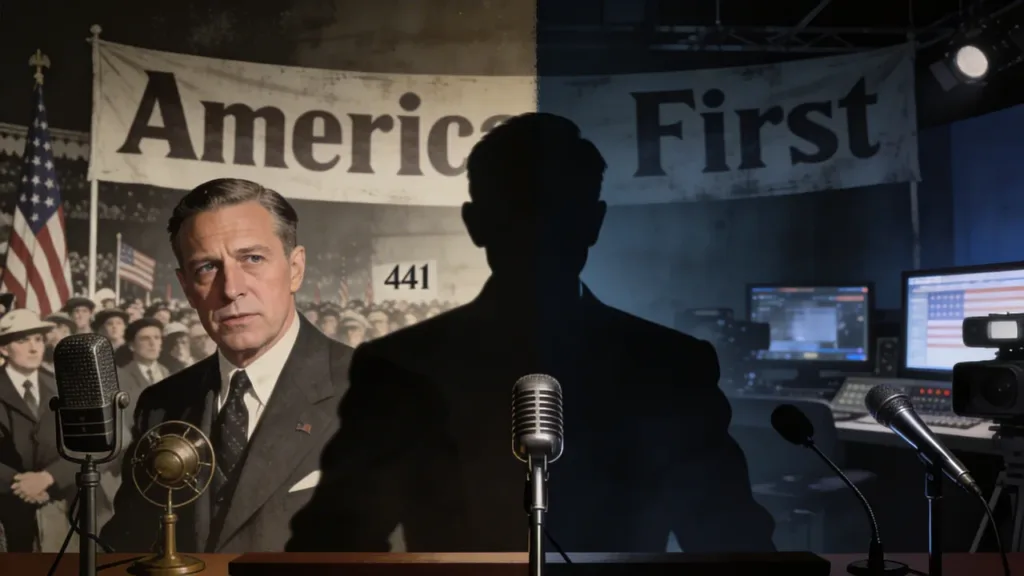
The pattern is not new. In fact, it bears a striking resemblance to arguments advanced more than eighty years ago by the most famous spokesman for the original America First movement: aviator Charles Lindbergh. Lindbergh, celebrated for his pioneering solo flight across the Atlantic, became a leading voice for isolationism as Europe descended into the crisis that would eventually become World War II. As a spokesman for the America First Committee, Lindbergh warned that American involvement in the European war would serve the interests of foreign powers rather than the United States.
In September 1941, Lindbergh delivered a speech in Des Moines that would become infamous. In that address, he argued that three groups were pushing the United States toward war: the British government, the Roosevelt administration, and “the Jewish people.” According to Lindbergh, Jewish influence in American media and politics encouraged policies that were supposedly contrary to American interests. The speech sparked immediate outrage and cemented the perception that the America First movement had drifted from patriotic skepticism about foreign wars into something darker—an argument that framed Jewish political participation itself as suspect.
The historical lesson of that moment is not merely that Lindbergh expressed offensive views. It is that political movements centered on nationalist rhetoric can, under certain circumstances, slide into conspiratorial thinking. Once political arguments begin to frame national policy as the product of hidden ethnic or religious influence, the line between legitimate debate and scapegoating becomes dangerously thin. In the early 1940s, that dynamic helped discredit the America First Committee and contributed to its collapse shortly after the Japanese attack on Pearl Harbor.
Modern political rhetoric obviously unfolds in a different context, but the echoes are difficult to ignore. Carlson’s commentary has often portrayed American support for Israel as evidence that U.S. policymakers serve foreign interests rather than national ones. While criticism of any government’s policies—including Israel’s—is a normal feature of democratic debate, the framing of such criticism can matter greatly. When arguments suggest that American policy is secretly manipulated by Jewish influence, they begin to resemble historical narratives that have long fueled antisemitism in Western political life.
This is why Trump’s decision to distance himself from Carlson carries broader significance. Trump’s political brand has long been associated with the phrase “America First,” yet he has simultaneously positioned himself as one of the most openly pro-Israel presidents in American history. During his administration, the United States moved its embassy to Jerusalem, recognized Israeli sovereignty over the Golan Heights, and helped broker the Abraham Accords between Israel and several Arab states. Those policies reflected a strategic vision in which American interests and Israeli security were seen as complementary rather than contradictory.
By suggesting that Carlson had strayed from the path, Trump implicitly signaled that there are limits to how far nationalist rhetoric can go before it undermines American strategic interests. The United States has long relied on alliances and partnerships to project stability in volatile regions. Israel, in particular, functions as one of America’s most capable democratic partners in the Middle East. Portraying that relationship as evidence of foreign manipulation not only echoes troubling historical patterns but also weakens the intellectual foundations of American foreign policy.
The debate also reflects a larger struggle within American political movements about how nationalism should be defined. In its most constructive form, nationalism emphasizes the protection of national interests while recognizing the value of alliances and democratic cooperation. In its darker form, however, nationalism can become suspicious of international partnerships and prone to explanations that attribute complex geopolitical realities to hidden conspiracies. The difference between those two visions often lies in how political leaders frame their arguments and what historical lessons they choose to remember.
History suggests that movements which conflate patriotism with resentment toward allies rarely strengthen a nation’s global position. During the years before World War II, the America First Committee’s rhetoric created divisions within American society at precisely the moment when the United States faced an increasingly dangerous international environment. The controversy surrounding Lindbergh’s statements did not merely damage his reputation; it undermined the credibility of the broader isolationist cause.
Today’s political debates are obviously different in many respects, yet the structural parallels remain instructive. When contemporary commentators revive language that echoes earlier eras of suspicion and conspiracy, they risk repeating mistakes that earlier generations ultimately rejected. Political movements that wish to claim the mantle of patriotism must therefore be careful not to resurrect narratives that history has already shown to be corrosive.
Trump’s public distancing from Carlson may not end the debate about the meaning of “America First,” but it highlights an important historical truth. National movements always face a choice between two paths. One path recognizes that American strength has often depended on alliances, democratic solidarity, and clear-eyed strategic thinking. The other path drifts toward isolationism and the temptation to blame domestic minorities or foreign partners for complex global challenges.
The history of the 20th Century suggests which of those paths ultimately serves the United States better. Lindbergh’s rhetoric, once widely admired by segments of the American public, is now remembered largely as a cautionary example of how quickly nationalist sentiment can be distorted. The question facing modern political movements is whether they will learn from that history or repeat it.