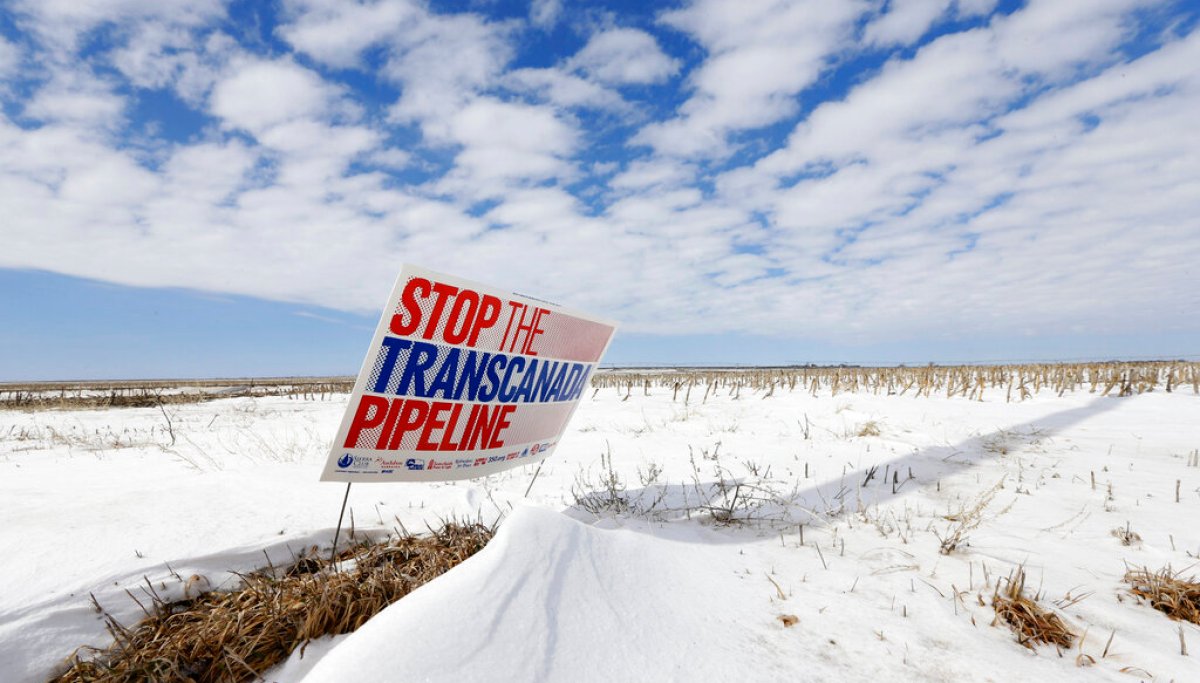
A Canadian company is seeking to revive, in a different form, one of the most controversial infrastructure projects in U.S. history: The Keystone XL Pipeline.
Building a major pipeline to ship oil from Canada’s tar sands would fulfill a longtime goal of the industry and President Donald Trump. But it faces several obstacles, including a complicated relationship between the Canadian government and the Trump administration.
Canadian company South Bow has proposed reviving parts of the canceled Keystone XL Pipeline as part of a new project called “Prairie Connector.” The existing Keystone pipeline system transports Canadian crude to U.S. refining markets in Illinois, Oklahoma, and Texas.
][\“South Bow is evaluating an expansion that would leverage existing infrastructure and permitted corridors in Canada and could connect to downstream pipelines in the United States,” company spokeswoman Kristin Anderson told the Washington Examiner in a statement.
“The concept is in early stages, and South Bow will work with prospective customers, stakeholders, and rightsholders before sharing further details,” she added.
The company is undergoing an “open season” period, inviting potential customers to make long-term binding commitments for shipping capacity before deciding whether to expand, offering nearly 450,000 barrels per day of transportation capacity.
South Bow said it may develop transportation service from Hardisty, Alberta, to multiple U.S. delivery points, including Cushing, Oklahoma, and destinations in the U.S. Gulf Coast. Companies have until the end of the month to place commitments.
The proposed project would need approval by the president, who previously expressed support for the pipeline.
“Our Country’s doing really well, and today, I was just thinking, that the company building the Keystone XL Pipeline that was viciously jettisoned by the incompetent Biden administration should come back to America, and get it built — NOW!” Trump said last year.
The pipeline would align with the administration’s “drill, baby drill” agenda to boost oil and gas production.
But Trump and Canadian Prime Minister Mark Carney have clashed, with the president at times threatening to impose sweeping tariffs on Canada.
Christopher Sands, director of Johns Hopkins University’s Center for Canadian Studies, told the Washington Examiner that Carney has been eyeing larger investment deals similar to those pursued by the Trump administration, and could go for a deal involving a revived pipeline involving significant capital from Canadian companies, banks, or pension funds.
Sands noted that it is unclear whether Trump would approve the pipeline.
“Although the president approved this before, he may have a different view now, so it could become a political football,” Sands said.
Still, he noted that it could benefit the Trump administration, as it would provide additional investment and new jobs for Gulf Coast refineries.
It was reported last October that Carney raised the idea of reviving the Keystone XL pipeline in a meeting with Trump.
The pipeline has been the subject of a political tug-of-war in previous years.
It was first proposed in 2008, and the pipeline was expected to transport nearly 830,000 barrels per day in 2012. However, former President Barack Obama rejected the pipeline. It was later approved during Trump’s first term, then canceled again by former President Joe Biden.
The ownership of the pipeline has also changed since it was first proposed. In 2021, TC Energy abandoned the project and then spun off its oil pipelines business to South Bow.
Recently, the CEO of the Canadian-based oil company Strathcona Resources, Adam Waterous, expressed support for the project.
“I’ve been a very early advocate of this project,” Waterous told Reuters.
TRUMP ADMINISTRATION CONSIDERS WAIVING JONES ACT TO EASE OIL PRICES
He noted that the project could be used to ease trade tensions between the two countries.
“The utility of a pipeline to the South is that it is a tool to achieve a tariff agreement to protect principally Canada’s steel, auto and aluminum sectors, while also allowing the Canadian oil sector to grow,” Waterous said.