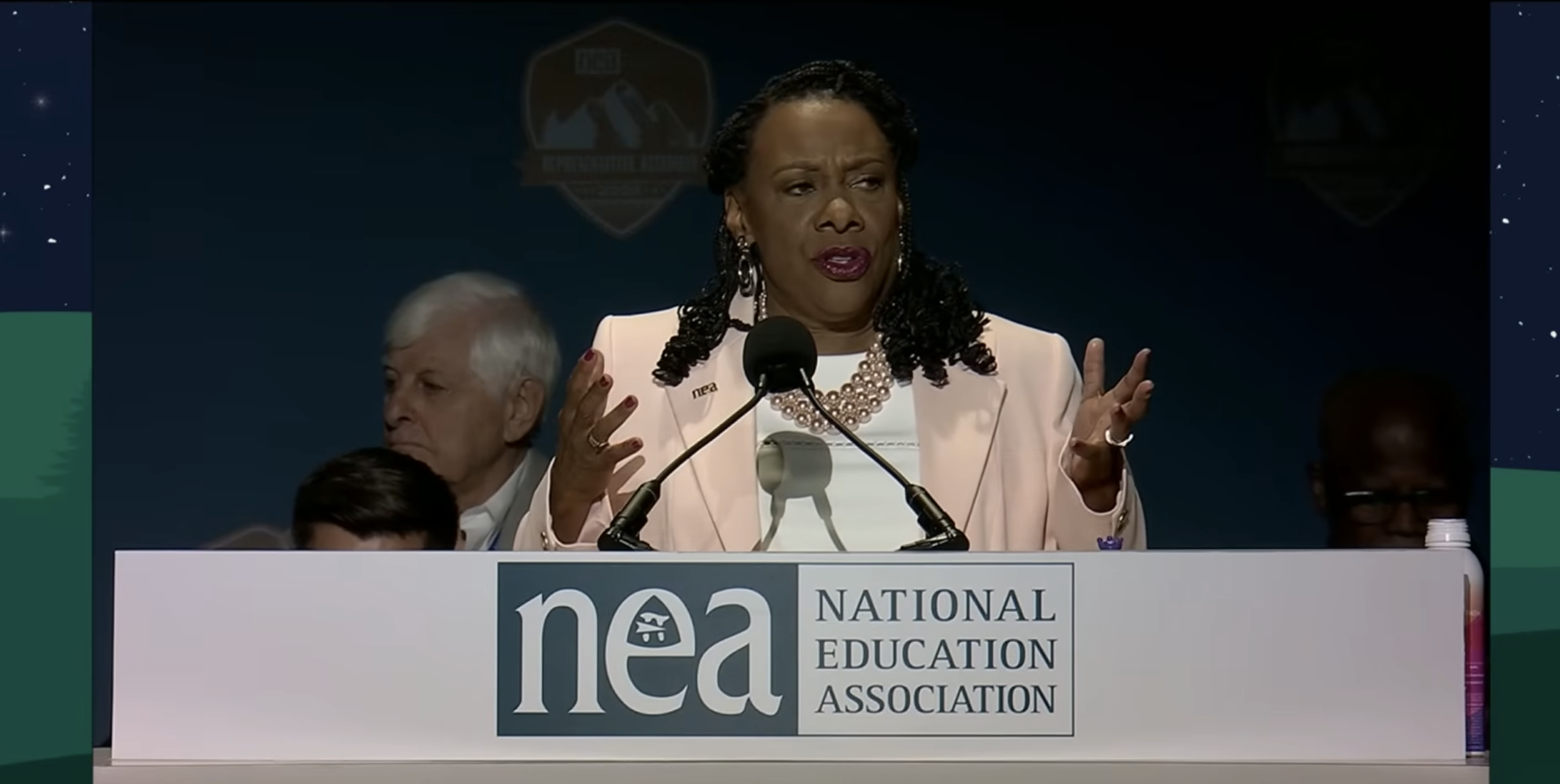
Most Americans believe that conferences for public school educators feature practical, hands-on sessions designed to improve academic and behavioral outcomes and effectively manage the various roles and responsibilities assigned to teachers by elected officials and school administrators.
Unfortunately, modern education conferences often look more like political rallies than thoughtful explorations into the art and science of teaching. And no group offers a more politicized conference experience than the nation’s largest teacher union, the National Education Association (NEA).
This week, NEA leaders and its members gather in the union-friendly confines of Chicago for the annual National Leadership Summit. NEA President Becky Pringle’s Summit welcome letter declares that the purpose of the National Leadership Summit is to leverage “organized power” toward “collective activism.” In the eyes of the NEA, the most serious problem facing public education is political apathy.
Likewise, the event’s agenda reflects the NEA’s commitment to radical left-wing politics and shocking indifference toward the nation’s appalling academic outcomes. Scores on the 2024 National Assessment of Educational Progress (NAEP) tests were below pre-pandemic levels in all tested grades and subjects. These academic declines come amid record levels of education spending and a decade of school staffing surges. These are profound problems that the NEA and its allies are unequipped to solve and unwilling to discuss, as the National Leadership Summit makes clear.
What does “collective activism” mean in practical terms? First, collective activism requires compliant politicians and a common enemy. One early-bird session, “Standing Up to Authoritarianism: Advancing Skills to Meet the Moment” promises to offer case studies and resources to help members and its local association “elect pro-public education school board candidates and create policy wins for students and their educators.” Topics include civic resistance and noncooperation to counter the so-called “authoritarian threat,” which is shorthand for the Trump administration and its allies.
Of course, electing “pro-education” candidates is no guarantee that the political class will bend the knee to the whims of NEA leadership. That is why the National Leadership Summit includes a session for members who want to run for a local, state, or federal office. According to the session description, participants will “examine the core components of what it takes to run for public office” and “review the steps to take before kicking off a successful campaign.” NEA members in the halls of power are reliable votes for the union agenda.
Collective activism also requires applying political pressure to elected officials through advocacy. The National Leadership Summit affords attendees the opportunity to hone their lobbying skills in a session titled, “Speak Up and Speak Out: Learn to be an Advocacy Champion for Your Students, Colleagues and Community.” This session teaches members how to coordinate political advocacy campaigns focused on elected officials at all levels of government.
Finally, collective activism requires money, and the NEA has plenty of it. Federal disclosure reports show that the union redirects tens of millions of dollars in membership dues to allied political organizations and mostly Democratic candidates for local, state, and federal offices. But they want more. A summit offers a session titled “Running a Local PAC Drive” to teach members how to raise money for political contributions by creating and operating a political action committee (PAC). These NEA-affiliate PACs would provide additional union-directed dollars to candidates that reflect its values.
And what are the NEA’s values? The National Leadership Summit agenda suggests that the union is doubling down on diversity, equity and inclusion (DEI) by championing a host of economic, racial, and social justice causes prized by the radical left. Notable session titles in this regard include:
- “Amplifying the Voices of BIPOC and LGBT Members”
- “Hope Floats: Anchoring Racial and Social Justice in the Floods of Authoritarianism”
- “Know Your Rights: Leading for Immigration Justice and Organizing for Safe Zone Resolutions”
- “Read All About It! Embracing Lessons of Racial and Social Justice from Every Voice”
- “Creating An Anti-Racism Taskforce at the Local Level”
- “Repairing the Harm: Leading with Accountability and Empathy in Predominantly White Spaces”
- “The Politic of the Curl: Confronting Hair Discrimination in Schools”
Alternatively, National Leadership Summit organizers could have offered sessions that highlighted the recent success of research-based, student-focused educational reforms in Mississippi, Alabama, Louisiana, and Florida. The fact that they refuse to do so gives away the game. National Education Association leaders yearn to secure and maintain political power, even at the expense of supporting the kind of high-quality education our children deserve.
Terry Stoops is the director of state affairs for Defending Education. Over the last two decades, he has held leadership positions in North Carolina and Florida focused on influencing state education policy and championing parental rights through advocacy, research, and public commentary.