Order Anni Cyrus’ new book, The Architecture of Jihad: HERE.
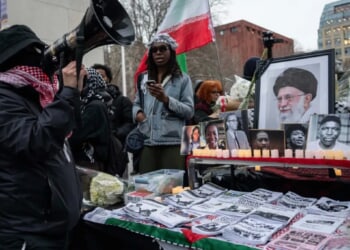
This is nothing new in my coverage. I have been saying it for years. But today the issue has become more urgent because of what we are hearing from Western politicians as they discuss the future of Iran.
The phrase appears again and again: We do not want another radical leader in Iran.
Every time I hear that sentence, I know the conversation has already gone off the rails. Because the problem is not “radical leadership.” And the solution is not “moderate leadership.”
The real issue is something Western policymakers still refuse to confront: the difference between Muslims and Islam, and the difference between individual behavior and governing doctrine.
Before we talk about “moderate,” “radical,” or “reformer” leaders in Iran, we need to understand something much more fundamental.
A Muslim is an individual. Islam is a governing system.
When Western politicians debate whether Iran might produce a “moderate Islamic leader,” they are treating the problem as if it were about the personality of a single man. But the Islamic Republic was never built around one personality. It is built around a collective doctrinal structure that places Islamic law above any individual leader.
That is why the language of “moderate vs radical” misses the point entirely. In a system where the law itself is derived from Sharia, the question is not how moderate the leader is. The question is how fully the system is implemented.
The West continues to search for a “good Islamic ruler.”
But the problem is not the ruler. The problem is the rulebook that defines what kind of ruler can survive in the system.
Muslims vs Islam
One of the most persistent confusions in Western political discourse is the failure to distinguish between Muslims as people and Islam as a governing doctrine. This confusion allows policymakers to believe that the ideology itself is flexible, when in reality it is the individuals living under it who vary in how strictly they apply it.
Muslims are human beings. Like any population, they range from devout to secular, from strict to relaxed, and from politically active to entirely disengaged. Many Muslims simply want to live their lives, raise their families, and practice their faith privately. When people speak about their Muslim neighbors, coworkers, or friends, they are describing individuals whose behavior reflects personal choices, cultural influences, and the realities of living in modern societies.
Islam, however, is not merely a personal belief system. It contains an entire legal and political framework that historically governed societies. The Qur’an, the Hadith collections, and the centuries of Islamic jurisprudence known as fiqh form the basis of what is commonly called Sharia. Sharia is not simply spiritual guidance. It is a body of law addressing criminal punishment, political authority, warfare, taxation, social order, and the treatment of non-Muslims.
But the reach of this system does not stop with non-Muslims. Once Islamic law becomes the foundation of political authority, it governs the behavior of Muslims themselves. In practice, this means the same framework that claims to represent the Muslim community also disciplines, restricts, and in many cases punishes Muslims who simply want to live normal lives outside the demands of ideological enforcement.
This distinction matters because individuals can choose to interpret or apply their religion differently, but the underlying doctrine itself does not change simply because a particular leader wishes it to.
When Western politicians speak about a “moderate Islamic government,” they are often imagining that the ideology itself can be softened by the personality of whoever holds power. In reality, within systems explicitly built on Islamic law, leaders are expected to administer and defend that law, not rewrite it to suit modern political sensibilities.
The Myth of the Moderate Islamic Ruler
The modern political vocabulary surrounding Islam introduced three comforting categories: moderate, reformer, and radical. These labels suggest that the ideological spectrum within Islamic governance mirrors Western political divisions, where leaders may lean more conservative or more liberal while still operating under the same constitutional framework.
In free societies, individuals or movements may push radical ideas or even act in ways that challenge constitutional principles, but the system itself contains mechanisms designed to restrain them. Courts, legislatures, and public accountability create a structure of checks and balances that limits how far any ideology can impose itself on the population.
But Islamic governance has historically not operated on that kind of ideological scale. The legitimacy of an Islamic ruler is tied directly to his commitment to implementing Sharia. A leader who openly rejects core elements of Islamic law does not merely face political disagreement. Within systems where religious legitimacy defines authority, such a move can cost him his power, his freedom, and in some cases his life.
This is precisely why the Iranian system was designed the way it was after the 1979 revolution. The structure of the Islamic Republic ensures that no elected politician can override the authority of the religious legal framework. Institutions such as the Guardian Council and the office of the Supreme Leader exist precisely to guarantee that the state remains aligned with Islamic jurisprudence.
In other words, the system was built to prevent exactly what Western analysts keep hoping for: a leader who simply decides to reinterpret the entire ideological foundation of the state.
The language of “reformist” leaders in Iran has existed for decades, but even the most so-called reformist presidents operated within the same doctrinal limits. They could adjust policy, rhetoric, or diplomatic posture, but they could not dismantle the legal supremacy of Sharia within the structure of the Islamic Republic.
Presidents such as Mohammad Khatami and Hassan Rouhani were widely described in Western media as reformists, yet both governed fully within the same clerical framework and never attempted to dismantle the legal supremacy of Sharia that defines the Islamic Republic.
At this point, the common response usually appears almost immediately. If Islamic governance is so rigid, critics ask, how do we explain countries that the West regularly describes as “moderate Islamic states”? Saudi Arabia, the United Arab Emirates, Jordan, Morocco, and others are often presented as examples of Islam adapting to modern governance.
But this argument confuses diplomacy and economic modernization with the legal foundations of the system.
A government may open luxury hotels, build modern cities, or develop strong relationships with Western economies while still maintaining a legal structure rooted in Islamic law. Skyscrapers, financial centers, and international tourism do not replace the underlying legal framework. They exist alongside it.
Anyone who doubts this can examine the actual penal codes of these states. In Saudi Arabia, the legal system remains explicitly grounded in Sharia jurisprudence. Apostasy, blasphemy, and certain forms of religious dissent can still carry severe penalties under the law. In the United Arab Emirates, while the country has pursued aggressive economic modernization and presents a more globally integrated image, the legal system still incorporates Sharia principles in key areas of criminal and family law.
Even where enforcement is uneven or politically moderated, the framework itself remains intact.
Another revealing question is religious freedom. In many countries described as “moderate Islamic states,” the construction of churches is tightly controlled, public Christian evangelism is restricted, and conversion away from Islam can bring serious legal and social consequences. These realities rarely appear in Western political speeches celebrating reform.
And the consequences extend beyond domestic law. Over the past several decades, individuals connected to countries often labeled as “moderate” have appeared repeatedly in international jihadist movements. This does not mean that every citizen of those nations is a jihadist, but it does demonstrate that the ideological ecosystem producing such movements does not emerge from nowhere.
None of this means that these governments are identical to the Islamic Republic of Iran or the Taliban. Political structures, leadership styles, and levels of enforcement vary widely. But the presence of economic modernization or diplomatic pragmatism should not be confused with a transformation of the underlying legal and doctrinal framework.
The system may be managed differently. The rule-book, however, remains the same.
This is why the debate about whether Iran’s current regime will produce a “moderate Islamic leader” often feels disconnected from the reality of how the system actually functions.
Understanding how these systems operate is exactly why I wrote The Architecture of Jihad. For years, I have studied the doctrines, legal frameworks, and political strategies that shape Islamic governance and influence global movements. This book is not a collection of headlines or opinions; it is a documented examination of the structures that too many policymakers still refuse to confront.
If you want to understand the rule-book that drives these systems, I invite you to read The Architecture of Jihad. The book is available now, and it was written for readers who want to move beyond political slogans and understand the ideology shaping events across the Middle East and beyond.