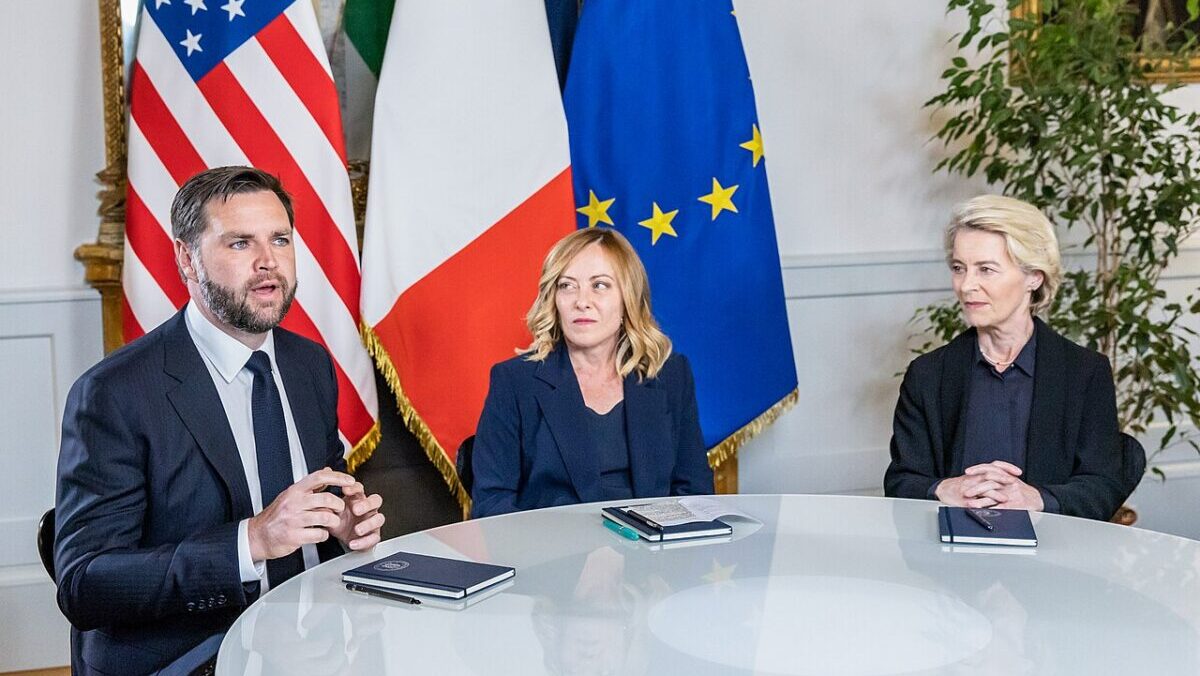
When Vice President J.D. Vance addressed the Munich Security Conference in February 2025, he delivered a blunt critique: Europe had retreated from fundamental values like free speech, pursued decades of progressive policies that eroded strength, and left the continent too weak to robustly defend the West. European leaders dismissed his criticism as “absurd” and “not acceptable.”
Yet the war against Iran has underscored Vance’s point.
The European Union has long-standing grievances against Tehran: decades of terrorism on European soil. Tehran has also taken numerous European visitors as hostages over the years, using them as leverage to extract concessions such as prisoner swaps, debt repayments, and asset releases. A striking example is the case of British-Iranian Nazanin Zaghari-Ratcliffe, who was detained in 2016 and was only freed in 2022 after the UK government repaid a long-standing debt of nearly £400 million.
Facing this persistent threat, Europe had a clear opportunity to unite with allies against a common foe. Instead, major nations delivered lackluster, divided responses — slow, sidelined, or obstructive.
Slow Reactions
Hours after the joint U.S.-Israel strikes on Iran began on Saturday, European Commission President Ursula von der Leyen posted on X.com that she would wait 48 hours to convene a special security meeting on Monday, prompting widespread mockery about crises addressed only during “business hours.” Such jests laid bare the EU’s bureaucratic inefficiency and its hesitance to respond decisively when stakes are high.
Furthermore, the EU largely avoided endorsing the U.S.-Israeli offensive, prioritizing de-escalation instead. This pattern of hesitance highlights self-imposed strategic limits and the EU’s questionable global credibility and strategic relevance.
Standing on the Sideline
The U.K.’s response was the most disappointing. Prime Minister Keir Starmer’s initial statement was to distance Britain from the U.S.-Israeli offensive, stressing no role and no offensive actions. His statement sparked widespread criticism, with many labeling him as “weak and pathetic.” Leaders from the Middle East expressed intense frustration over Britain’s inaction, particularly regarding its failure to assist in defending them and British citizens residing in their countries.
Then reports revealed that the UK government denied early U.S. requests (as far back as February 11) to use UK bases such as RAF Fairford and Diego Garcia. Only after Iranian attacks hit a UK base in Cyprus did Starmer relent, allowing U.S. use of bases for targeting Iranian missile sites and deploying UK military assets — nearly three weeks after initial outreach. President Donald Trump deemed it “too little, too late,” while former UK leaders such as Boris Johnson and Liz Truss decried the UK’s diminished stature. Even Tony Blair argued Britain should have backed America immediately.
UK analysts such as Joseph C. Sternberg of The Wall Street Journal highlight a significant domestic factor behind the UK’s inaction. Years of mass migration have resulted in Muslim populations dominating some key Labour districts such as in London and Birmingham. With low polling numbers, Starmer and other Labour leaders probably feared that any active involvement in the Iran war would alienate their Muslim voter bloc.
France’s and Germany’s responses fared slightly better than Britain’s. After issuing a joint statement condemning Iran’s reprisals and pledging defensive support, French President Emmanuel Macron announced an increase in France’s nuclear arsenal and the deployment of nuclear-armed aircraft to European allies.
Active Obstruction
Spain’s socialist Prime Minister Pedro Sánchez stood out in opposition, condemning the strikes as “unjustified,” “dangerous,” and a violation of international law while prohibiting U.S. use of bases such as Rota and Morón. Trump’s trade-cut threats drew swift Chinese backing for Sánchez.
Among EU leaders, Sánchez is particularly eager to strengthen ties with China. He is reportedly preparing an official trip to Beijing in April, his fourth official visit since 2023. Despite democratic rhetoric, Sánchez has conspicuously refrained from criticizing China’s dismal human rights record — undermining claims of principled leadership.
Too Weak to Defend the West
These stances reflect Vance’s deeper critique: the EU is becoming too weak to help defend the West.
Post-World War II priorities on welfare over defense left many European militaries underfunded, short-staffed, and reliant on U.S. protection. The Russia-Ukraine War exposed European countries’ struggles in providing Ukraine with meaningful, timely, and sufficient military support. Under pressure from the Trump administration, some European countries that are NATO members have increased their defense budgets but remain unprepared for high-intensity conflicts. German Foreign Minister Johan Wadephul has admitted that limited military resources are a key reason why Germany is not directly involved in the Iran War.
The EU’s energy dependency compounded the continent’s hesitation: years of aggressive decarbonization increased dependence on Russian gas. After Russia invaded Ukraine, EU member states have tried to replace natural gas imports from Russia with liquefied natural gas (LNG) from the U.S. and Qatar. However, Qatar has halted its LNG exports amid the escalating U.S.-Israeli conflict with Iran, and Russia threatened to cut off gas supplies to Europe, raising the EU member states’ fear of energy shortages and economic pain.
Europe’s reluctance to join offensive operations squandered an opportunity to confront a shared adversary decisively. While defensive steps and condemnations of Iran’s attacks show some alignment, the overall posture — slow, divided, and risk-averse — validates Vance’s warning. If leaders persist in favoring welfare over defense, climate ideology over energy security, and domestic politics over transatlantic resolve, Europe courts true irrelevance in a dangerous world. The Iran crisis isn’t just a Middle Eastern war; it’s a stark test of Western cohesion — and Europe is failing it.