President Donald Trump’s administration is on the defensive, not only from Iranian strikes in the Middle East but also from incoming criticism from members of his own base.
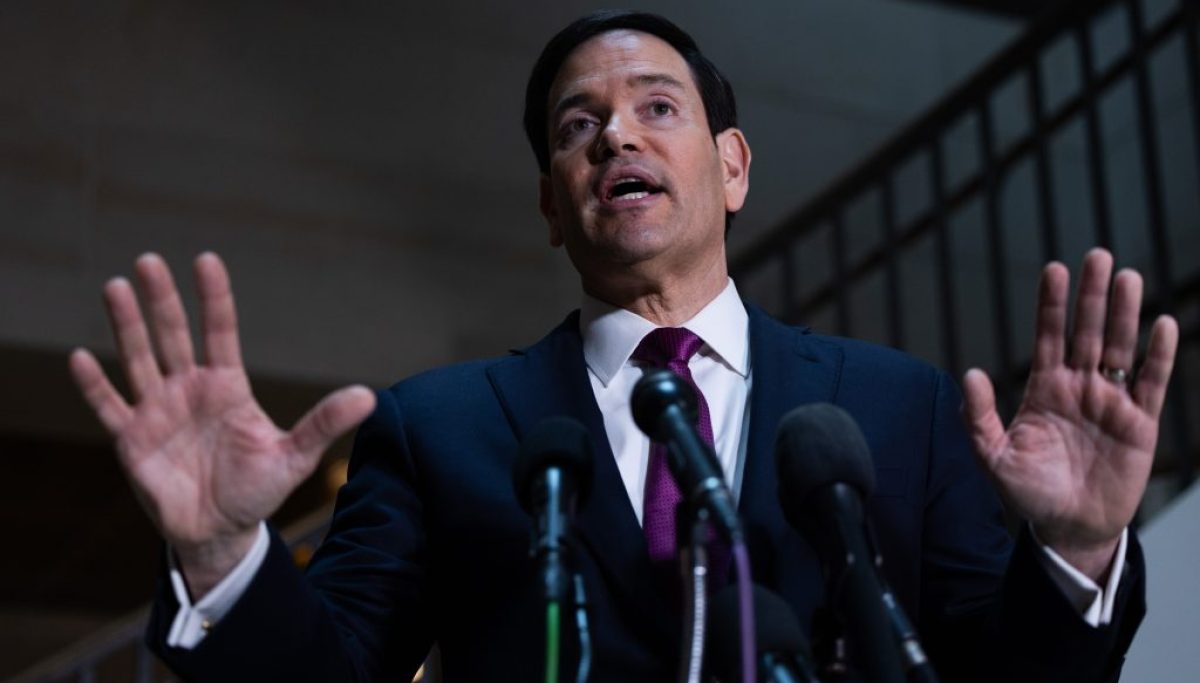
Secretary of State Marco Rubio‘s concession on Monday that the U.S. started proactively striking Iran in the early hours of Saturday morning because Trump was concerned Israel was poised to provoke reprisal attacks from Tehran against the U.S. has rankled some of the president’s own supporters.
Trump supporter dissatisfaction appears to have manifested in two parts. First, because the president repeatedly campaigned on ending so-called forever wars, and this conflict risks becoming a protracted conflagration; and secondly, because of increasing skepticism of Israel, with some instances of anti-semitism.
Former Rep. Matt Gaetz, the president’s original nominee to become attorney general, criticized the optics of the U.S. being pressured to take action against Iran because of Israel in response to a video of House Speaker Mike Johnson (R-LA) parroting Rubio’s comments.
“In making these statements, which are undeniably true, America looks like such a supplicant,” Gaetz wrote on social media.
More generally, former Rep. Marjorie Taylor Greene, a one-time Trump supporter who has disagreed with the president over his administration’s disclosure of the federal government’s files on Jeffrey Epstein, among other troubles, has scrutinized the strikes for resulting in a country “no longer … divided by left and right.”
“We are now a nation divided [by] those who want to fight wars for Israel and those who just want peace and to be able to afford their bills and health insurance,” Greene wrote on X.
The likes of conservative commentator Megyn Kelly and Blackwater founder Erik Prince have amplified Gaetz and Greene’s comments with their own.
Fewer than 24 hours later, Trump, during his first press conference since the start of the strikes, appeared mindful of the optics, contending instead that he “forced” Israel’s metaphorical “hand.”
Trump then undermined Rubio, telling reporters he ordered the first strikes because Iran was “going to attack first,” which does not align with U.S. intelligence assessments.
“They were going to attack if we didn’t do it,” he said Tuesday before a White House meeting with German Chancellor Friedrich Merz. “They were going to attack first, and I didn’t want that to happen. So, if anything, I might have forced Israel’s hand. But Israel was ready, and we were ready, and we’ve had a very, very powerful impact.”
Rubio went on to insist on Tuesday that Trump would have decided to strike Iran first, regardless of Israel.
“You guys can misrepresent it,” he said. “The bottom line is this: the president determined we were not going to get hit first. It’s that simple, guys. We are not going to put American troops in harm’s way.”
When asked about the optics, Center for Strategic and International Studies Zbigniew Brzezinski Chair in Global Security and Geostrategy Jon Alterman evoked the phrase “Kinsley gaffe,” or when “a politician tells the truth — some obvious truth he isn’t supposed to say.”
“President Trump is not the first U.S. president to feel a deep alignment with Prime Minister [Benjamin] Netanyahu on strategic matters in the Middle East,” Alterman told the Washington Examiner. “It seems to me, though, that isn’t always appropriate.”
For Alterman, this is because “Israel has felt that it is in perpetual war in its region, and it needs to remain on a war footing.”
“That hasn’t been the U.S. default posture, and while the United States has fought its share of wars in the region, the United States has generally been successful moving toward constructive and peaceful relations with regional states,” he said.
But despite Trump being open about the problems in his relationship with Netanyahu, including having less influence over the prime minister than he would prefer, Council on Foreign Relations Eni Enrico Mattei Senior Fellow for Middle East and Africa Studies Steven Cook reiterated that “Trump is the president of the United States.”
“If he did not want to go to war, he could have stopped the Israelis from moving forward,” Cook told the Washington Examiner. “After all, Trump forced Prime Minister Netanyahu to turn around Israeli planes last June after the president forced a ceasefire.”
Similarly, American Enterprise Institute foreign and defense policy senior fellow Danielle Pletka was adamant the U.S. “didn’t follow Israel into conflict.
“The United States shares the same enemies with Israel, so we have a coincidence of interests,” Pletka told the Washington Examiner. “But there have been decades on end where the United States ignored Israel’s priorities — think the Iraq War — in favor of our own calculus.”
The former Senate Foreign Relations Committee aide added, “What happened this time is that the Iranians told us and the Israelis – almost explicitly – the same thing: We will never stop enriching uranium. That was intolerable to both Jerusalem and Washington.”
Both Pletka and Republican strategist John Feehery agreed Rubio’s words were misinterpreted, though Feehery conceded those words contributed to the perception “that we got into this situation because of Israel.”
Of the Republican Party’s divide over Iran and Israel, Feehery said: “Many on the MAGA Right don’t like foreign wars and they don’t like Israel. This is not breaking news.”
Center for Strategic and International Studies’ Alterman underscored how “the MAGA universe came together in part out of a hostility to pursuing ambitious goals overseas while fighting costly wars of choice.”
“That distracted the government from improving things at home, and it took money away from domestic tasks,” he said. “Replacing the government of Iran with a more pliable one is an ambitious and costly undertaking, and it’s not clear to me that alternatives were considered. This will likely be the defining international event of the Trump presidency, and it is contrary to the principles on which the president campaigned. This could all turn out well, but there’s a very real chance that it won’t.”
Regardless, according to a Reuters-Ipsos poll conducted since Saturday’s strikes and published on Monday, 55% of Republican respondents approve of the U.S. attacks on Iran so far, compared to 13% who oppose them, though a plurality told pollsters they would be against them if troops were killed or injured, as they have.
The U.S.-Israel optics coincide with problematic internal Republican politics prompted by another conservative commentator, Tucker Carlson, who last October had white nationalist Nick Fuentes on his podcast, during which Fuentes claimed “organized Jewry” was the “big challenge” confronting the country.
PHOTOS: USHA VANCE TALKS CHILD LITERACY AT HOSPITAL READING EVENT
When asked if the optics could encourage antisemitism, Republican strategist Doug Heye said, “antisemites will find any reason to try to increase their ranks.”
“Everything fuels antisemitism,” AEI’s Pletka said. “Bottom line is that antisemites don’t need fuel — they adapt their prejudices to hate Jews no matter what.