Order Jamie Glazov’s new book, ‘United in Hate: The Left’s Romance with Tyranny, Terror, and Hamas’: HERE.
In February 2015, President Barack Obama convened the White House Summit on Countering Violent Extremism. For three days, administration officials, activists, and selected “community leaders” gathered in Washington to address jihadist recruitment, including in Minneapolis, where dozens of Somali youths had already left to join ISIS and al-Shabaab.
It was billed as a serious counter-terrorism effort. It was not.
Whitewashing Islamic Terror
From the outset, the summit was defined by what it refused to say. The Obama Administration had effectively banned the phrase “radical Islamic terrorism,” substituting the sanitized term “violent extremism.” Islamist doctrine was not addressed, except to say that neither it nor Islamic theology played any role in the ongoing global jihad.
President Obama closed the summit by warning against “twisted interpretations of Islam” and insisting that ISIS did not represent the faith. He announced federally funded initiatives centered on “community engagement” and cross-cultural dialogue. The message was clear: The problem was alienation, not ideology.
Into this atmosphere stepped then–U.S. Congressman and devout Muslim Keith Ellison of Minnesota.
Ellison did not call for tougher terror-finance enforcement. He did not demand greater scrutiny of overseas money flows from a state that had become a hub for jihadist recruitment. Instead, he used the national stage to push for reversing restrictions on Somali remittance channels – financial pipelines banks had begun shutting down over terror-financing concerns.
Speaking about those restrictions, Ellison complained: “This is not a good thing, and it runs counter to the efforts we are engaging in right here, right now.”
At a summit devoted to combating extremism, Ellison focused on restoring the flow of money.
Banks, Hawala Networks, and a Trip to Mogadishu
Banks pulled back from Somali remittances because Somalia’s financial system is fragmented and vulnerable to infiltration by al-Shabaab, the al-Qaeda–linked terrorist group operating there. Once funds leave regulated U.S. institutions and enter hawala networks – informal transfer systems with limited transparency – oversight drops sharply. Even legitimate remittances can be skimmed or taxed in militant-controlled areas.
Institutions such as Sunrise Community Banks and Merchants Bank of California acted to comply with federal anti-terror financing laws, which impose severe penalties if funds are found to support designated terrorist organizations – even indirectly.
In a statement circulated by Oxfam, Ellison warned of the “devastating effects of closing the last safe and legal pipeline” to Somalia. Months before the summit, he sponsored the Money Remittances Improvement Act, designed to make it easier for nonbank institutions to provide global remittance services.
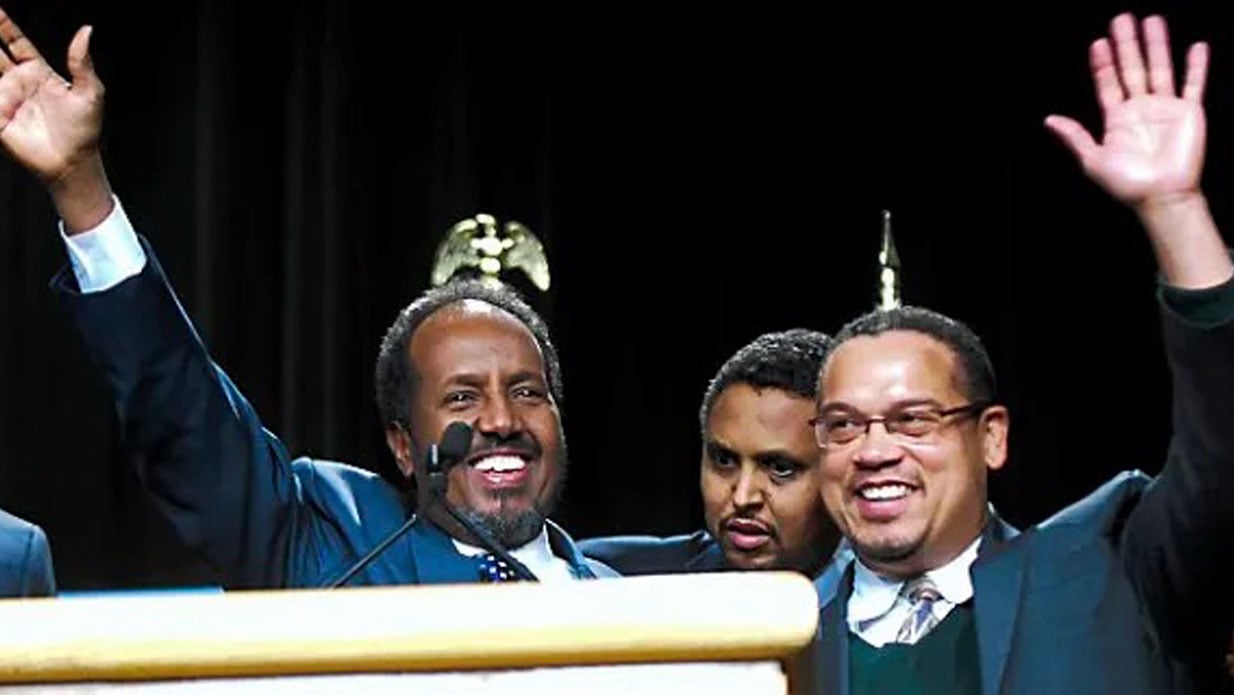
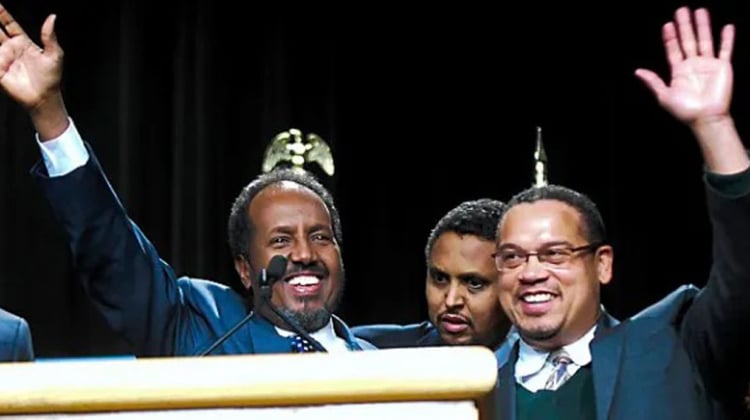
In February 2013, Ellison traveled to Mogadishu, the capital of Somalia, to meet with newly elected Somalia President Hassan Sheikh Mohamud, whom Ellison appeared to develop a close relationship with, to discuss the issue of remittances and the difficulty of getting money to Somalia from the U.S.
By then, Minneapolis had already experienced waves of Somali youth departing for jihadist battlefields. Federal prosecutions had documented recruitment networks. Yet Ellison’s public concern at the White House was not terror-finance risk. It was the perception that financial scrutiny might alienate Muslims and push “the youth” toward radicalization.
The implication was that enforcement itself could be the problem.
The Ideological Company at the Summit
The summit’s guest list underscored the administration’s reluctance to confront Islamist ideology directly. It included leaders from the Muslim Public Affairs Council (MPAC), a radical Muslim group that has defended entities associated with terrorism, including those linked to Hamas.
Among the summit speakers was MPAC President Salam al-Marayati. Al-Marayati has described Hezbollah attacks as “legitimate resistance,” defended Islamist political leaders convicted of terror-related crimes abroad, and on September 11, 2001, suggested Israel should be placed on the “suspect list.”
Also featured was MPAC co-founder Maher Hathout, who praised Muslim Brotherhood founder Hassan al-Banna as a reformist and justified Hezbollah violence as consistent with “American values.” Days after 9/11, Hathout encouraged conspiracy theories casting doubt on the hijackers’ identities.
Ellison’s Own Record
In the 1990s, Ellison – who is today Minnesota’s Attorney General – was affiliated with the Nation of Islam (NOI) and wrote columns defending its positions under the pseudonym “Keith X Ellison.” He referred at the time to anti-Semitic NOI leader Louis Farrakhan as a “role model.”
Ellison has happily spoken at events sponsored by the Council on American-Islamic Relations (CAIR), a Hamas-linked outfit that has recently been designated a terrorist organization by multiple states. Ellison knows CAIR’s National Executive Director Nihad Awad, since their time together at the University of Minnesota Law School.
In April 2010, Ellison traveled to the Gaza office of Islamic Relief, a group that has been banned by several nations and has been labeled a “Hamas front” by Israel. Four years earlier, Israeli security services arrested Islamic Relief’s Gaza Program Director Ayaz Ali for transferring funds to Hamas institutions and organizations.
From Summit Rhetoric to Minnesota Scandal
Fast forward to Minnesota’s current crisis.
The state is engulfed in what investigators have described as one of the largest fraud scandals in modern history. The Feeding Our Future scheme alone involved hundreds of millions in taxpayer dollars. Overall losses across programs have been estimated in the billions.
During a 2026 Homeland Security Subcommittee hearing, Senator Josh Hawley confronted Ellison, accusing him of meeting with individuals later charged in the fraud investigation and accepting campaign donations from them.
Hawley told him: “You helped fraudsters defraud your state and this government of $9 billion, and you got a fat campaign contribution out of it. You ought to be indicted.”
He further alleged that testimony before his subcommittee indicated that hundreds of millions tied to Minnesota fraud flowed to “terrorist groups, transnational criminal organizations, the drug trade, drug trafficking, and child trafficking.” He added that Ellison “helped them do it.”
Keith Ellison – The Center of the Controversy
The 2015 summit was supposed to confront extremism. Instead, it whitewashed its ideological roots.
Ellison used that moment on the national stage to argue that the money must keep flowing – publicly opposing financial restrictions designed to mitigate terror-financing risks, in one of the most unstable financial environments in the world. Years later, billions in Minnesota taxpayer funds have vanished.
Minnesotans are now living with the consequences of a political culture that treated oversight as an inconvenience, and Keith Ellison is at the center of the controversy.
Beila Rabinowitz, Director of Militant Islam Monitor, contributed to this report.