At the end of Kate Chopin’s nineteenth-century novel, The Awakening, protagonist Edna Pontillier steps into the Gulf waters in a desperate bid to escape the human ties that impose upon her soul. She has spent the entire novel disassembling every structure and relationship: abandoning her marriage vows for a series of purposefully fleeting sexual encounters, breaking the socio-economic norms of her Cajun society, offloading her children, moving out of the family home, and picking up an artistic occupation in order to manifest her autonomy.
At one point in the novel, she explains her guiding principle: “I don’t want anything but my own way. That is wanting a good deal, of course, when you have to trample upon the lives, the hearts, the prejudices of others …” By the novel’s end, she has managed to get her own way entirely. Yet still Edna feels the burden of human connection, spurring her despairing swim from humanity in a last, fatal attempt to find pure individuality.
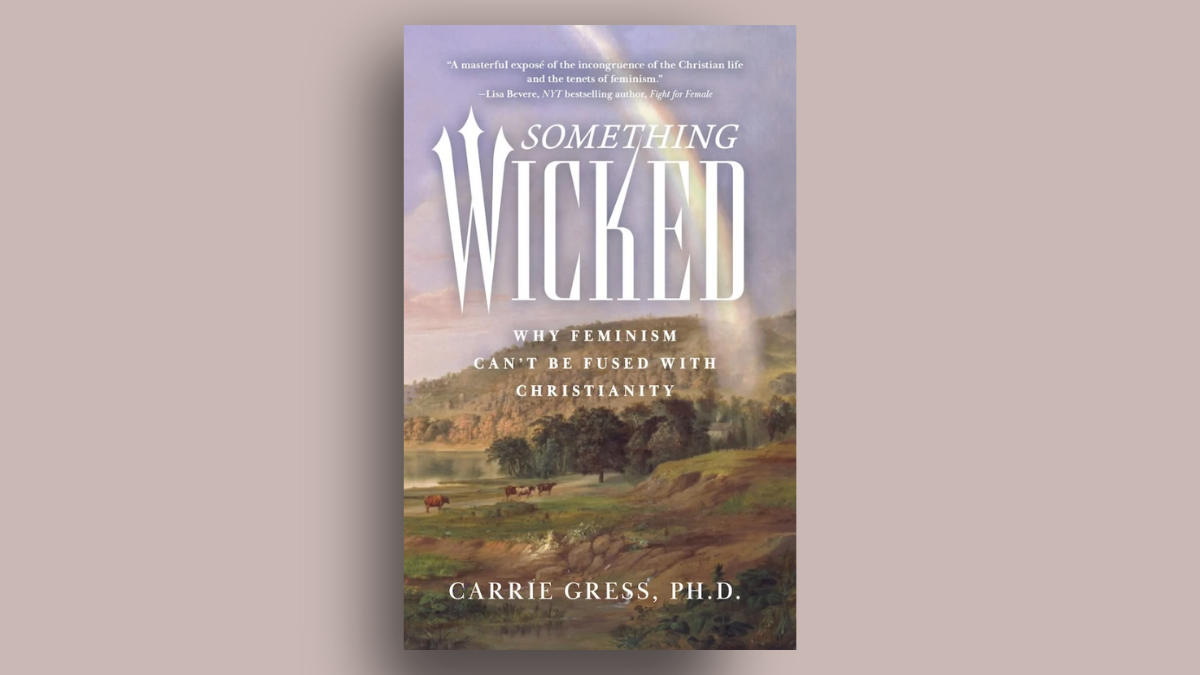
As I read Dr. Carrie Gress’s new book, Something Wicked: Why Feminism Can’t be Fused with Christianity, I could not stop thinking of Edna swimming to her death in the vain pursuit of total autonomy at any human cost. Gress charts feminism’s rise and development from Mary Wollstonecraft to the present day. She highlights a movement that presents women with an idol of autonomy, and commands them to trample upon the lives of all who might compromise its worship. Something Wicked strips the mask off of feminism to reveal a violent and bitter rival to Christianity itself — one promising a newer “truth” that it claims will set us free.
The first part of Gress’s book is a beautifully researched exposé of feminism’s hostility to Christianity, and especially to Catholicism, from its earliest writings to the present day. Feminism’s deep antipathy to Christianity was closely tied to the progressive Unitarianism of many of its most important first-wave voices. Unitarianism rejects the fundamental Christian beliefs in the divinity of Jesus and the reality of human fallenness. Instead of acknowledging the need for a divine savior, Unitarianism focuses on human reason and progress as virtue. Inspired by this heterodoxy, Wollstonecraft crafts the feminist idol of autonomy: the enlightened individual’s exercise of her own private reason, unencumbered by any exterior authority.
It is vital to appreciate just how integral to feminism this rejection of Christianity is, as the core of Gress’s argument in later sections of the book demonstrates how feminism models itself in demonic imitation of the religion that its most influential leaders vocally reject. As Gress notes in one place, the most sacred moment of the Catholic Mass is when the priest proclaims the words of Christ at the Last Supper, “This is my body, given up for you.” By contrast, the fiercest cry of the feminist is the act of abortion, which inverts the sacred and turns it into diabolical horror: “This is your body, given up for me.”
Gress also connects the idol of autonomy to feminism’s deep association with the gay and transgender movements via its rejection of gendered differences and sexual complementarity. As the feminist philosopher, Simone de Beauvoir, proclaimed, “One isn’t born but rather becomes a woman.” Gress demonstrates that such thinking is a lurid parody of Christian baptism, twisting the second-century theologian Tertullian’s comment, “Christians are made, not born.” A Christian is made by submitting oneself to Christ and the Church. One wonders if those original first-wave feminists could have possibly imagined just how many external authorities — including basic biology — their idol of autonomy would call upon its adherents to reject.
Disturbingly, while feminism vaunts human autonomy and reason over traditional mores and biology, it has a predilection for the occult, so much so that Gress names it one of the “three commandments” of the movement. Many modern-day feminists shout their covens along with their abortions, but Gress shows that this connection goes far back into the earliest days of feminism. Elizabeth Cady Stanton and Lucretia Mott ran occult gatherings in their homes, which inspired the seminal feminist Seneca Falls Conference. This obsession with the occult carries even into so-called “Christian feminist” circles.
Gress spends a significant portion of the book debunking those feminists who claim to be Christian as well as correcting those Christians — especially Catholics — who think they can be “new” feminists. “New” feminism comes from the single instance that Pope John Paul II used the term in a 1995 encyclical. Building off of that one line, these would-be feminists try to reclaim Mary Wollstonecraft and a tradition of feminism separate from the woke, broken, and vile feminism that has brought Western civilization to its knees.
This section is Gress’s most important, as she notes that many Catholic feminists have fought diligently in the correct trenches of the culture war. Is there a strand of feminism that can be saved and turned towards the good? Can Christians safely align themselves with this new feminism? Or is it a quiet, slow-acting poison? Here, Gress’s philosophical training comes to the forefront, as she demonstrates that new feminists read Wollstonecraft entirely incorrectly. New feminists claim to have recovered a misunderstood classical virtue theorist, a daughter of Aristotle and Aquinas. Gress sets Wollstonecraft in her philosophical context, explaining that her thought “is located decidedly amid the broken fragments of a newer system that uses the same words but infuses them with very different meanings.” As Gress convincingly argues, Wollstonecraft is not a useful or safe voice for conservatives and Christians. Rather, she is the shout that started the avalanche.
Feminist readers idolize The Awakening — until Edna steps into the Gulf. Why does their heroine commit suicide? Some readers condemn society: Oppression chased her into the water. For them, Edna Pontillier is a call to ever more activism and vigilance surrounding women’s issues.
For other readers, the idea that Edna dies is unbearable. There are academic articles devoted to frankly embarrassing fantasies of a feminist Venus, diving into the ocean to be reborn as a goddess upon the foam. Barely any reader pauses to wonder why a woman who jettisons every deep human bond in return for everything she says she wants is left feeling so empty and numb.
Something Wicked asks us to take a step back and evaluate an ideology that pursues pure individual autonomy by trampling upon the lives of others. As Dr. Gress quotes in her opening, “A tree is known by its fruit” (Matthew 12:33).
Dr. Mary Elizabeth Cuff is an independent scholar, writer, and full-time homeschooling mom of five. She is the author of Mother to Mother: Spiritual and Practical Wisdom from the Cloister to the Home (TAN Books) and two forthcoming children’s books.