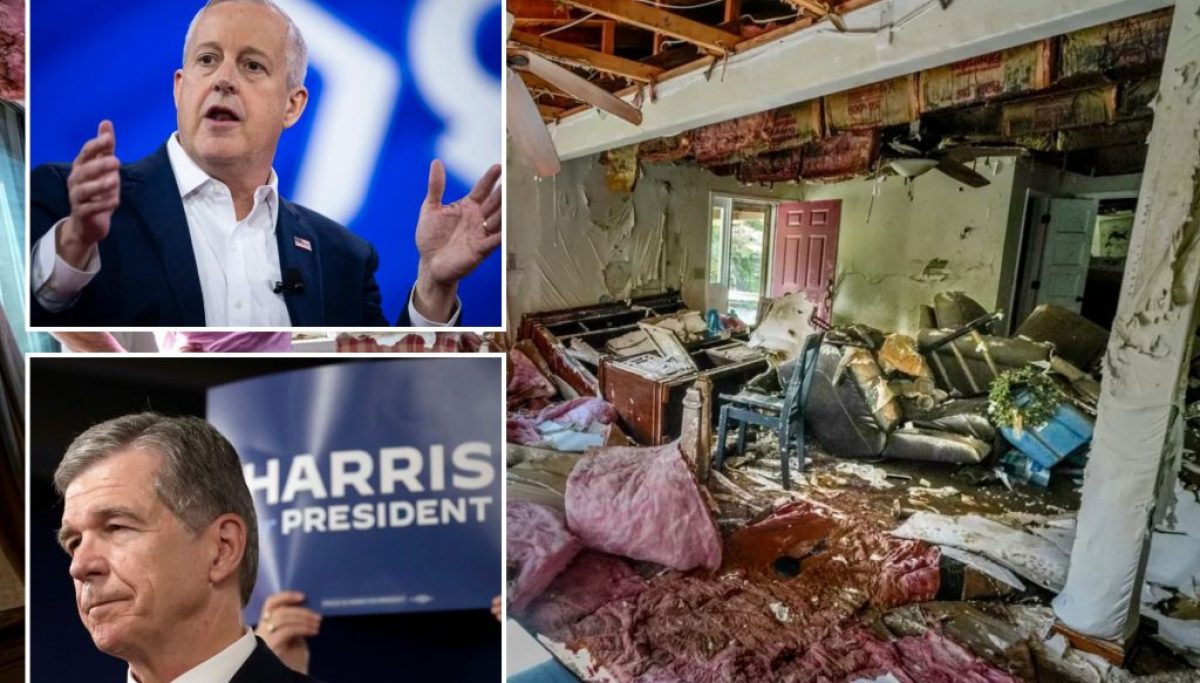
Hurricane Helene’s stalled recovery is quickly emerging as one of the most politically volatile issues in North Carolina’s marquee Senate race, with both Republican front-runner Michael Whatley and former Democratic Gov. Roy Cooper facing sustained attacks over how relief efforts have unfolded.
The disaster has created a rare opening in which both parties believe they have a case for accountability. Democrats are tying Whatley directly to his role overseeing recovery efforts and President Donald Trump’s promises to rebuild the region. Republicans argue the region’s frustrations reflect years of structural failures under Cooper’s disaster management system, stretching back to earlier storms.
“People don’t get blamed for the disaster itself, but they do get blamed for the recovery,” Chris Cooper, a political science professor at Western Carolina University, told the Washington Examiner. “And the recovery doesn’t look good.”
The emotional stakes remain high in western North Carolina. Hurricane Helene made landfall in September 2024, killed more than 250 people, and caused more than $78 billion of damage. Parts of Asheville and surrounding communities still show visible scars from the storm.
Even worse, disaster reimbursement delays, delayed housing repairs, and the holdup of infrastructure rebuilding have fueled anger in the communities that are hardest hit.
Whatley, a former chairman of the Republican National Committee, entered the race with Trump’s endorsement. Given that Trump won North Carolina, the endorsement instantly made Whatley the front-runner for the GOP nomination.
Whatley’s relationship with the president was evident in January 2025 when Trump arrived in North Carolina to survey the damage from Hurricane Helen. During the trip, Trump criticized FEMA and told reporters he wanted Whatley playing a leading role in ensuring rebuilding stayed on track.
“Michael Whatley is going to be very much in charge,” Trump said. “So I said, ‘Michael, fix it.’”
Democrats have repeatedly cited those remarks as evidence that Whatley became the public face of the federal response. His campaign disputes that characterization, emphasizing his role on the administration’s FEMA Review Council, a body tasked with evaluating disaster policy rather than managing day-to-day operations, according to reporting from the Charlotte Observer.
Chris Cooper said disasters often fade quickly from campaign politics, but Helene is unusually durable because it exposes one of the few areas where both candidates can be directly tied to outcomes.
“They’re two people who are hard to hit on a lot of issues,” Cooper said. “Disaster relief is one of the few areas where voters can attach responsibility.”
He argued the issue may cut more sharply against Whatley because of his limited public service record.
“It’s like Michael Whatley had one hit song out. Roy Cooper has had six albums,” Cooper said. “If that one song didn’t go so well, it’s an easier thing to hit Michael Whatley on.”
Whatley is also facing criticism from within his own party, underscoring how deeply the recovery issue has penetrated Republican grassroots politics.
At a January Republican Assembly meeting in Fayetteville, attorney and Senate candidate Don Brown accused Whatley of failing western North Carolina residents.
“But Michael Whatley has failed,” Brown said in audio obtained exclusively by the Washington Examiner. “I did talk to, just so you all know, a prominent conservative U.S. senator today. The president of the United States is aware of the problem with Michael Whatley. But he has failed.”
Brown’s claim that Trump has privately expressed concern about Whatley is flatly disputed by the White House.
A source familiar with the matter said the president met with Whatley during his recent North Carolina visit and “had a great conversation,” calling Brown’s characterization false. In a Truth Social post referenced by a White House official, Trump credited Whatley with helping drive the recovery effort after taking office, writing that Whatley “energized” rebuilding projects in flood-damaged areas. According to White House figures, FEMA has obligated $5.9 billion in North Carolina related to Hurricane Helene as of November 30, including $3.2 billion since January 2025.
Brown’s campaign did not respond to inquiries from the Washington Examiner.
Democrats were quick to seize on the internal Republican criticism.
“Even Republicans know Michael Whatley has failed as recovery czar and completely abandoned Western North Carolina,” said Mallory Payne, a spokesperson for the North Carolina Democratic Party. “North Carolina deserves better than an absent DC insider like Michael Whatley.”
Whatley’s campaign rejected the criticism and cast the race as a referendum on Cooper’s record in office.
Danielle Alvarez, an adviser to Whatley, said the Trump-endorsed candidate “stood alongside the president” during the 2024 election and would work with the administration in the Senate to accelerate rebuilding. She accused Cooper of abandoning western North Carolina during Helene and argued that years of Democratic leadership left the state unprepared for major disasters.
The Republican primary field also includes Brown, Michele Morrow, who won a surprise 2024 primary before narrowly losing statewide, along with Margot Dupre, Richard Dansie, Elizabeth Temple, and Thomas Johnson.
Republicans are simultaneously working to shift blame toward Cooper, who was governor at the time, by framing Helene as part of a longer pattern of failed disaster management. Republicans are simultaneously working to shift blame toward Cooper by framing Helene as part of a longer pattern of failed disaster management. Republicans have repeatedly criticized the state’s recovery efforts after Hurricanes Matthew in 2016 and Florence in 2018, arguing that long rebuilding delays reflected mismanagement under Gov. Cooper, who was in office during Florence. They cite local reporting showing thousands of residents were still awaiting repairs years after the storms.
National Republican Senatorial Committee spokesman Nick Puglia accused the former governor of abandoning storm victims across multiple crises.
“North Carolinians devastated by Hurricanes Helene, Matthew, and Florence were abandoned by Roy Cooper,” Puglia said in a statement provided to the Washington Examiner. “Days before Helene’s landfall, Cooper was rubbing elbows at an elite climate conference in New York. He never even appointed a disaster recovery coordinator. North Carolinians will hold Cooper accountable for his botched recovery efforts.”
A seasoned North Carolina Republican operative said the hurricane fight may generate loud campaign messaging but is unlikely to fundamentally reshape the race.
“I suspect that this issue with the hurricane stuff will be a wash,” the operative said. “Nobody’s hands are clean.”
He argued that Cooper’s political durability stems less from sweeping accomplishments than from the structural reality of North Carolina government, where governors wield limited power compared to the legislature.
“It’s really tough to get heat and scrutiny on an elected governor in North Carolina when the legislature keeps you from being able to do anything,” the operative said. “When you can’t really make people mad, you don’t take the damage.”
The strategist added that hurricane politics alone are unlikely to decide the outcome in a state where Senate races tend to follow partisan fundamentals.
“This race is going to come down to the environment more than anything,” he said, predicting a contest decided at the margins regardless of the recovery debate.
The North Carolina race is already shaping up as one of the most expensive Senate contests in the country. Cooper has dominated fundraising since jumping into the race last year. The former governor pulled in $7 million from October through December, nearly double the $3.8 million Whatley raised. Cooper entered 2026 with $12.3 million in cash on hand. Whatley finished the quarter with $3.7 million.