Order Jamie Glazov’s new book, ‘United in Hate: The Left’s Romance with Tyranny, Terror, and Hamas’: HERE.
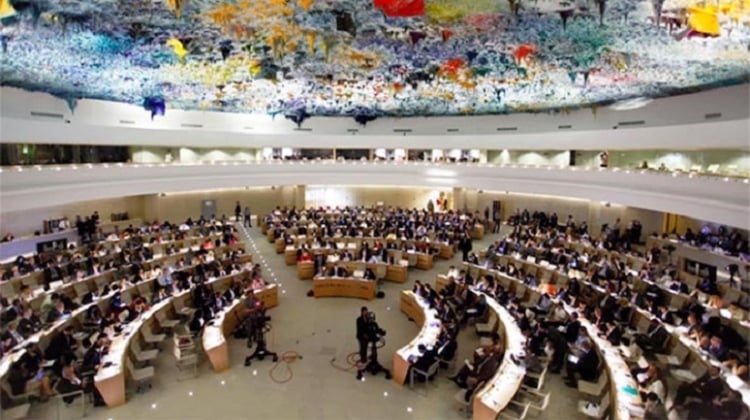
Amazing, but true: this time, it’s not Israel that is the object of UN scrutiny, but the Islamic Republic of Iran, that finds it is subject to near-universal condemnation for its savage repression of protesters. More on Iran in the dock at a special meeting of the UN Human Rights Council just held in Geneva can be found here: “‘Nuremberg moment’: UN Human Rights Council adopts motion for probe into Iran protest violence,” by Danielle Greyman-Kennard, Jerusalem Post, January 23, 2026:
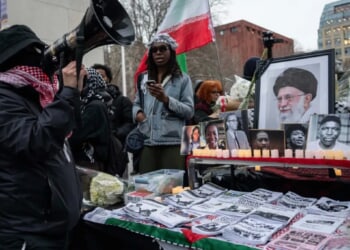
The UN Human Rights Council on Friday passed a motion extending an independent probe into human rights abuses in Iran and called for an urgent inquiry into the violent crackdown by authorities on protesters.
The session was held at the request of Iceland, Germany, North Macedonia, Moldova, the UK, and Northern Ireland, following weeks of repression in Iran. Cuba, Pakistan, Egypt, and China opposed the proposal, prompting a vote. The request was supported by 21 member states and 30 observer states.
Sara Hossain, chair of the Fact-Finding Mission on the Islamic Republic, told the UN Human Rights Council that witness testimonies and digital evidence pointed to “severe” human rights violations in Iran, including the use of torture, sexual violence, and the broadcast of forced confessions on state television….
Anne Herzberg, a prominent human rights lawyer and UN representative for NGO Monitor, told The Jerusalem Post that the UN Human Rights Council’s failure to meet for weeks was a notable contrast to how quickly the council convened to discuss flare-ups in the Israeli-Palestinian conflict.
“The council is always immediately ready to act, yet when we have a murderous regime that routinely abuses human rights, killing thousands and thousands of protesters in the street and completely blocking out their Internet, it took weeks for the council to even hold a session,” she noted….
Ali Bahreini, an Islamic Republic representative at the UN, has asserted both that the regime does not recognize the session’s legitimacy or its outcome, and that of the recognized 3,117 people killed in the unrest, 2,427 were murdered as a “direct result of terrorist operations.”
In fact, Western observers and Iranians in exile with contacts inside Iran believe the numbers of Iranian casualties are far larger. They suggest that up to 30,000 Iranians may have been killed, and 330,000 wounded in the more than three weeks of protests. And, of course, they were not murdered or wounded by “terrorist operations” directed by America and Israel, as Iran preposterously claims, but by the Islamic Revolutionary Guards Corps, the Basiji, and the Iranian military.
The Iranian representative also strongly rejected that the session was held out of concern for the Iranian people, arguing that if the council had cared about civilians, it never would have “imposed inhumane sanctions” nor have “supported Israel’s war of aggression” in June.”
Those so-called “inhumane sanctions” that the United States imposed on Iran were designed to weaken the power of the “inhumane” regime that for 47 years has made the lives of Iranians miserable. As for the Iranian representative’s claim about Israel’s “war of aggression,” that 12-day war in June 2025 was in response to fears that Iran had enough uranium enriched to just below weapons-grade, and thus was getting close to manufacturing a nuclear weapon, that everyone knew would be used to threaten Israel, and was also launched to prevent Iran from building a formidable arsenal of ballistic missiles. In both war aims, it was successful.
The regime official claimed that Tehran supported people’s right to protest in response to economic turmoil but that the protests evolved from January 8-10 into violence. Terror attacks, property destruction, and armed attacks on both civilians and law enforcement forced restrictions, the representative alleged.
No, Iran did not support the people’s right to protest; it at once came down hard, using violence — live fire — on those nonviolent protesters, and it was only after protesters had been killed in large numbers that the protests themselves became violent.
Iran’s allies reject UN intervention on Tehran’s human rights violations, continue to point fingers at Israel.
Those allies include Iran’s fellow despotisms Russia and China.
Those arguing in support of the regime argued that Tehran was capable of restoring social order, investigating accusations of human rights violations, and claimed that UN intervention was unnecessary. Some of those backing Iran, and denying either the legitimacy of the UN council or the legitimacy of concerns which led to the meeting, accused the UN of double-standards and took the opportunity to condemn Israel’s strikes against Iranian nuclear sites and personnel in the June war.
Has real “social order” been restored in Iran? Only in the sense that millions of people in Iran are now too afraid to go out on the streets, where they fear that the regime will kill them. That is the “social order” that prevails in a concentration camp.