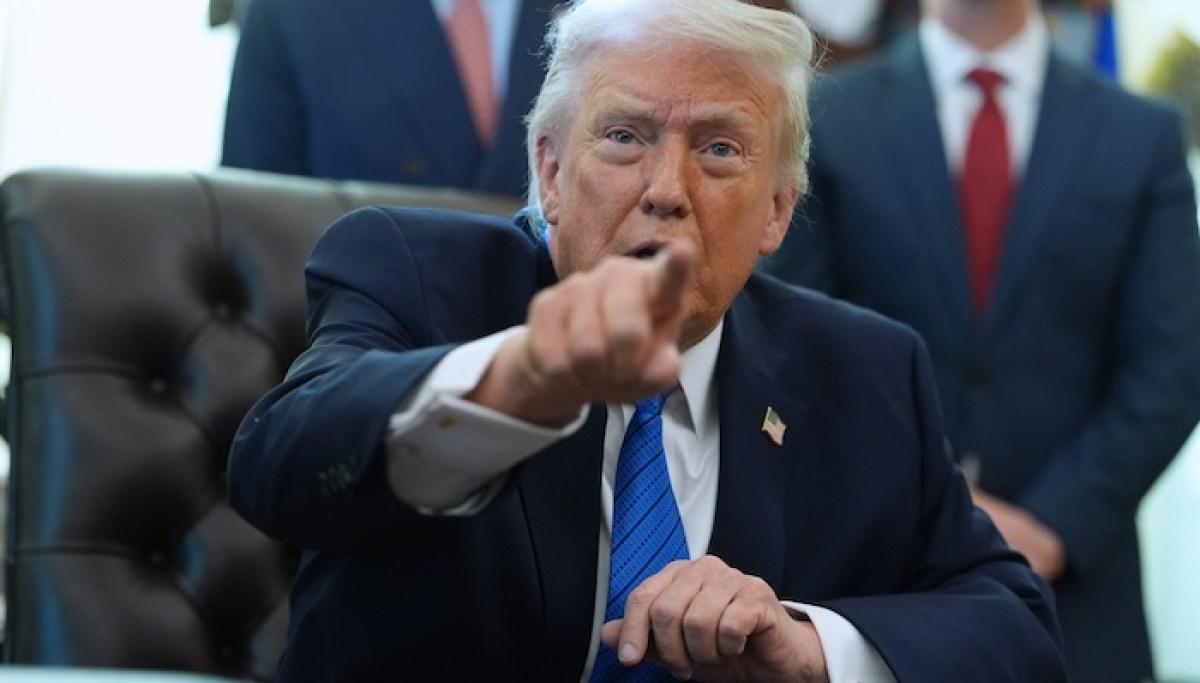
President Donald Trump’s actions during his first year back in office show he has developed a playbook for handling adversaries.
Once a national security threat is identified, he will lean into diplomacy while simultaneously amassing nearby military forces in case of a lack of progress in negotiations. Trump will also push for a diplomatic resolution while threatening military intervention if that fails, ensuring the other party knows that’s a real possibility if they don’t comply.
That playbook is currently playing out with regard to Iran, was on display late last year with Venezuela, and was even evident ahead of last year’s strikes on Iran’s nuclear facilities. However, any military operation carries inherent risks.
“I think one of the things one has to say about both [Operation] Midnight Hammer last year and the capture of [former Venezuela dictator Nicolas] Maduro is that they were enormously impressive militarily. They were completely successful militarily, and we all want [Russian President Vladimir] Putin and [Chinese President] Xi Jinping to learn a lesson from that about the American capabilities,” Elliott Abrams, who served as Trump’s special representative for Iran during the president’s first term, told the Washington Examiner. “But the question you have to ask is, ‘Does the president over-learn a lesson?’ That is, does he realize that not every — it’s the law of averages. Not everything is going to be perfect.”
Trump said on Wednesday that “a massive armada is heading to Iran,” and that he hopes “Iran will quickly ‘come to the table’ and negotiate a fair and equitable deal.” Trump also warned that “time is running out” and if they don’t make a deal, “the next attack will be far worse!”
Trump, himself, did not provide specifics on what a deal would look like, other than that Iran cannot have nuclear weapons. Special envoy to the Middle East Steve Witkoff previously said such a proposal would have to include limits on their enriched uranium, long-range ballistic missiles, and support for their proxies in the region.
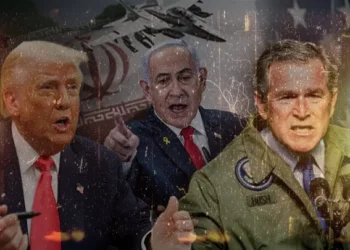
As Trump threatens a more significant U.S. military operation than the one conducted last June, targeting three of Iran’s nuclear facilities, Iranian officials have warned recently that a new U.S. attack would result in a stronger response as well.
It’s unknown whether there will be a diplomatic off-ramp for the governments in Washington and Tehran, and what exactly will play out if not. But Trump has shown that tapping him along with negotiations can lead to action.
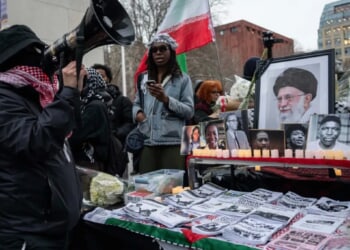
This renewed U.S.-Iranian pressure initially began when Trump threatened to intervene militarily after Iranian forces began cracking down on protesters who had taken to the streets to oppose the regime. Iranian government officials said there were roughly 3,100 deaths, though human rights organizations say that total is a significant underestimation.
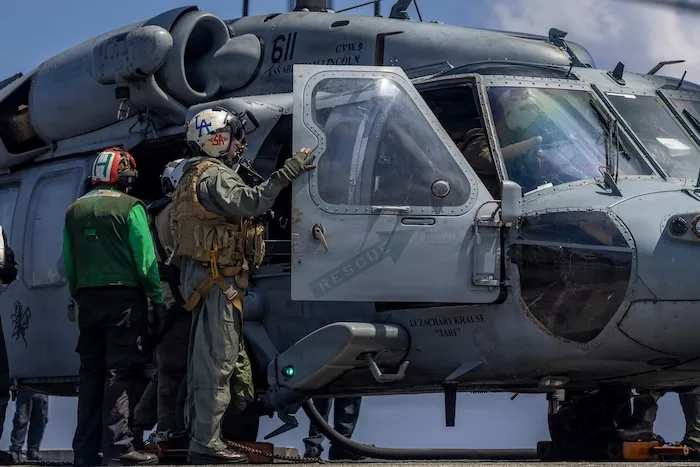
Trump had warned that “help is on the way,” but that hasn’t yet come to fruition, and the protests have largely been squashed.
In April 2025, the president gave Iran a 60-day ultimatum to agree to a deal on its nuclear program, warning that if the two countries didn’t come to a deal, the United States could target those facilities. The U.S. had a significant military presence in the region at the time, and Israel launched the opening salvo in what ultimately became known as the 12-day war, one day after that 60-day time period ended.
“Two months ago I gave Iran a 60-day ultimatum to ‘make a deal.’ They should have done it! Today is day 61. I told them what to do, but they just couldn’t get there. Now they have, perhaps, a second chance!” Trump said in a post on Truth Social that day.
Even after Israel had already attacked Iran, and Tehran subsequently retaliated, Trump maintained that he would make up his mind on whether to join the war within two weeks, citing the “chance for substantial negotiations,” he said. The U.S. bombed three Iranian nuclear facilities two days later.
The president largely applied the same playbook to Venezuela in late 2025. The military sent several naval assets to the Caribbean, where they began carrying out lethal strikes on vessels they had identified as drug smugglers. Amid those operations, the president spoke about the need for Maduro to stop enabling the cartels, which he was accused of leading, and work in line with U.S. interests.
Maduro ultimately was an “impediment to progress” and had refused to make a deal with the Trump administration, Secretary of State Marco Rubio told lawmakers on Wednesday. It left the president with one option — a mission to capture the dictator.
“This was one option that was available to the president after exhausting every other option,” Rubio said.
Multiple U.S. forces were injured in the mission, while dozens of locals, who were either Venezuelan or Cuban, were killed. Maduro, who refused U.S. demands, now awaits trial while sitting in a New York prison.
“I think it’s very clear the president has been emboldened by Venezuela, and that, you know, he has under his belt now, at least in his mind, a success with respect to Maduro. Whether that is informing how he views Iran or not, in a way, is less important, because certainly the Iranians also see this, and I think this is also heightening tensions,” Mona Yacoubian, a senior adviser at the Center for Strategic and International Studies, told the Washington Examiner.
A similarity between Operation Midnight Hammer and the Maduro capture is that both were one-off, hourslong missions that occurred in one night. There were no ground forces present or extended operations.
RUBIO: ‘NO ONE KNOWS’ WHO WOULD TAKE OVER IF IRAN’S SUPREME LEADER IS REMOVED
Rubio also noted that while the administration does not anticipate further military operations in Venezuela, there is still a possibility it could happen if the government in Caracas doesn’t cooperate with American interests.
“I can tell you right now with full certainty, we are not postured to nor do we intend or expect to have to take any military action in Venezuela at any time,” Rubio said during the hearing. “The president does reserve the option in self-defense to eliminate that threat.”