Order Jamie Glazov’s new book, ‘United in Hate: The Left’s Romance with Tyranny, Terror, and Hamas’: HERE.
When European leaders took the stage at the World Economic Forum this year, the language was familiar: partnership, shared values, transatlantic unity. What was conspicuously absent was memory. Not nostalgia, not sentiment—but memory. Because when it comes to America’s role in Europe’s survival, prosperity, and security, much of today’s European political class behaves as if history began yesterday.
That selective amnesia is now colliding with reality over a place most Europeans rarely think about at all: Greenland.
The uproar over American interest in Greenland—framed as aggression, arrogance, or neo-imperialism—reveals less about U.S. intentions than about Europe’s failure to reckon honestly with the unpaid debts of history. Greenland is not a conquest fantasy. It is a sparsely populated, strategically vital landmass sitting on the North American continent, commanding Arctic routes that will define twenty-first-century security. And for most of the modern era, it has been protected not by Europe, but by the United States.
That fact did not begin with recent geopolitical tensions. It began in World War II.
In 1940, Denmark collapsed under Nazi occupation. It did not liberate itself. It did not defend its overseas territories. When Denmark fell, the United States assumed responsibility for Greenland’s defense—not out of opportunism, but necessity. Washington understood something Europe seems to have forgotten: geography does not care about sentiment. Greenland mattered then for Atlantic security. It matters even more now.
And that was only one chapter in a much longer ledger.
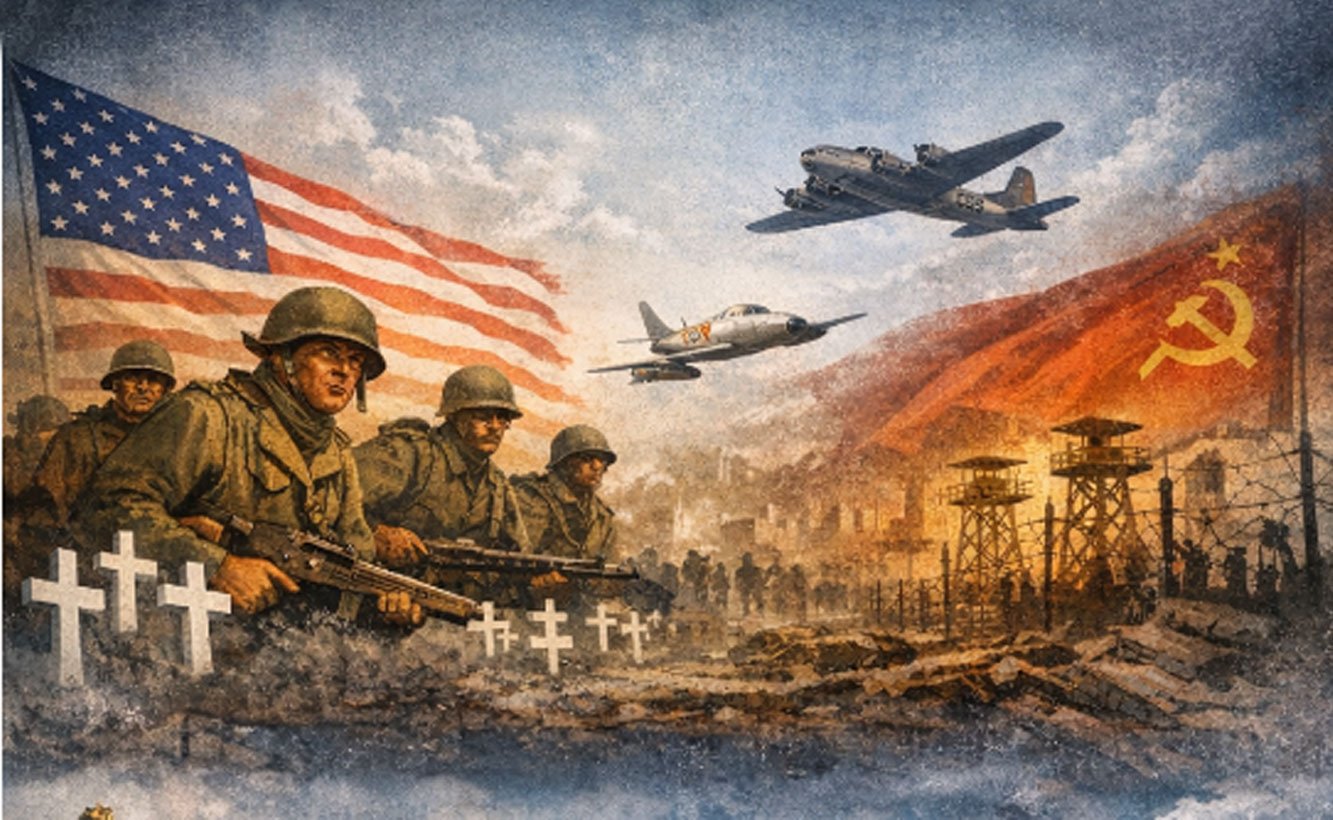
Europe did not merely benefit from American involvement in World War II—it survived because of it. Hundreds of thousands of American servicemen died fighting across Europe, from Normandy to the Ardennes. Their graves still line the continent. After victory, the United States rebuilt former enemies instead of dismantling them, launched the Marshall Plan, and chose reconciliation over vengeance. Then, for nearly half a century, America stood watch against Soviet expansion, absorbing the costs of deterrence so Western Europe could rebuild, prosper, and debate philosophy rather than survival.
This was not a temporary favor. It was a generational commitment.
Against that backdrop, the current outrage over Greenland is striking. Here is a territory with roughly thirty-two thousand inhabitants, culturally distant from Copenhagen, economically reliant on external support, and strategically indispensable in an age of Arctic militarization. And yet, when the United States signals interest in ensuring its long-term security alignment, Europe responds not with discussion or gratitude, but with indignation.
The irony is difficult to miss. Europe has spent decades urging the United States to shoulder global security burdens—only to recoil when American strategic interests intersect with European complacency. The same leaders who warn about Russian aggression and Chinese expansion suddenly discover a fierce attachment to sovereignty when American power seeks to stabilize an obvious vulnerability.
This is not about “buying land.” It is about responsibility.
For eighty years, American power has underwritten European stability. That arrangement was never unconditional, but it rested on an implicit understanding: the United States would defend Europe, and Europe would act as a partner rather than a client. Increasingly, that understanding has eroded. NATO obligations are treated as suggestions. Defense spending is deferred. Moral lectures replace material commitments.
Greenland exposes that imbalance with uncomfortable clarity.
Had the United States not intervened in the twentieth century—twice—Europe would not be hosting conferences about global governance. It would be living under regimes that did not permit such discussions. That is not rhetorical exaggeration; it is historical fact. And yet today, American leadership is greeted less with acknowledgment than with suspicion, as though the guarantor of Europe’s security were an intruder rather than its architect.
None of this means Greenland’s future should be dictated unilaterally. But it does mean the conversation should begin from honesty, not posture. Greenland’s security has never been provided by Denmark alone. It has been guaranteed by American reach, logistics, and deterrence. Pretending otherwise does not assert sovereignty; it denies reality.
The deeper issue is not Greenland at all. It is Europe’s growing habit of outsourcing responsibility while resenting the power that makes such outsourcing possible. That posture is unsustainable. Strategic competition is returning. The Arctic is no longer peripheral. And moral debt does not expire simply because it is inconvenient to acknowledge.
History does not demand repayment. But it does demand recognition.
If European leaders wish to speak the language of partnership, they must first remember the terms on which that partnership was built. Gratitude is not submission. Cooperation is not conquest. And acknowledging America’s role in Europe’s survival is not an insult to sovereignty—it is a prerequisite for seriousness.
Greenland is a test. Not of American ambition, but of European memory.
And the most troubling answer Europe seems poised to give is this: how soon they forget.
Aaron J. Shuster is a cinematist, writer and essayist whose work focuses on history, moral philosophy, and geopolitics. He writes frequently on the intersection of power, memory, and responsibility in Western civilization.