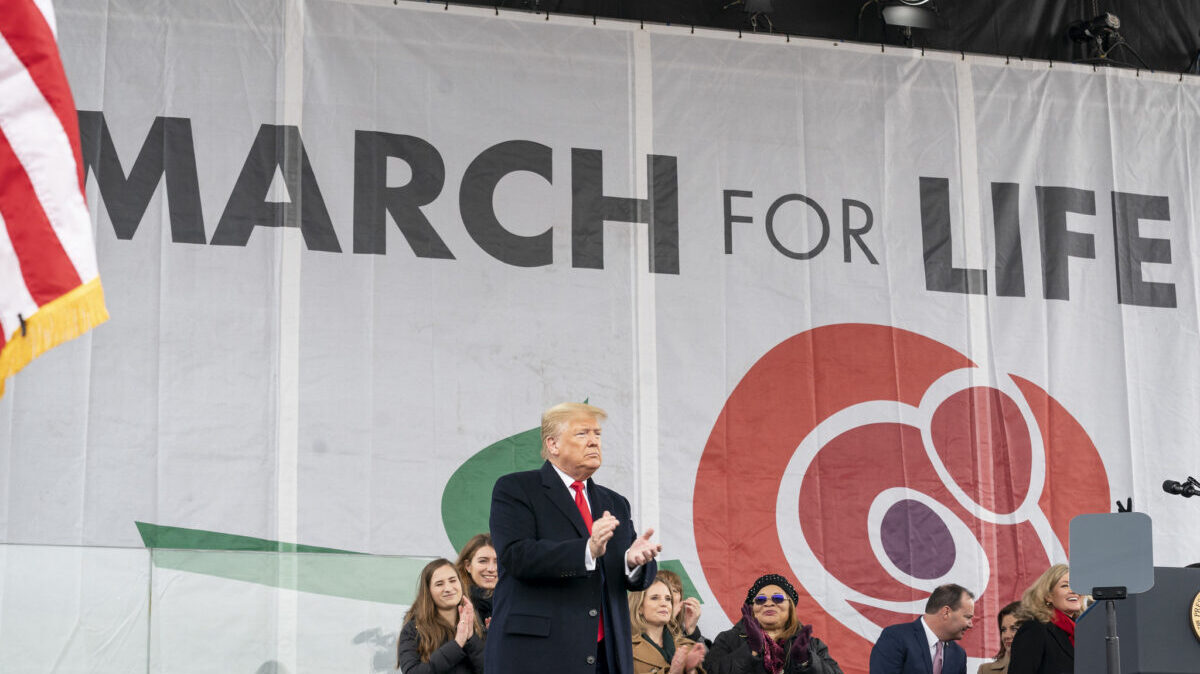
Last week, the March for Life, the annual pro-life rally in Washington, D.C., announced that Vice President J.D. Vance would be speaking at the event. One would think this support and attendance by one of the most powerful politicians in the country would be an unequivocally positive thing. The mission of the March for Life is “uniting, educating, and mobilizing pro-life people in the public square,” bringing together Catholics, Protestants, non-Christians, and even secular opponents of abortion. In 2020, President Donald Trump (hardly the typical model of pro-life advocacy and Christian living) became the first sitting president to attend the march, stating that “[w]e’re here for a very simple reason: to defend the right of every child born and unborn to fulfill their God-given potential.” If powerful politicians are interested enough to attend the event and support the cause of life, one would think Vance’s attendance is a win for the pro-life movement.
But it is not that simple. There is a serious divide among pro-lifers concerning the Trump-Vance administration. The divide is based on a fundamental question: Should pro-life conservatives back off the abortion issue because there is no political ability at the federal level to restrict abortion? Or does being pro-life require maximalist stances on abortion restriction, regardless of whether those efforts have any chance of success?
On one hand, pro-life organizations such as Catholic Vote have thrown in their lot with the Trump-Vance political movement. And for good reason: nearly all American institutions are controlled by the left, which has gotten so extreme that not only is its platform categorically hostile to traditional Christian values, but the 2024 Democratic National Convention set up a Planned Parenthood mobile clinic outside to administer free abortions and vasectomies. Opposed to this seemingly demonic modern Democrat Party, the Trump-Vance Republican Party is at least making moves to dislodge the left from American institutions and restore sanity. Faced with these options, isn’t the political choice for pro-life Christian voters obvious?
Pro-life Critics of the Current Administration
On the other hand, voices such as Peter Laffin claim that the Trump-Vance administration is “the most anti-life Republican administration in history.” The argument seems to be that, even if Trump-Vance is the lesser of two evils, the current administration relies on the pro-life vote but has voiced support for the abortion pill and IVF, signaling that Trump and Vance take the votes of pro-life Christians for granted and aren’t going to do much of anything to restrict abortion.
The pro-life critics of the current administration are right about something: it is never acceptable to support what is evil. It is politically prudent for the current administration to say something like “every abortion is the taking of an innocent human life. This is a sin, a tragedy. But as we look at the numbers, a shockingly high number of the American people do not agree that abortion should be banned at the national level. There is nothing we should do at the federal level to restrict abortion given the current culture.”
Unfortunately, the Trump-Vance platform has gone beyond stating that there is no political appetite for abortion restrictions. Vance has said, for example, that he and President Trump support the Supreme Court’s decision to allow access to the abortion medication mifepristone. This might sound like a semantic issue, but it is not. Inaction is not the same as support. It is simply never acceptable to support a moral evil like abortion, even if it is prudent not to take action against it in some circumstances.
This matters because, to most Christian conservatives like myself, Vance is the best hope of the post-Trump Republican Party. This thesis is the reason I published my recent book JD Vance and the Future of the Republican Party. We need to ensure that Trump’s successor is a fighter who will continue to advocate for a Republican Party that emphasizes a pro-worker, pro-family environment at home and peace abroad. That means ensuring that the pre-Trump neoconservatives do not succeed in reestablishing control of the GOP. All this means conservatives need Vance to succeed Trump.
While I admire nearly everything about Vance’s politics without reservation, his messaging on abortion has been the one exception. I hope and pray that he realizes that, as one of the most powerful political voices in the world, prudence on the abortion issue still means using the bully pulpit to tell the world that abortion is wrong.
Worsening Political Realities
Abortion is always the murder of an innocent unborn baby, a tragedy and a crime. But pro-life policy purists need to face up to worsening political realities.
First, Roe v. Wade is now dead and that changes the political landscape entirely. Before the Supreme Court’s decision in Dobbs overruled Roe v. Wade (thanks to three Trump-appointed Supreme Court justices), there was no risk for Republican politicians being outspoken against abortion. There was no need to do anything because Roe had constitutionalized abortion as a so-called right. Republicans could posture to the pro-life Christian base, demand abortion bans, and fundraise on the issue. There was no risk that anyone would have to take a vote, because legislative restrictions on abortion were off the table. Dobbs completely changes the equation by making abortion a real political issue.
Second, politics in a democratic republic involves facing the reality of where the culture stands on an issue. The number of people who unequivocally believe that abortion should be banned is quite low. A 2024 Pew Research study found that only 57 percent of Republicans believe abortion should be illegal in most or all cases. Let that sink in. While it might be possible to garner majorities for restrictions on the most egregious forms of abortion (partial-birth abortions or third-trimester abortions), there is barely even a majority among Republican voters who support serious abortion restrictions.
Until the culture changes and the minds and hearts of voters are converted in massive numbers, Republican politicians on the national stage boldly advocating for abortion restrictions will bring about, not greater pro-life policies, but only electoral defeat. With that, Republicans would lose ground on many other less important issues.
I agree that the murder of the unborn is the central moral crisis of our time. But I need to understand how politicians speaking and acting “more pro-life” will do anything other than lose elections.
As I argue in my new book, it is unfair and imprudent to insist on an unabashedly anti-abortion policy stance when there is so little political appetite for such policies. Bold advocacy for abortion bans, for restriction of the evil abortion pill, or for an end to IVF will not result in fewer abortions. It will only result in political failure.
Trump appointed the justices that overturned Roe v. Wade. The Trump-Vance administration pardoned many pro-life advocates prosecuted for violating the FACE Act in the very first week of the administration. The likely Republican candidate for president in 2028 has agreed to speak at the March for Life this week. Perhaps pro-lifers need to realize how little political power the movement has in a deeply anti-life culture, and to take the modest wins for life that this administration can offer.