Order Jamie Glazov’s new book, ‘United in Hate: The Left’s Romance with Tyranny, Terror, and Hamas’: HERE.
I moved to Norway from Amsterdam 27 years ago, and after a few months, when my language proficiency had increased to the point at which I could read newspapers and follow TV, I learned that one thing was exactly the same as in the Netherlands: the issue of Islam was almost entirely ignored in the media. I discovered, however, one significant exception: a prime-time debate program called Holmgang, which aired every week on TV2 and which occasionally featured heated discussions about immigration, Islam, and integration. At the end of each episode, viewers were invited to call in and register their vote on the question of the day. One evening the question was: “Is radical Islam a threat to Western values?” An overwhelming number of callers voted yes. It wasn’t a scientific poll, but the results made headlines. And they made at least one man hopping angry.
That man was Abid Q. Raja, who had been born in Norway to immigrants from Pakistan. After studying law at the University of Southampton and Oxford, he became a celebrated Oslo lawyer and, in the Norwegian media, a walking symbol of the purported success of Islamic integration. At the same time he worked as the official spokesman for the World Islamic Mission in Oslo, where, during his tenure, an imam was covertly recorded by a journalist saying, among much else, that non-Muslims are immoral and their marriages invalid. Meanwhile Raja wrote angry op-eds defending arranged (read: forced) marriages, among other appalling practices. And when Holmgang, that oasis in the Norwegian media, actually treated Islam as the problem that it was, Raja went ballistic, insisting in an op-ed that the host of Holmgang be fired.
He was. In fact Holmgang was canceled. The year was 2008.
For a while there, it felt as if the Islam issue had moved to the back burner. In 2011, after Anders Breivik murdered 77 people in Oslo and on a nearby island, supposedly in response to the nation’s high levels of Muslim immigration, politicians and the media alike sought to use this atrocity to silence all criticism of Islam. For a while the issue remained untouchable. Meanwhile, Raja underwent a magical transformation. Claiming to have “evolved,” to have become more “liberal,” and to have learned to believe in “dialogue,” he was elected a deputy member of Parliament in 2009, became a full MP in 2013, won re-election and became vice president of Parliament in 2017, and in 2020 was named Minister of Culture, gaining control over such powerful institutions as the Norwegian Broadcasting Corporation (NRK), Arts Council Norway, and the Norwegian Film Institute. By this point, Raja was treated consistently as Norway’s model Muslim par excellence; given that his autobiography was the bestselling non-fiction book of the year in both 2021 and 2022, much of the public apparently fell for his new image. A quarter-century ago, I said he’d be Norway’s first Muslim prime minister. I still think so.
How much things have changed in that quarter century! Since 2000, Norway’s population has risen modestly, from 4.5 to 5.6 million – but the number of Muslims has leaped from 56,000 to over 183,000. Other numbers have risen too – such as the number of gang crimes, rapes, and assaults on Jews. Hijabs, once confined to Oslo, can now be seen in the remotest hamlet. And there have been terror attacks, which are dutifully reported on, then dropped down the memory hole. And none of these developments causes any serious re-evaluation of immigration policy.
What’s scary is that in this quarter century, a generation of young Norwegians has grown to adulthood in a society in which hijabs, and even niqab, are part of the landscape, a society where the Overton window has shifted to include the acceptance of forced marriages and of gender-segregated audiences and to all but exclude those who criticize Islamic teachings on egalitarian and secular grounds. They’re used to it. They’ve never known anything else. Their brows furrow at any criticism of what, to them, is simply the way things are. Yes, they still wave the flag lustily on Constitution Day (May 17) and still believe in freedom of speech; yet they can tolerate as their current Minister of Culture Lubla Jaffery, a woman of Pakistani parentage who, when it was announced last year that Facebook would cease censoring conservative views, laid viciously into Mark Zuckerberg.
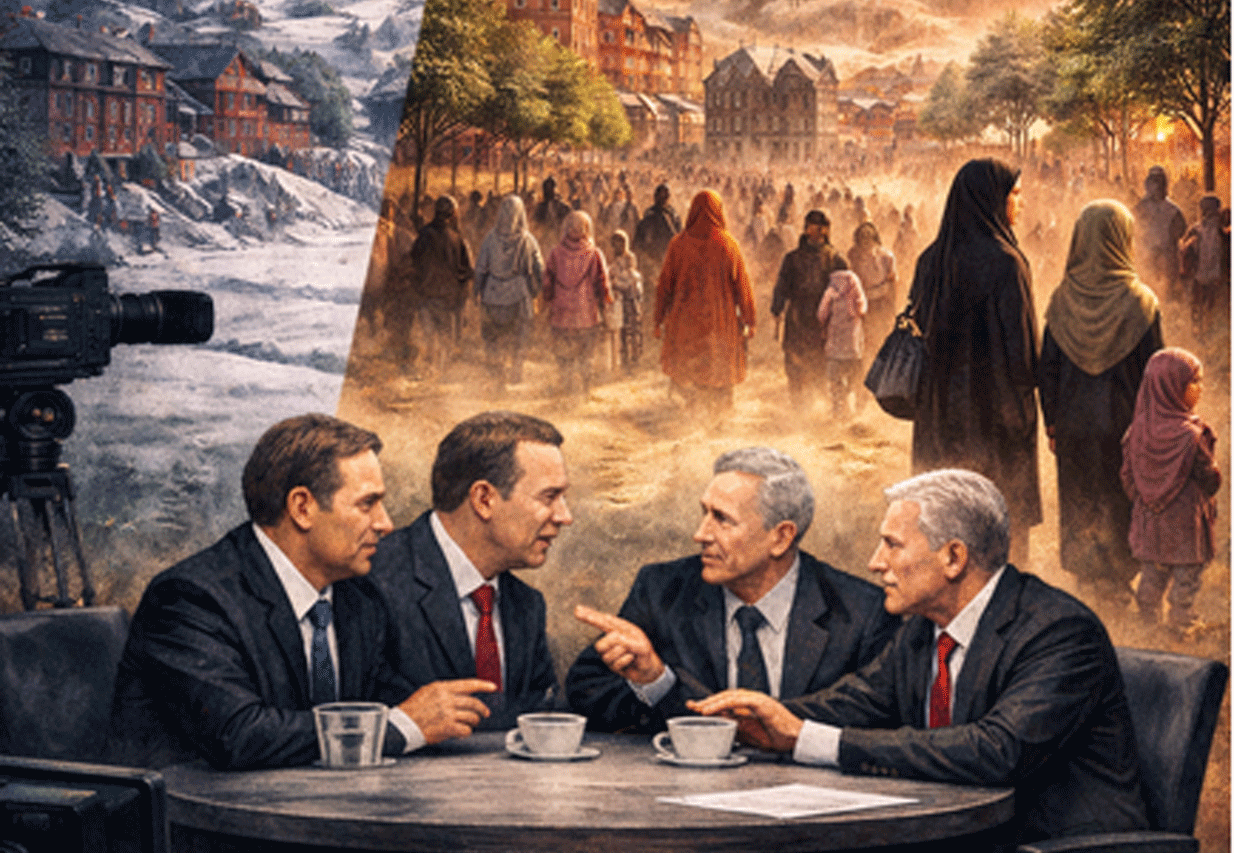
No, the immigration debate hasn’t died. Since 2010, NRK has broadcast a twice-weekly program called Debatten. On January 13, its topic was “Does immigration threaten Norwegian culture?” Yes, the same topic that got Holmgang in hot water eighteen years ago. The entire show sent my déjà vu soaring. Yes, there were minor differences: the Labor Party, which used to savage the Progress Party for opposing mass immigration, now largely agrees that there’s a problem. And the idea of deporting immigrants, at least illegal or criminal ones – an idea that was once verboten – is now actually discussed.
But that’s the key word: discussed. There’s not much action, but there’s plenty of talk. While mass immigration and high reproduction rates cause the number of Muslims to grow apace – placing ever more difficult burdens on the schools and health care and the welfare system and the police departments – politicians go on TV and talk about it. And they say pretty much the same things they’ve always said. On Debatten the other night, you could hear Eivind Trædal of the Green Party declare: “In my lifetime, we have had a lot of immigrants in Norway. And during that period, Norway has become a safer, richer and actually a much cooler country. We should also thank the immigrants for that.” I’ve been hearing this same hogwash – Islam is a cultural enrichment! – for 27 years. Sylvi Listhaug of the Progress Party, for her part, criticized Islam’s honor culture, the rise in street crime and anarchy in the schools, and all the other downsides of mass Islamic immigration that people like me have been jawing about for decades.
In short, la plus ça change. After watching that episode of Debatten, Rita Karlsen of Oslo’s Human Rights Service commented that it had proven one thing: namely, that “the only thing that exists in immigration policy is precisely the debate.” Bingo. And it’s not just true of Norway. Yes, there’s progress on the Islamic front here and there in Europe, such as the rise of Georgia Meloni, the Sweden Democrats, and Alternative for Germany. But there’s also too much of the same old talk. God bless Geert Wilders and Tommy Robinson for their inspirational speeches, but for heaven’s sake, when will these heroes be put in positions in which they can actually do something?
Some of us saw the Reform Party in England as a beacon of hope for real change; the other day it put up a Muslim woman as its candidate for Mayor of London. Like a number of her fellow European politicians, she’s a smooth talker, saying all the right things about immigration and integration. But she’s a Muslim. Honestly, whom is she kidding? How long does this game go on? And how many of these master debaters have reflected on the fact that debate can become an addiction – that doing nothing but talking about an issue for years, endlessly repeating the same ragged talking points, can, in the long run, be paralyzing, rendering real action almost impossible? Not to mention the fact that it puts people like me into the idiotic position of talking too much about too much talking.
Yes, the Islamization thing is worse in Sweden. And Britain. And, well, Germany and France and Belgium and the Netherlands. As for Ireland, which the day before yesterday was a Catholic stronghold, it’s bowed down to Islam in a way that seems beyond pathological. But when it comes to the utter preeminence of talk, the near-sacralization of it, Norway, I would argue, takes the prize. It’s here in the land of the fjords that the politicians are most uniformly possessed by the conviction that dialogue – if pursued with infinite patience over, if necessary, an infinite period of time – can resolve any human dispute, however difficult, and usher in a world of eternal harmony. Most ordinary Norwegians, thank goodness, don’t buy this line, but it can be damned hard to resist when it’s in the air, pumped out by the media on a daily basis. Which is why, even as Islam sinks its wily roots deeper and deeper into the hardscrabble Norwegian soil, the response to it here is, for the most part, nothing but talk, talk, talk, year in and year out. And too few members of the Norwegian public seem to be getting as sick of it as they should.
Which – in a time when Donald Trump is showing that so many terrific, previously unimaginable things can be made to happen with a previously unimaginable speed – is maddening as hell.