Order Jamie Glazov’s new book, ‘United in Hate: The Left’s Romance with Tyranny, Terror, and Hamas’: HERE.
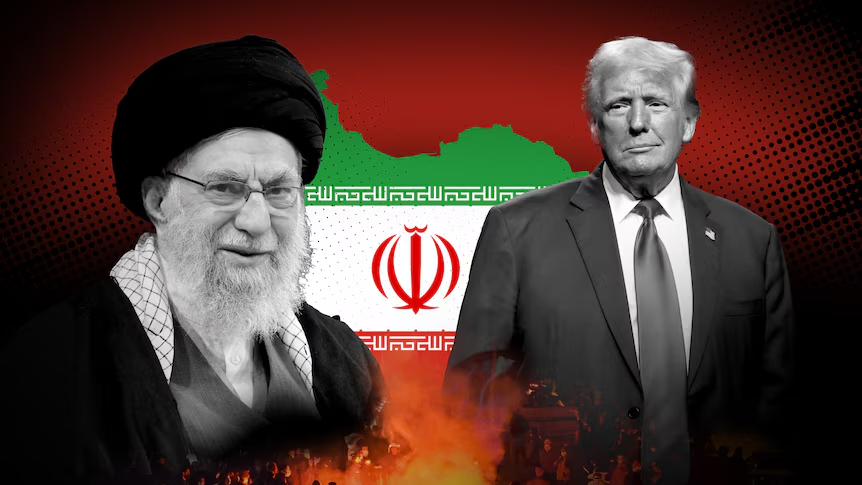
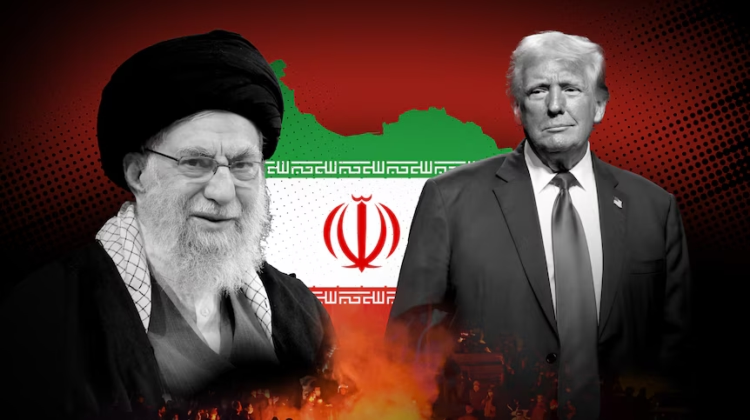
For nearly half a century, the theocratic leaders of Iran have waged war against the “infidel” West, especially the U.S. and Israel, dubbed the “the big Satan” and “the little Satan.” The Mullas’ malign intentions have been easy to read by their support for terrorist foreign proxy forces aimed at both enemies. Since its creation, Iran’s Mullas and their proxies with impunity have bathed their hands in American blood, as well as the blood of their own citizens. And their efforts to possess nuclear weapons, stopped for now by Donald Trump, were met by the West with useless diplomatic theater.
How is it that the country with the most powerful military in the world has let a pygmy rogue state serially murder its citizens for nearly 50 years, and thwart its interests and endanger its national security? By appeasing, feckless policies starting with Jimmy Carter and his “rules-based international moralizing” idealism, and continued by Barack Obama. Not until Donald Trump was elected president, have those blunders by Carter and Obama begun to be corrected.
Many other foreign policy missteps contributed to the loss of Iran from our side of the Cold War. One is the debacle of Vietnam, when the U.S. won the war only to lose the peace; and the other is what Henry Kissenger called the “disintegration of the CIA” that left an intelligence vacuum in Iran. The first led to a failure of national nerve known as the “Vietnam syndrome,” a political pacifism that privileged diplomatic engagement, civilizational self-loathing, and fear of using force to support a critical Cold War ally.
Carter’s moralizing foreign policy damaged our country’s deterrent power, as the Iran crisis illustrated. He also promoted the “power” of principled example over force to persuade other nations, especially our sworn enemies. Human rights, a principle of the West, was projected as a universal good, as was our Constitution. Another Western ideal, disarmament, similarly was considered universal.
These became the foundations of Carter’s foreign policy, along with acceptance of America’s limitations and guilt, predicated on the fiasco of Vietnam and the alleged depredations of the C.I.A. both at home and abroad, leading to what Kissinger called the agency’s “disintegration.”
Carter’s speeches disseminated these weak dicta around the world. In his inaugural address, for example, Carter acknowledged the nation’s “recent mistakes,” counseled Americans not to “dwell on remembered glory,” and reminded his fellow citizens that “even our great nation has its recognized limits” and can “simply do its best.” Not exactly a rousing way for a leader to fire up confidence in the citizens.
This self-loathing and hesitancy about American’s greatness was doubled-downed a few years later in the famous “malaise” speech, which insisted the country’s “commitment to human rights must be absolute,” and at the same time scolded that “we will not behave in foreign places so as to violate our rules and standards at home.” Surely our guiding principles should be ensuring our national security and pursuing our national interests, not reducing the world’s armaments rather than our enemies’ as Carter proposed.
Equally dangerous was Carter’s CIA Director Stansfield Turner’s fulfillment of Carter’s idealism. As Arthur Herman observed, “secrecy as well as human intelligence was passé; openness was the new catchphrase.”
Covert action and counterintelligence were abandoned or severely reduced rather than developing human intelligence assets. Herman added, Turner “concentrated on technical intelligence assets and attempts to run the intelligence community, ruthlessly disbanding what remained of the clandestine service,” and firing 1300 covert officers––a change that would reveal Carter’s fecklessness when the Iranian Islamic Revolution broke out, and our intelligence was lacking important information about the Ayatollah Khomeini, and the Islamic religious foundations of the revolt.
On top of that failure of imagination, the adherence to the “rules-based order of international moralism,” and Carter’s quasi-pacifism, the President’s foreign policy team seemed to lack any knowledge of Islamic doctrines and history.
The first consequence, as co-authors Michael Ledeen and William Lewis wrote in “Debacle: The American Failure in Iran”: “Throughout the whole crisis, the Americans were hobbled by their own doctrines. To supply the Shah was viewed in many quarters as a betrayal of Carter’s human rights campaign, especially if the Shah used American support as an excuse to deploy lethal military force against his enemies. But to permit the Shah to be toppled was a geopolitical risk of vast dimension.”
Moreover, the Iranian revolutionaries assumed from these moves that the Americans were abandoning the Shah just as they had cast aside the South Vietnamese.
Rather than basing their strategy on the tenets and practice of Islam, Carter’s team relied on the anticolonialism Cold War narrative in which the United States supported neocolonialist oppressors like the Shah who denied their people human rights and political agency. Carter’s human rights goals were challenged by some of his advisors, but to no avail.
As Barry Rubins reported, “By mid-December [1978] the United States did not have any coherent policy nor was there even a system of coordination between the different policymaking groups. . . each step was dictated partly by chance, partly by the relative strength of various personalities in the policymaking groups.”
This ensured that Khomeini was running the show to achieve his jihadist religious purpose to “kill the infidel wherever you find him,” and protect Islam and the clerics from the Shah, whose “regime” according to Khomeini in 1963, “is fundamentally opposed to Islam itself and the existence of a religious class.”
In other words, the revolution was not about imperialism or oppression or a lack of human rights. It was about the Shah’s modernizing programs that were anti-Islamic, promoting foreign ideas such as a secular government, the emancipation of women and religious minorities, and the cultural and technological incursions from the infidel West.
In the end, Iran was lost to the free world––“a calamity,” historian Niall Ferguson wrote, “whose ramifications were and are incalculable.”
Carter’s handling of the Iranian Islamic Revolution quickly manifested the folly: The embassy hostages crisis ended with Carter paying the mullahs danegeld for their release; the earlier, ill-planned failed hostage rescue that left eight Americans dead, with a televised spectacle of mullahs gleefully poking the soldiers’ remains with their canes, and taunts of Carter from Khomeini; and Iran’s establishment of a terror proxy training camp in Lebanon’s Bekaa Vally, whence jihadist attacked the U.S. Marine barracks, killing 241 without any retaliation from the U.S.
These are just a fragment of the reckoning Iran still owes the U.S. Before Trump became president, Barack Obama had signed the U.S. up for the diplomatic groveling of the “Iran nuclear deal,” a de facto permission-slip and glide-path for the rogue terrorist nations to acquire nuclear weapons. Trump pulled the U.S. twice from this appeasement, and severely damaged the infrastructure the mullahs had already built.
But Iran is still a threat, and currently is brutally murdering its own citizens for protesting their leaders. Donald Trump has warned the clerical regime that “If Iran shots [sic] and violently kills peaceful protesters, which is their custom, the United States of America will come to their rescue.” The president also said on social media, “We are locked and loaded and ready to go.”
The President shouldn’t put off this threat any longer. The Washington Post has suggested many ways of following through on the threat. “Trump has military options to make good on his threats. A kinetic approach might involve bombing the bases that belong to security forces or directly targeting top government officials. It could be as simple as directing drones to take out paramilitary militias as they drive to violently put down protests.”
We should heed the advice that in 1938 Duff Cooper, First Lord of the Admiralty in his farewell speech after resigning Chamberlain’s cabinet in protest over his handling of Hitler at Munich: “The Prime Minister has believed in addressing Herr Hitler through the language of sweet reasonableness. I have believed that he was more open to the language of the mailed fists.” Iran is long overdue for a reckoning.