Republicans in so many ways have wasted their majorities in Congress over the past year. But the GOP has an opportunity to amp up its lackluster tenure with a second reconciliation package that its sponsors say will lower costs and cut the deficit by more than $1 trillion.
Of course, the devil is always in the details.
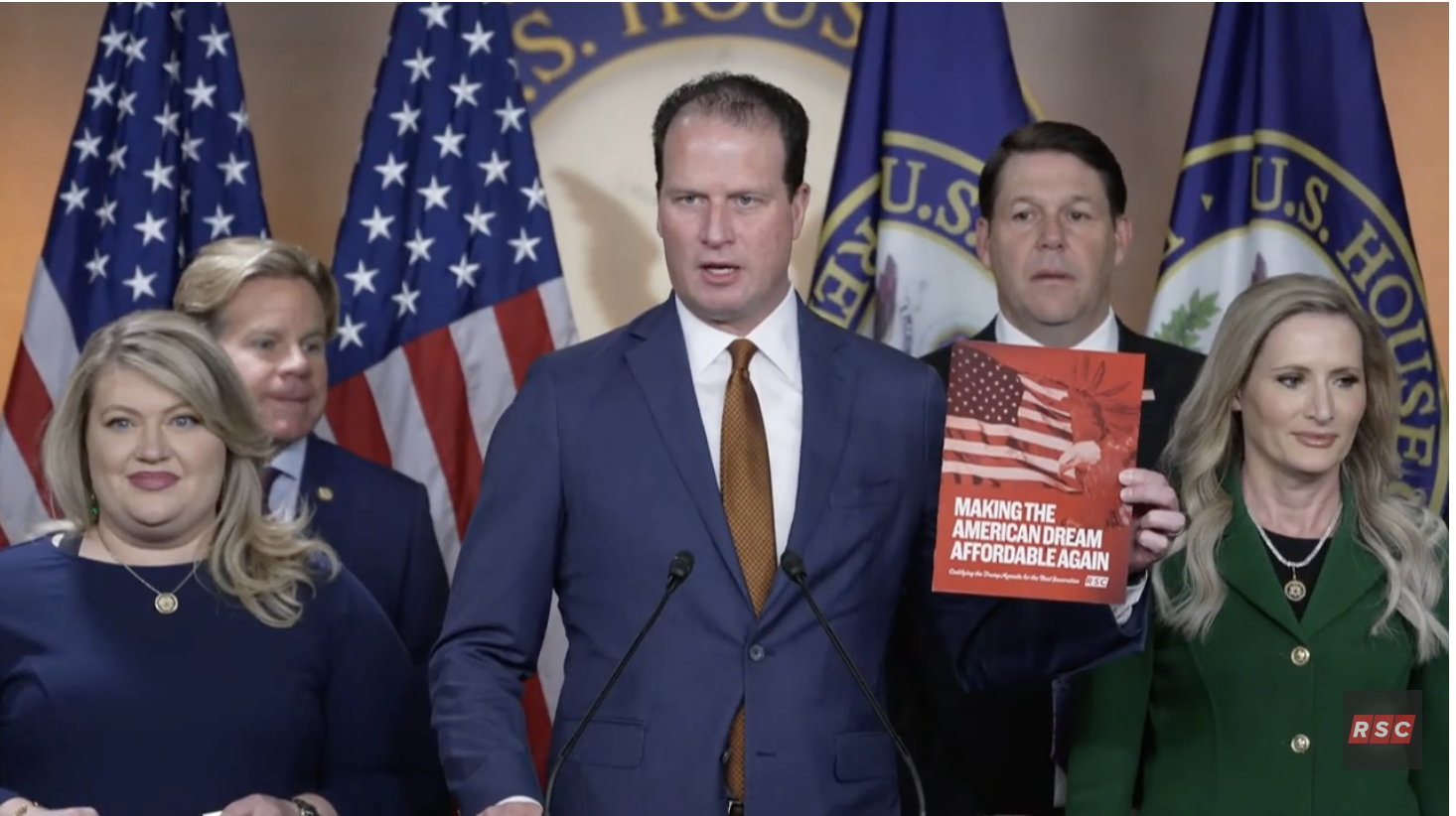
On Tuesday, Republican Study Committee members unveiled the Reconciliation 2.0 Framework, a proposal the lawmakers bill as a “comprehensive conservative roadmap” for the next reconciliation bill. The framework, its sponsors say, is aimed at affordability and codifying much of President Donald’s Trump’s America First agenda.
“There’s three major things that I think are threatening the American dream right now: housing costs, health care costs and energy costs,” said Republican Study Committee Chairman August Pfluger, R-Texas, at a press conference Tuesday.
‘This is Our Moment’
The proposal includes the “Don Payment” program, a zero-to-low-down-payment mortgage offering through the Federal Housing Administration for borrowers with good credit. On the healthcare front, the framework would reform the fraud-filled Obamacare subsidy structure and created federal Health Freedom Accounts. And the framework would codify the TrumpRx prescription drug program.
To cut energy costs, the lawmakers propose taking a bigger ax to regulations, speeding up burdensome permitting processes and tapping into newly opened Venezuela oil markets in the wake of the stunning capture of socialist thug Nicolas Maduro. The Republican plan would use “discounted Venezuelan oil” to help refill the U.S. Strategic Petroleum Reserve” that the Biden administration drained to 40-year lows.
As proposed, the framework would include several provisions aimed at clamping down on rampant fraud, like the welfare theft that has swept through Minnesota’s Somali community. Treasury Secretary Scott Bessent has compared the government benefits crimes to drug cartel money laundering, using many of the same schemes and shell companies.
The Republican Study Committee’s proposal introduces reforms to ensure only U.S. citizens are counted when federal welfare funds are allocated to states. Blue States have been big abusers of shifting funding streams to pay for their exploding illegal alien populations. Billions of dollars in transportation funds would be withheld from states and cities issuing driver’s licenses to illegal aliens, as well as jurisdictions breaking federal laws and “undermining the President’s effort to secure the border.”
Altogether, Republicans project the package would trim the federal deficit by more than $1 trillion.
“This is our moment to flip the script, restore balance for the American people, and put power back in your hands, not the bureaucrats, foreign nationals or illegal immigrants,” Abe Hamadeh, R-Ariz., a member of the Republican Study Committee leadership team, said at Tuesday’s press conference.
Pfluger said passage of a second reconciliation bill — like last year’s One Big Beautiful Bill (reconciliation proposal) would require just 51 votes to pass in the Senate, as opposed to the usual 60 — limiting the power of obstructionist Democrats. Pfluger and his fellow committee members noted the urgency of the moment in a midterm campaign year that will dominate congress and the headlines in the coming months.
‘Narrow Window of Time’
Hamadeh said he and his colleagues didn’t run for office “to continue the status quo.”
“We were elected to help President Trump to make America great again and with Reconciliation 2.0 and this framework we take another giant step towards that,” the Arizona lawmaker said.
But while Trump has been “flooding the zone” with 228 executive orders and 57 memoranda in the first year of his second term, it feels like the Republican-controlled Congress has squandered its golden opportunity thus far. Congress has codified some of Trump’s EOs limiting the growth of big government, including several in the Republicans’ signature legislative achievement, the One Big Beautiful Bill. But many pieces of Trump’s energetic agenda remain stalled thanks in large part to a flaccid majority.
“If we fail to pass legislation that permanently secures the border, addresses the affordability crisis, improves health care and restores law and order, we will lose this majority. And we will deserve it,” Rep Nancy Mace, R-S.C., wrote last month in a New York Times op/ed asking, “What’s the Point of Congress?” Mace, who is running for governor of the Palmetto State and who seems to crave attention like J.B. Pritzker craves fried foods, has a point.
As Mace noted, “no majority is permanent.” Something Democrats get. When they return to power, they will do what they always do: ram the most liberal bills through Congress. Of course, if Democrats take back control of the House, they will impeach Trump. If they take control of the Senate as well, they will convict him — of whatever TDS-riddled “crime” they come up with.
And Trump’s executive orders on everything from stopping DEI madness to “Unleashing American Energy” will surely be wiped out by the next Democrat in the White House.
So Republicans must act urgently, and they must give voters a reason to vote — a reason to give them another majority.
“We’ve got to get this done. We know we have a narrow window of time,” Pfluger said. “The American people gave us a mandate and we are not going to stand idly by, watching this time just pass. We’re going to take action.”
Will the old status quo guard let them?
Matt Kittle is a senior elections correspondent for The Federalist. An award-winning investigative reporter and 30-year veteran of print, broadcast, and online journalism, Kittle previously served as the executive director of Empower Wisconsin.