Walk through the streets of Washington, D.C., and you will notice a curious uniform: white AirPods or black noise-cancelling over-the-ear headphones. These accessories announce, before a word is ever spoken, do not approach.
We are living in the most connected era in human history, yet a recent study by the Chamber of Commerce ranked Washington, D.C., as the loneliest city in the country. That contradiction should give us pause. In a culture starved for community, why do we keep choosing tools that amplify distance?
Headphones were once a courtesy, a way to enjoy music on a commute without bothering others. Now, they have evolved into something else entirely, a social signal. They do not just say, “I am listening to something.” They say, “I am unavailable to you.” No eye contact. No small talk. No shared moment. Just point A to point B, sealed off from the human environment we happen to be moving through.
They have become the modern equivalent of horse blinders, but worse. Traditional blinders help a horse focus forward. Our version does that and demands mutual invisibility. It is not enough that I do not see you; I need you not to see me either.
This posture has quietly reshaped public life. Humor has been drained from shared spaces. When was the last time you heard people laughing on a sidewalk or joking with a stranger in line? Public life now feels stiff, tense, and hyper serious. Everyone is absorbed, optimized, managing something, careers, schedules, playlists, while forgetting that cities are supposed to be places where people bump into one another, literally and socially.
Even spaces designed for interaction have not been spared. Farmers markets. Outdoor festivals. Community events. You will see people browsing stalls with AirPods in, standing shoulder to shoulder, while remaining worlds apart. These environments should invite conversation, but the dominant cue says otherwise. Leave me alone.
But of course, it is a free country: No one is arguing for banning headphones. But freedom does not mean freedom from consequences, and the social costs of this habit are becoming impossible to ignore, especially for younger generations who have never known public life without digital insulation. We do not yet know what constant disengagement is doing to children’s confidence, empathy, or ability to read social cues. We will find out, but likely too late to undo any harms easily.
Layered on top of this is a broader cultural anxiety about interaction itself. Over the past decade, we have absorbed a message, often well-intentioned, that approaching others in public is risky. Men, in particular, have learned to calculate every word, every glance, every attempt at conversation through the lens of possible misinterpretation. Women, understandably, have been encouraged to remain guarded. The result is not safety so much as paralysis. Normal, respectful, human interaction has become fraught, and everyone retreats behind technological armor.
Headphones fit perfectly into that retreat. They offer plausible deniability. No one can accuse you of being rude if you did not hear. No one can accuse you of overstepping if you never engage. It is efficient. It is safe. And it is devastating for social dynamics.
What is especially ironic is that this withdrawal is often framed as individuality. In reality, it is conformity. Look around. Same devices. Same posture. Same distant stare. A city of people priding themselves on uniqueness while signaling, in unison, that they have no interest in one another. It is less self-expression than social surrender.
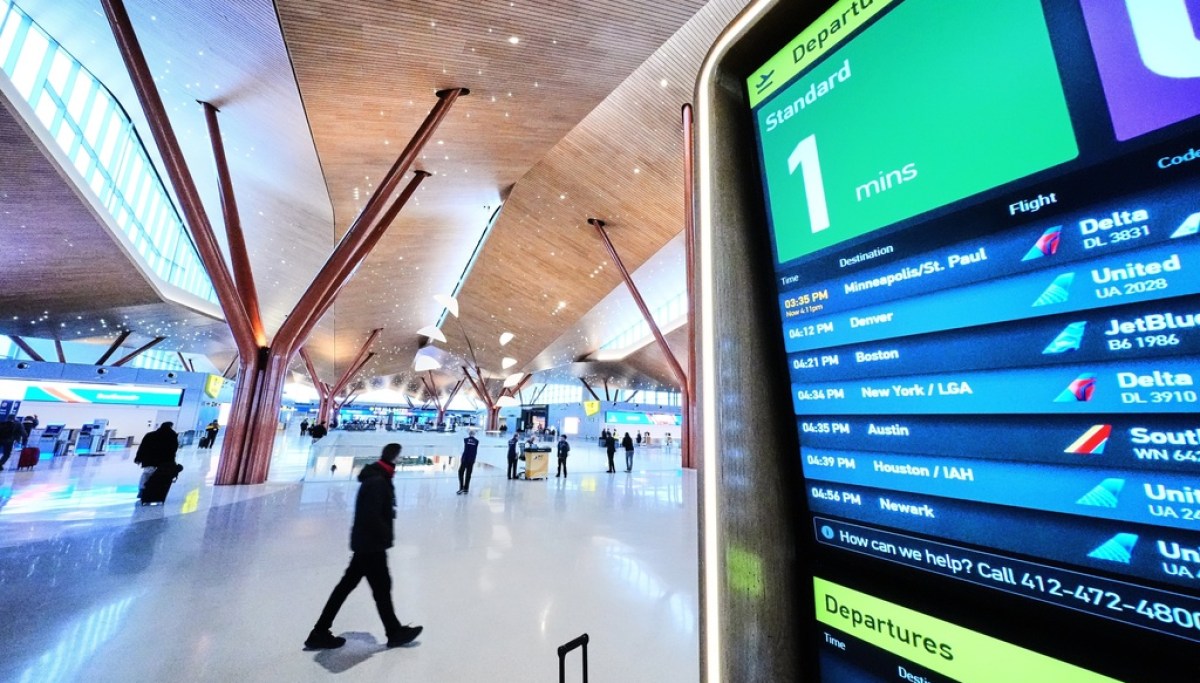
There is also something quietly mechanical about it all. Half man, half machine, we outsource our attention to algorithms while navigating physical spaces as if they are obstacles rather than shared environments. We move through public life like commuters through an airport terminal, focused, impatient, emotionally neutral.
This was not always the norm. Not long ago, there were unspoken expectations of civic friendliness, nothing forced, nothing intrusive, just a baseline acknowledgment that other people exist and might be worth a nod, a smile, or a sentence. Those conventions did not limit freedom. They made daily life warmer, lighter, more human.
TRUMP’S MARIJUANA MOVE WILL MAKE COMMUNITIES LESS SAFE
We should be honest about what we are losing. Community does not disappear overnight. It erodes through millions of small refusals to look up, to laugh, to speak, to risk a moment of awkwardness. AirPods helped ignite this trend, and the pandemic accelerated it, but their normalization has been locked in.
In a city desperate for connection, choosing to disengage may be the loneliest habit of all.
Daniel McKenna is a native of Arlington, Virginia, and a graduate of the University of Mary Washington. He works in cybersecurity and independently operates a private business in the collectibles market.