Although it might be hard to believe these days, there was a time when atheism was cool. Twenty years ago, a squad of public intellectuals called the “New Atheists” became overnight celebrities by writing bestselling books criticizing religious belief and bashing Christians on television.
Of course, there were many factors that precipitated this phenomenon. George W. Bush’s War on Terror tarnished both Islam and Christianity as irrational warmongering forces in the popular imagination. The millennial generation had been conditioned by nonstop pro-science, anti-religious propaganda in media and school. And specific scientific events, like the cloning of Dolly the sheep and the construction of the Large Hadron Collider (which will soon shut down), accompanied by outspoken atheist scientists who placed their faith multiverses and string theory also lent enormous credibility to prominent skeptics.
In the years that followed the rise of the New Atheists, a crop of Christian luminaries — apologists like William Lane Craig and Peter Kreeft, theologians like Scott Hahn and Pope Benedict XVI, and academics like Bishop Robert Barron and David Bentley Hart, to name a few — easily rebutted the specious claims of the New Atheists and revived important philosophical discussions about religion in the modern world. At the same time, the War on Terror received far less attention and diminished from the public consciousness during Barack Obama’s presidency, while science became politicized and lost so much of its cultural influence over the years.
For the most part, however, the world simply grew up. People realized that atheism leads to ruin in a multitude of ways for both individuals and communities. This truth has not necessarily pushed people back into the pews, yet it has soured them on atheism. Rather than associating it with smart, successful adults who are leading humanity to greater heights, the term conjures images of pasty, immature incels ranting on Reddit.
That said, not everyone has grown out of this phase. Some still cling to their bad arguments and claim the intellectual and moral high ground, ardently convinced that their periodic dunks on the faithful will bring the public back to their side.
One such skeptic is the New Atheist writer and podcaster Sam Harris. While he has softened his stance on religion, even adopting some of its practices like meditation, he continues to dismiss many of the metaphysical claims of religion as irrational nonsense.
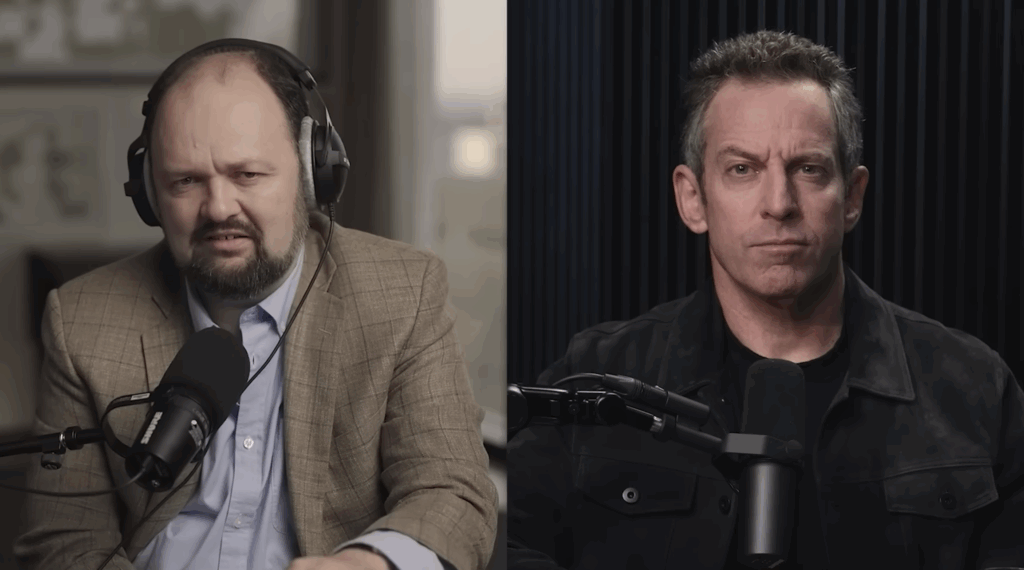
This became apparent in Harris’s recent interview with conservative Catholic columnist Ross Douthat. If nothing else, this nearly two-hour discussion revealed just how far the world has changed from the days of the New Atheists. Despite his elevated language and self-assured smugness, Harris displayed a shocking ignorance about religion as well as general history, moral principles, and basic logic.
Presumably, Douthat was brought on to Harris’s show to discuss his recent book Believe (which I reviewed here). Harris seemed ready pounce on Douthat for daring to suggest that religious faith is good, quickly moving the discussion from the book to answering Harris’s several objections and counterclaims.
Putting it mildly, Harris’s efforts to embarrass Douthat backfired. First, he insisted that technology and science would make people happier despite the widespread malaise and addiction destroying the developed world. He argued that atheist ethics were intrinsically more moral than any religious moral code, notwithstanding genocidal fascist and communist regimes of the past century. He asserted that a universalist, intellectually rich religion like Christianity, which gave birth to the Scientific Revolution, somehow makes adherents more tribal and dogmatic. And then he concluded that if God existed, He would include incontrovertible proofs of it in Divine Scripture, listing important physics equations, cures for cancer, and the like.
Once Douthat politely dismantled these facile arguments, Harris reflexively pivoted to tedious gotchas about Christian sanctions against homosexual behavior, the questionable theories of Christian Theocrats, and Tucker Carlson seeing demons. Douthat wisely resists the bait, knowing quite well what Harris is trying to score a point against him and has no intention nor the capacity to understand these issues in their proper context.
Even though Harris never loses his composure, it’s apparent that he is flustered throughout much of the conversation. Rather than “being enlightened by his own intelligence,” he betrayed his own shallow ignorance. Who should take him seriously on any matter of consequence when he has such simplistic views of science, religion, human beings, morality, culture, and politics?
Ironically, perhaps the greatest (and saddest) revelation to come from the interview was the obvious stranglehold that Harris’s atheism has on his own personal development. Harris easily had the makings of being a brilliant thinker, capable of penetrating insights and nuanced reasoning, but he ditched this potential by adopting atheism. As he spoke with Douthat, one can definitely sense him laboring under so much contradiction and cognitive dissonance. Here is a smart man who has forcibly turned himself into a midwit.
In Harris’s defense, Douthat is no intellectual slouch, and he has a knack for catching his interlocutors off guard (see his interviews with Hasan Piker, Ezra Klein, or Tony Gilroy). His good humor and modest demeanor make him an effective Christian apologist, especially against complacent leftists who rarely face any challenges to their outlook. Rather than forcing non-Christians into a corner in a formal debate, he quietly and politely dismantles their skepticism as he discusses other issues, such as artificial intelligence, pop culture, or political trends.
Some Christians might take issue with Douthat’s unwillingness to press the issue and elicit some concessions, if not a conversion of some kind, but they should understand that such a profound internal change, or metanoia, tends to happen over time. Moreover, these discussions about the faith are not merely about the people talking, but also about those listening. For many of Harris’s fans, Douthat was probably the first smart Christian who successfully bested Sam Harris in a conversation about religion.
All of which might spell doom for Harris’s ongoing popularity and relevance if he continues down the path he has taken. New Atheism has long since become outdated and lame. Its appeal is almost completely gone. Hopefully, Harris can realize this, save his soul, and put his abundant talents to better use. The world and his career would certainly benefit as a result.