The Trump administration announced new dietary guidelines aimed at ending “corporate-driven” preferences for ultra-processed foods, added sugar, and refined carbohydrates on Wednesday.
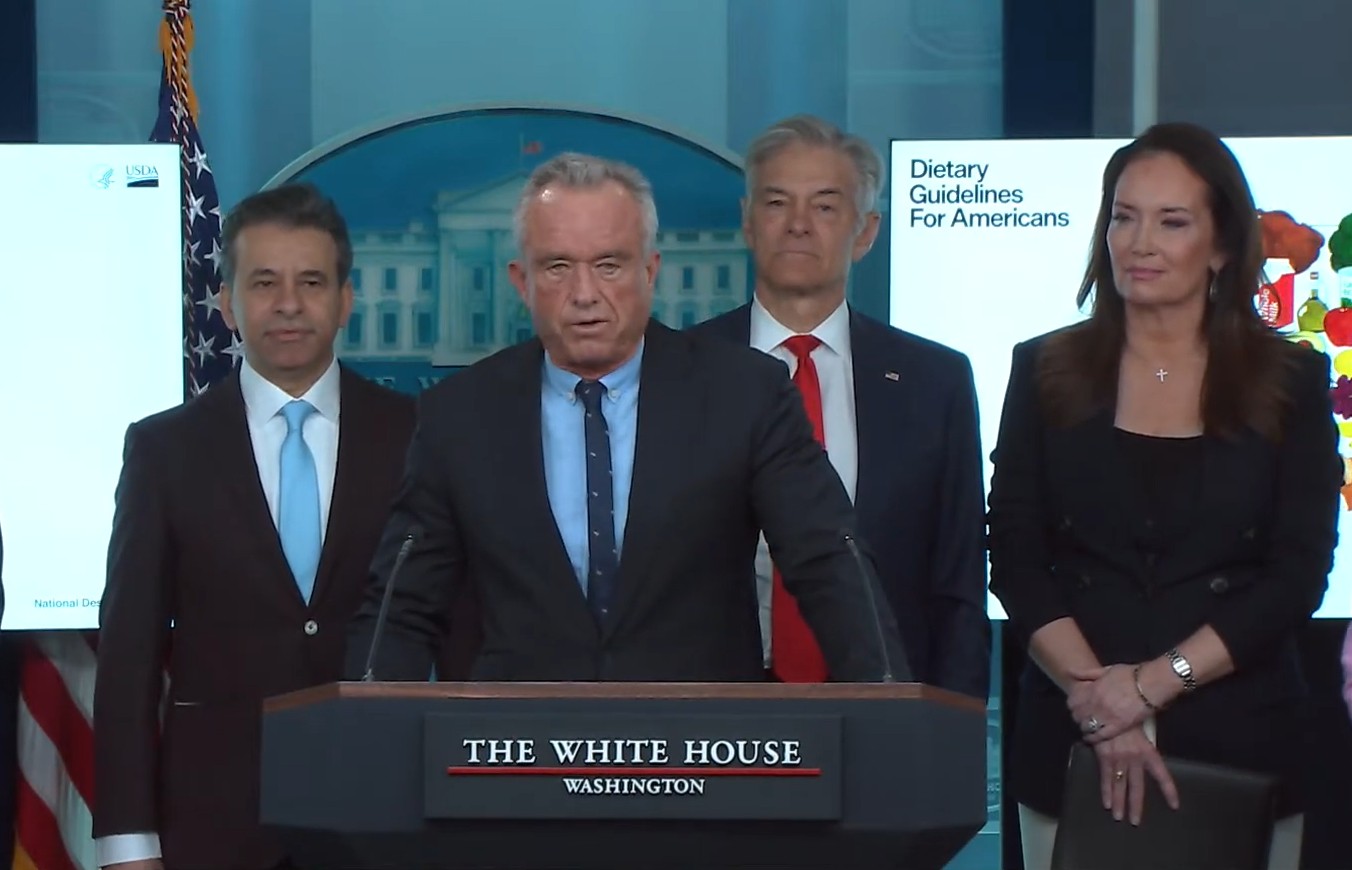
The Make America Healthy Again-oriented changes to the food pyramid, nutrition education, and government programs’ methods for procurement and approval of food represent the “most significant reset of federal nutrition policy in history,” Health and Human Services Secretary Robert F. Kennedy Jr. said at a White House press briefing.
“For decades, Americans have grown sicker while health care costs have soared. The reason is clear: The hard truth is that our government has been lying to us to protect corporate profit-taking, telling us that these food-like substances were beneficial to public health,” Kennedy said. “Federal policy promoted and subsidized highly processed foods and refined carbohydrates, and turned a blind eye to the disastrous consequences. Today, the lies stop.”
“My message is clear: Eat real food,” he added.
Federal dietary guidelines shape many federal programs, as well as the groceries eligible under the Supplemental Nutrition Assistance Program (SNAP), school lunches, the food procured by government agencies, including the Pentagon, Veterans Affairs hospitals, and more. They also guide how Americans are educated about food and nutrition.
“Common purchases” for the 42 million Americans on SNAP are products that include added sugars and chips, Kennedy said, noting that 78 percent of those on SNAP are also enrolled in Medicaid.
Agriculture Secretary Brooke Rollins said her department is working to finalize a “rule that will mandate” that all 250,000 retailers that accept SNAP benefits in the United States “double the type of staple foods” they provide to SNAP recipients.
“For decades, we’ve been fed a corrupt food pyramid that has had a myopic focus on demonizing natural, healthy saturated fats — telling you not to eat eggs and steak — and ignoring a giant blind spot: refined carbohydrates, added sugars, ultra-processed food,” Food and Drug Administration Commissioner Marty Makary said, noting 60 percent to 70 percent of children “are getting their calories from ultra-processed foods,” calling it an “epidemic.”
“We are ending the war on saturated fats. Diets rich in vegetables and fruits reduce disease risk more effectively than many drugs,” Kennedy said. “Whole grains outperform refined carbohydrates. Added sugars, especially sugar-sweetened beverages, drive metabolic disease, and today, our government declares war on added sugar. Highly processed foods loaded with additives, added sugar, and excess salt damage health and should be avoided.”
Americans have often been told that purchasing healthier food options is simply more expensive and that highly processed foods are the affordable option, but Rollins said that the data does now actually show that. She also said that there are “food deserts” in some parts of the country that do not have a nearby grocery store with real food in them, which is an issue she said USDA is working to address.
“The idea that a cheap meal made of processed food is cheap is an illusion, because you’re paying for it on the back end,” Kennedy added. “You’re paying for it with diabetes, with obesity, with illness, and if you internalize that cost of the meal, it would be a tiny fraction of the long-term cost.”
Centers for Medicare and Medicaid Services (CMS) Administrator Mehmet Oz noted that recommendations for alcohol consumption also changed, encouraging less alcohol use while doing away with the typical two drinks for men and one drink for women limit that has been pushed for decades. According to Oz, “There was never really good data to support that quantity of alcohol consumption.”
Chronic illness and obesity are often rooted in poor diet, and White House Press Secretary Karoline Leavitt noted that obesity “accounts for $400 billion in medical spending each year.”
“Federal dollars have … promoted low-quality, highly processed foods that lead to scores of long-term health issues, which means Americans have gone broke because of these health issues,” she said. “Faulty dietary guidelines of the past stacked the deck against healthy eating and food options for everyday American families, which has fueled the chronic disease epidemic and jacked up the health care costs of households across the country.”
According to Kennedy, citing statistics from Johns Hopkins and the CDC, 48 cents out of every federal tax dollar are spent on health care, while 90 percent of health care spending is to treat chronic disease. “That means that 40 percent … of every dollar that taxpayers pay in this country is going to treat diseases that could be averted through good food,” he said.
“The United States has the highest obesity and Type 2 diabetes rate in the developed world,” while spending “three times more per capita” than Europe on health care and reaching a life expectancy that is five years shorter than Europe’s, “largely due to diet-related chronic disease,” Kennedy said.
America has extremely high levels of childhood obesity, Kennedy added, and about 33 percent of teens have pre-diabetes, while 35 percent of teens are overweight. A fifth of young adults have fatty liver disease unrelated to alcohol consumption, and more than three-quarters of “military-aged Americans are ineligible for military service” because of health issues related to diet.
“If a foreign adversary sought to destroy the health of our children, to cripple our economy, to weaken our national security, there would be no better strategy than to addict us to ultra-processed foods,” Kennedy said. “It’s shocking that our own government helped to drive these cataclysmic changes in our diet. The damage is real. It is preventable, and President Trump has ordered it to end.”
Kennedy anticipates that through changes in Americans’ diets the United States could save $600 billion a year, which translates to “50 percent of Medicare’s projected long-term deficit or $5,000 per family annually.”
Oz also estimated significant reductions in taxpayer expenditures for Medicare and Medicaid, noting America’s health expenses are rising twice as fast as gross domestic product (GDP) is growing.
“You can’t be a wealthy nation without being a healthy nation,” he said, adding that “30 percent of health care costs are directly attributable to obesity,” about $300 billion per year from Medicare alone. He also estimated a 10 percent reduction in obesity would lower Medicare costs by $30 billion.
Oz also pointed out that if Americans live longer and healthier lives, they will likely find themselves working beyond the current age of retirement, which is 61. If they work just one more year, because their health allows it, Oz anticipates a resulting multi-trillion-dollar increase in GDP.
Breccan F. Thies is the White House correspondent for The Federalist. He previously covered education and culture issues for the Washington Examiner and Breitbart News. He holds a degree from the University of Virginia and is a 2022 Claremont Institute Publius Fellow. You can follow him on X: @BreccanFThies.