It’s not hard to determine what those at the helm of our nation’s leading intellectual and cultural institutions think of the idea of “western civilization.” The Trump administration’s attempts to restore beauty and proportion to our national capital’s architecture through a return to classical forms is routinely labeled racist. The administration’s complaints about the capitulation of the arts, including at the federally-funded Kennedy Center, to politicization and wokeness is dismissed as vain, self-worshipping posturing. Even conservative study and celebration of Greece and Rome — including the proliferation of classical schools — are accused of evincing a crypto-white-nationalist temperament.
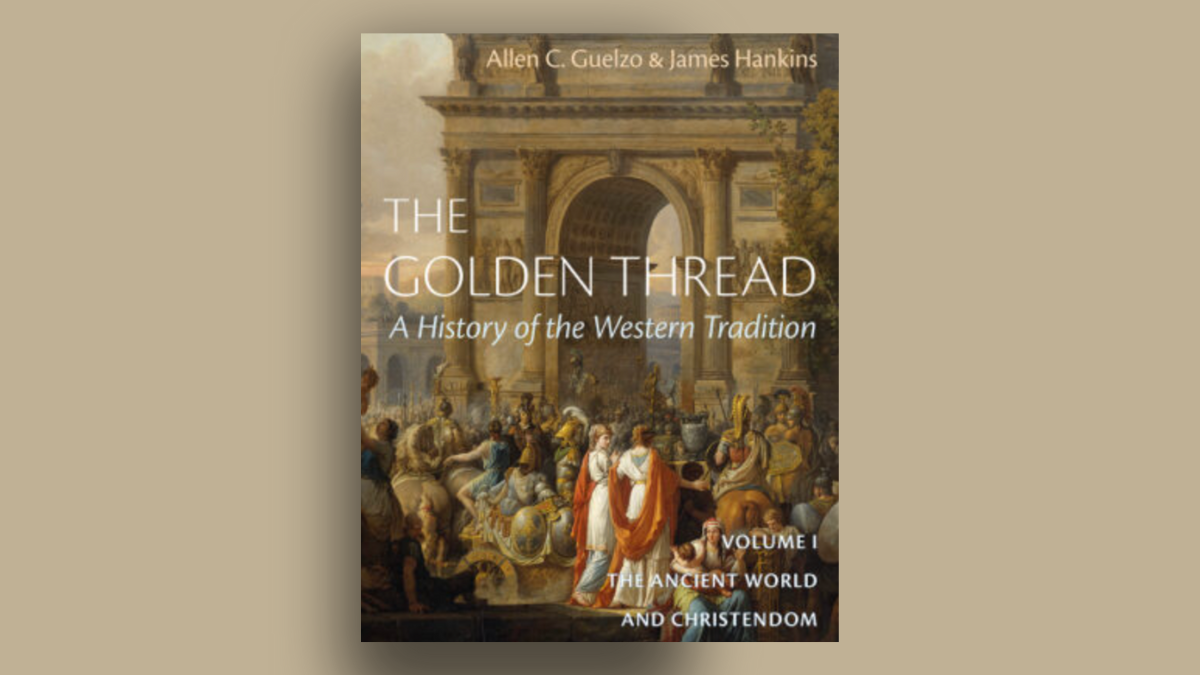
It seems any effort to protect, let alone restore a celebration of western civilization to American institutions of learning and the arts will be an uphill battle. Yet for those eager to strengthen their own knowledge of western civilization — or inculcate the next generation in its verities — there is a new, excellent weapon in the fight. The two-volume The Golden Thread: A History of the Western Tradition, written by Ivy League scholars James Hankins and Allen Guelzo, offers an exemplary, accessible textbook worthy of every bookshelf that seeks to honor our glorious tradition.
Why Western Civilization Still Matters
A civilization, Guelzo and Hankins argue in their introduction, is a space, a place where “people may breathe,” creating “a public forum, a city square, in which they may do something other than tremble and labor for simple survival.” Civilization “allows people to erect monuments of art, literature, and thought alongside the everyday need to work, to produce, to exchange.” And civilization is essential, because “the human spirit cannot be captured simply by the way we earn bread or avoid massacre; there is a natural yearning after order, after beauty, after truth.” At least in the West, that civilization is a synthesis of several different traditions: the Greeks, the Hellenized Romans, and the Christianized Greco-Romans.”
Guelzo and Hankins know that their project comes at a time when many, if not most, scholars are moving in the opposite direction, seeking to decenter Western civilization and maligning even the idea of Western civilization as a unifying concept and reality. They write: “There has been a highly successful campaign to portray Western civilization as uniquely evil — uniquely disfigured by slavery, racism, genocide, militarism, economic exploitation, environmental devastation, monstrous levels of income inequality, and male oppression of women.”
Denying Western civilization, however, comes with unforeseen negative consequences, among them, in the authors’ minds, “black-and-white thinking, confirmation bias, and catastrophism,” which in turn foster an emotive, arrogant fanaticism. The George Floyd (aka “1619 Project”) riots, and widespread maligning of white males across American institutions offer excellent examples of this self-destructive thinking in action. It is also, as Guelzo and Hankins explain, embarrassingly ignorant, given that so many of the qualities of modernity celebrated by the left, such as rights-based law and empirically-based inquiry, are uniquely Western novelties. “The young are more likely to acquire the frivolous state of mind, now common, that thinks great civilizational achievements can be jettisoned without loss, once found guilty of ‘white supremacy.”
Though “The Golden Thread” is an impassioned, extensive defense of the West, it is not intended to be triumphalist. It does not assume that the Western tradition is destined to triumph over all other world civilizations or that the rest of the world needs to conform to the West’s example. Rather, it recognizes that inasmuch as the West conforms to the truths of natural law, it manifests what is best about man and his ability to create what is good and beautiful. It is also something that can be easily lost and forgotten — hence the title, that speaks to a certain fragility to Western civilization, which over its three-thousand-year history has suffered attacks from both without (such as nomadic barbarian peoples whose relationship to civilization is parasitic) and within (the aforementioned woke ideologues).
A Monumental Scholarly Accomplishment
There are many admirable qualities about The Golden Thread, the first volume of which was written by Hankins, the second by Guelzo. The authors pepper excerpts from primary sources throughout their expert narrative and analysis, which helps readers more directly connect with the thought and life of Western civilization’s great figures. Likewise excellent are periodic short biographies of important historical personages such as Wellington, the British general who defeated Napoleon on the Iberian Peninsula and at Waterloo.
Also impressive is the incredible amount of beautiful, historically-significant artwork. Nor, thankfully, was the publisher stingy in allowing the art to take up entire pages in order to more effectively appreciate its beauty. Though certainly a political, military, and economic textbook, the authors should be commended for including large sections on art, social trends, and philosophy. To wit, this is the first history textbook I have ever seen with an entire section devoted to the Frankfurt School of Theodore Adorno and Antonio Gramsci, two of the leading thinkers responsible for what has come to be called critical theory, and which is the intellectual force behind many of the contemporary left’s most ambitious political and cultural projects.
I do have a few complaints. The second volume features an interesting standalone, multi-page section discussing the question “Is Russia European?” It’s an important and quite relevant question given current events, and one likely to remain so for decades to come — I wish the authors had included more such provocative discussions. For example, volume two ends before 9/11, presaging the West’s clash with Islam — why not include a section on the question of whether or not Islamic and Western tradition are compatible or inherently in tension? More critically, I was confused at how little attention the textbook pays to the American Revolution and Civil War, especially given Guelzo has written a handful of books on 19th century America.
These are nevertheless minor quibbles given what Guelzo and Hankins have achieved. This is the textbook I wish I had when I was teaching high-school history almost twenty years ago, and one my wife and I plan to use as part of our homeschooling curriculum with our own kids. “To be civilized, in essence, is to act in ways that make us and those around us better and happier,” the authors write in the introduction. Interpreted as an extension of that civilizing impulse that has defined the West for three millennia, this textbook succeeds at both.
Casey Chalk is a senior contributor at The Federalist and an editor and columnist at The New Oxford Review. He is a regular contributor at many publications and the author of three books, including the upcoming “Wisdom From the Cross: How Jesus’ Seven Last Words Teach Us How to Live (and Die)” (Sophia Institute Press, 2026).