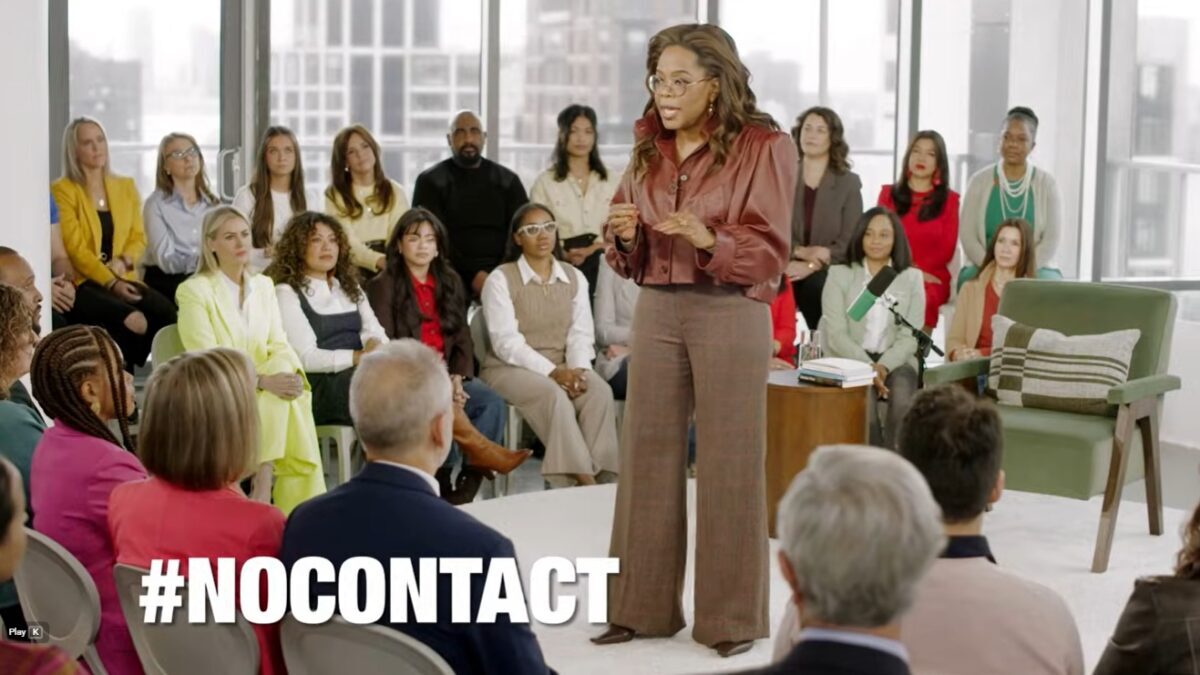
Family estrangement has moved from the margins to the mainstream and this shift is now visible across popular culture and media alike. Oprah recently gave airtime to the “rising trend” of adult children who have severed ties with their parents. The New York Times offered suggestions for how to cope with family estrangement, especially around the holidays. While some people sever family ties out of genuine necessity, the practice has exploded into broader and lesser justifications in recent years and often takes on an authoritarian tenor, one that presumes that the adult child cutting contact is always right and righteous.
A recent Wall Street Journal piece, “These Moms Are Done Being Doormats for Their Estranged Children,” chronicles how that absolutism appears to be provoking a counterreaction. Journalist Elizabeth Bernstein describes what she calls “the pissed-off parent pushback,” profiling one mother who started a TikTok account to connect with others whose adult children, in her words, have become “ungrateful little bastards.”
To understand this peculiar moment, it helps to situate this newer version of family estrangement within the latest iteration of identity politics, the logic of which invites us to recast all relationships as adversarial. Such black-and-white thinking is full of moral clarity but lacks moral complexity. It therefore tends toward excessive corrections that sacralize entire victim classes. Just as the #metoo era slogan “believe all women” functioned as an overcorrection categorically condemning men and granting infallibility to women, so too has the emerging impulse to believe all adult children in the no contact movement.
A Cycle of Competing Claims
But membership in a “victim class” no longer carries the cachet it once did. Many are realizing that it is a devilish way of sorting people. The framework is too blunt to account for individual responsibility or context, and it inevitably relies on emotional coercion. As that coercion becomes more visible, it provokes a backlash. Those on the receiving end learn to use the same language of grievance in response, turning a politics of identity into a cycle of competing claims.
This reactionary dynamic is playing out across nearly every identitarian divide today: between the sexes, across races, and now, increasingly, between parents and children. We are living in the era of the endless reaction. For decades our betters have told men that they are either buffoons or bullies. Similarly, they have treated whiteness as a pathology. In response we get reactionary movements, from the manosphere to Nick Fuentes, and acolytes of each flexing our only remaining moral muscle: outrage. They then provoke further counter-reactions and the pendulum swings again, eroding any way forward and leaving us all in a sterile stalemate.
As I write in my forthcoming book, “No Contact” (Forum, 2026) this movement is newer, but the grift is the same and the reaction cycle is quicker to form. While their anger is understandable, such parental claims to retributory victimhood are neither justifiable nor effective. The family cannot survive as a battlefield of competing moral claims.
Real Remedy
The real remedy is to step out of this endless reaction cycle. This task falls most heavily on parents because the parent-child relationship is asymmetrical. This asymmetry is not a matter of power or privilege, but of the unique call to the nobility and generative nature of true moral authority. Parents who find themselves unjustly estranged should refuse to capitulate to bad behavior, yet they must also resist mirroring it. In doing so, they stand outside the cycle of provocation and retaliation, bearing witness to a different moral grammar altogether. This posture does not guarantee reconciliation. But it preserves the conditions under which a healthy reconciliation remains possible.
More broadly, this is the task facing all of us. Identity politics must be disavowed entirely, not selectively. As long as we continue to choose outrage and reactionary responses, the cycle of accusation and backlash will keep reproducing itself. Stepping outside that logic is not as immediately satisfying, but it is the only way to recover personal and civic health and stop the spiral of disintegration.
Noelle Mering is a fellow at the Ethics and Public Policy Center and the author of “Awake, Not Woke,” co-author of the “Theology of Home” book series, and author of the upcoming book “No Contact: How a Seductive Ideology Broke Families and Friendships and How We Can Repair Them.”