In Focus delivers deeper coverage of the political, cultural, and ideological issues shaping America. Published daily by senior writers and experts, these in-depth pieces go beyond the headlines to give readers the full picture. You can find our full list of In Focus pieces here.
A civil war for the soul of the post-Trump conservative movement has broken out into the open in recent weeks. The Republican coalition, long united by the sheer force of a single figure with a malleable worldview and a strictly transactional nature, is now scrambling for an ideological identity. And the outcome is anything but certain.
The high-stakes struggle is drawn along numerous lines, but it broadly pits two warring factions against each other. On one side stands the New Right: Populists and nationalists eager to utilize government power to pursue their policy aims. And on the other hand, traditional conservatives: Internationalists and free-marketers who are suspicious of government power.
While the legacy media predictably portray this dispute as a meltdown, it is actually a sign of a functioning political movement, one that is doing the hard work of self-discovery that the Democratic Party is too fragile to attempt.
An ideological scramble
The more profound and more entrenched the divisions on the Right reveal themselves to be, the more fluid and overlapping the factions on both sides are, the more extraordinary Trump’s political achievement seems in hindsight. How did he manage to unify all of this?
Indeed, the schism on the Right is so deep that even the most fundamental questions about the movement’s character are being debated.
For instance, is it conservative to believe that American identity should be based on adherence to the creed of self-evident truths enumerated in the Declaration of Independence? Or should emphasis be placed on America’s particular heritage and the preservation of a distinct people?
Further, should the movement have clear and strictly enforced ideological boundaries? Or is any attempt to deny entry a form of unacceptable ‘gatekeeping’ indistinguishable from the Left’s ‘cancel culture’?
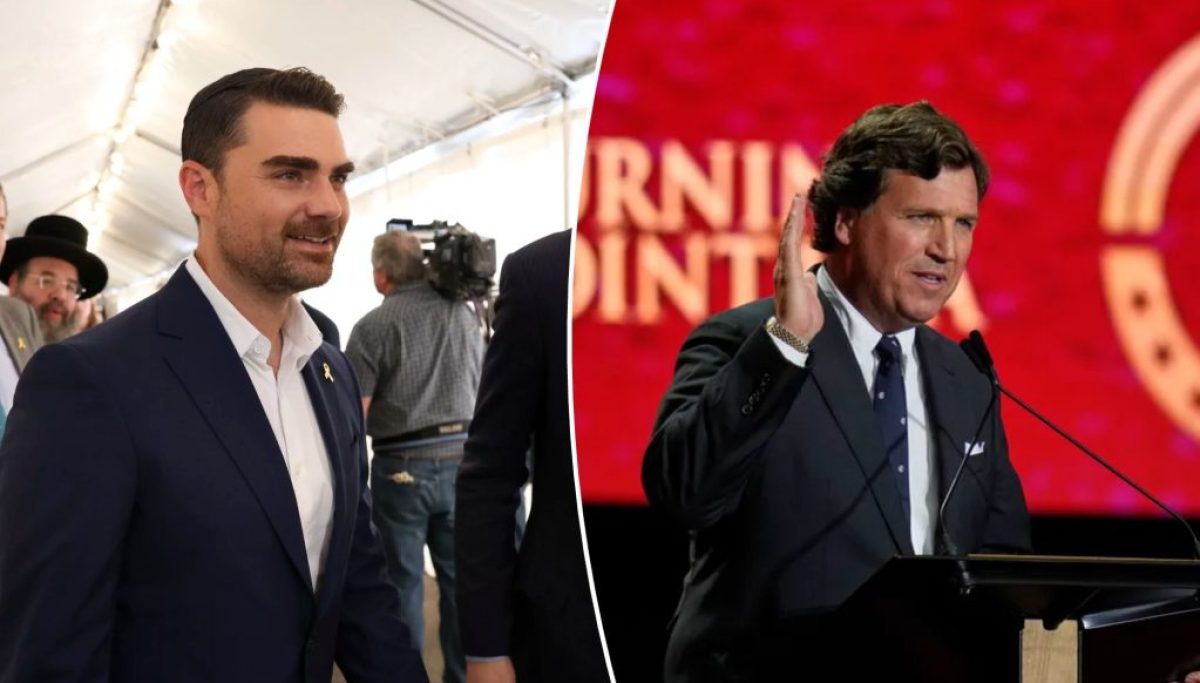
Dueling speeches from leading voices within these camps at Turning Point USA’s AmericaFest dove passionately into these questions.
Ben Shapiro admonished as “charlatans” and “grifters” those trafficking in conspiracism and antisemitism who threaten to destroy the movement from the inside out. In response, Tucker Carlson, who months earlier hosted avowed white supremacist Nick Fuentes on his podcast for a friendly interview, accused Shapiro of attempting to cancel opponents, especially voices critical of Israel.
The next day, Vivek Ramaswamy articulated a vision of America as a fundamentally creedal nation, rejecting the idea that there are tiers or degrees of ‘Americanness’, as “heritage Americans” on the New Right believe.
“I think the idea of a heritage American is about as loony as anything the woke left has actually put up,” he said. “There is no American who is more American than somebody else. … It is binary. Either you’re an American, or you’re not.”
Vice President and 2028 presidential front-runner JD Vance, who earlier this year endorsed the idea that ancestry makes some Americans more American than others, told the audience that Christianity is America’s true creed. He then offered a broadly inclusive vision for the conservative movement, appearing to side with the Carlson faction in opposing ‘gatekeeping’.
“So if you love America, if you want all of us to be richer, stronger, safer, and prouder, you have a home on this team. I didn’t bring a list of conservatives to denounce or to deplatform, and I don’t really care if some people out there — I’m sure we’ll have the fake news media — denounce me after this speech.”
The event was exhilarating political theatre, marked by its uncomfortable and acrimonious nature, yet brimming with life. AmericaFest provided only further evidence that the nation’s intellectual energy and creativity reside on the Right. Healthy, living movements engage in vigorous internal debate. Dead movements fall silently into lockstep, sacrificing ideals and values to the prevailing orthodoxy.
Signs of health
Two aspects of the civil war in particular bode well for the movement’s future. The first is that the debate is progressing in a logical order, beginning with values and principles from which a coherent policy platform will eventually flow.
Several prominent conservative commentators expressed frustration over the lofty and abstract nature of the arguments at AmericaFest. One said to me, “I don’t get what we are arguing about here. What’s the policy in question?” But it’s only natural that a movement should determine its character before announcing what it intends to do on policy. In fact, it is essential for future unity and stability.
After all, what marriage counselor worth his salt would advise warring parties to paper over their differences? No, the good advice is always to get to the root of the conflict and work out problems on the most fundamental level. And that is precisely what the conservative movement is doing.
Even more crucially, the civil war on the Right is being fought in the clear light of day. Since the brouhaha over Heritage Foundation President Kevin Roberts’s video defending Carlson’s decision to host Fuentes, calling critics of the move a “venomous coalition,” the two sides have engaged in a highly public dispute. Playing out mostly over social media and on podcasts, leading figures on both sides have lobbed attacks, often deeply personal in nature, at one another by the hour. On the surface, the party appears dysfunctional.
But it remains far better to litigate these differences in the open than to allow them to fester behind a facade of unity. The brute fact is there is only one Republican Party, and if it’s going to be large and strong enough to defeat the Left, some concessions will need to be made by both sides. It’s a messy and bitter process. But it’s preferable to silence or denial.
Better still, the public nature of the dispute gives Republican voters a voice. The ideas of both sides are being aired constantly, giving the voting public ample time to absorb them, weigh the character of the leaders advancing them, and even to respond to them on Twitter. This public vetting process enables the conservative faithful to influence the conversation by selecting winners and losers in real time. So far, the conservative civil war has been downright democratic.
Democratic silence
And it could not provide a sharper contrast with how the Democratic Party is resolving its tensions. The party is so afraid of a frank and open discussion about its future that it is actively suppressing its own 2024 election postmortem. In mid-December, Democratic National Committee Chair Ken Martin abruptly shelved its comprehensive review of what went wrong for Kamala Harris and the Democrats.
Martin ordered the autopsy immediately after winning the DNC Chairmanship earlier this year, stressing the importance of releasing it publicly so that Democrats could have a frank conversation about their failures. Martin’s reversal underscores his lack of confidence in his party’s ability to have a fruitful, public exchange of ideas, to say nothing of his party’s lack of moral courage.
“In our conversations with stakeholders from across the Democratic ecosystem, we are aligned on what’s important, and that’s learning from the past and winning the future,” read Martin’s statement. “Here’s our North Star: does this help us win? If the answer is no, it’s a distraction from the core mission.”
By “stakeholders,” we can be certain Martin meant the Democratic elite, not voters, and probably not even the party’s activist base. This secrecy and top-down control reveal a party that trusts neither its own voters nor its leaders’ ability to navigate difficult, yet necessary, internal debates. Meanwhile, the progressive Left, led by Sen. Bernie Sanders (I-VT), Rep. Alexandria Ocasio-Cortez (D-NY), and New York City Mayor-elect Zohran Mamdani, continues to pull the party leftward with barely a peep of pushback from Democratic moderates.
A 2028 VANCE CORONATION IS BAD FOR HIM AND THE GOP
The contrast could not be more stark. One party is going through the messy but vital process of discovering its most fundamental principles, while the other is suppressing uncomfortable truths and hoping that silence will pass for unity. One party is courageous to air its internal grievances, while the other is afraid of its voters, its donor class, and its own shadow.
It’s impossible to say which party will emerge stronger by 2028. To be sure, plenty could go wrong for conservatives by then. But I know for certain which one is taking the matter of movement building seriously, and which one is running scared.