[Order Michael Finch’s new book, A Time to Stand: HERE. Prof. Jason Hill calls it “an aesthetic and political tour de force.”]
In one of the most gruesome episodes linked to a wave of violent protests sweeping Bangladesh, an innocent Hindu garment factory worker was beaten to death, tied to a tree, and set on fire by a Muslim mob in Bhaluka Upazila, Mymensingh district, late Thursday night. The victim has been identified as Dipu Chandra Das, a young Hindu man who lived as a tenant in the Dubalia Para area. According to local officials, a group of residents confronted him around 9 p.m., accusing him of making derogatory remarks about Islam. The situation quickly escalated, and the mob severely beat Das before tying his body to a tree and setting it ablaze. Law enforcement later recovered his burnt remains and sent them to Mymensingh Medical College Hospital for post-mortem examination. No First Information Report (FIR) or formal police case has been registered yet in connection with the killing. Such incidents are not unprecedented in Bangladesh, where Hindus have frequently been attacked or killed following blasphemy accusations, with police action often absent. The absence of swift accountability, therefore, is hardly surprising.
This incident has ignited outrage and fear among Hindus, coming at a time when Bangladesh is engulfed in widespread unrest following the killing of jihadist “student leader” Sharif Osman Hadi.
Sharif Osman Hadi, 32, rose to prominence during the 2024 youth-led uprising and served as spokesperson for the activist group Inquilab Mancha. His rise was primarily driven by his ability to recruit Bangladesh’s aimless and ideologically adrift youth for jihad, using aggressive anti-India sermons to sell an absurd and dangerous fantasy of seizing India’s so-called “Seven Sisters,” the seven northeastern states near Bangladesh. His polarizing rhetoric found eager audiences among youth and student groups who reject Bangladesh’s secular foundations and openly advocate recasting the country as an Islamic state.
Unidentified men shot Hadi on December 12 in Dhaka while he was traveling in a battery-powered auto-rickshaw. He was rushed to Dhaka Medical College Hospital and later flown to Singapore for treatment. He died in a Singapore hospital on Thursday, after days on life support.
Hadi’s supporters hold strong anti-India views, and it was only a matter of time before their wrath found the first defenseless Hindu on the street and finished him off. They immediately took to the streets demanding justice, accountability, and denunciation of his killing.
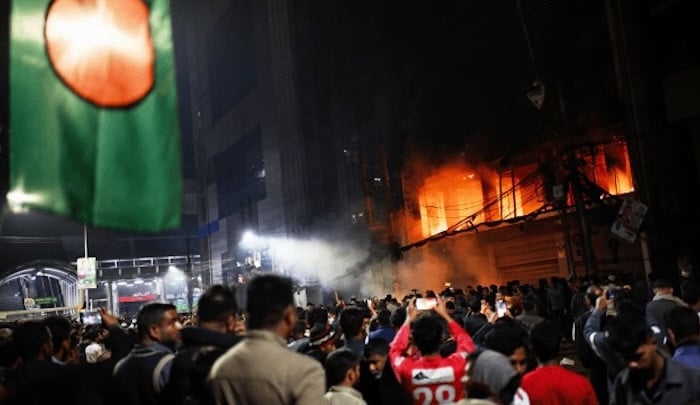
These protests soon turned into organized Muslim violence, with Muslim mobs attacking institutions viewed as obstacles to Bangladesh’s post-Hasina Islamic ascendancy. The offices of Prothom Alo and the Daily Star were stormed and burned down. These are two of the country’s most influential media outlets, known for reporting on political violence, the rise of jihad activity, and the Islamic abuse of religious minorities. In recent years, they have reported extensively on Islamic violence and corruption. Journalists who were temporarily trapped inside both buildings described scenes of chaos, with smoke-filled newsrooms and reporters expressing fear for their lives during the assaults.
In other flashpoints, vicious demonstrators hurled bricks and stones at the residence of the Assistant Indian High Commissioner in Chattogram, a clear sign of rising anti-India sentiment among some factions of the protest movement.
Reacting to the deteriorating situation, India temporarily suspended visa services at its missions in Khulna and Rajshahi, citing security concerns after protests were reported near Indian diplomatic posts.
Although this latest lynching has occurred in the context of the current protests, the Muslim-majority nation has a broader history of mob violence against minorities tied to unfounded accusations of blasphemy or religious offense. In recent years, social media-fueled allegations have frequently triggered vigilante justice against minorities. Hindu community leaders and bloggers have been abducted and hacked to death.
Bangladesh’s law enforcement record offers no reassurance to its Hindu minority. Time and again, police have failed to act swiftly to protect Hindus whom mobs have targeted with violence. In many cases, no FIRs are registered at all; when cases are formally filed, investigations rarely proceed with seriousness, and perpetrators frequently go free without punishment. This entrenched culture of impunity has normalized violence against minorities.
Against this backdrop, Dipu Chandra Das, the poor Hindu laborer lynched to death and burned publicly, will likely become yet another forgotten name in Bangladesh’s long list of unaccounted victims. The silence extends beyond the border as well. In neighboring West Bengal, where political discourse often claims moral leadership on secularism and human rights, outrage and protest marches are routinely reserved for distant conflicts like Gaza. At the same time, the brutal killing of a fellow Bengali Hindu just a few kilometers away across the border barely registers.