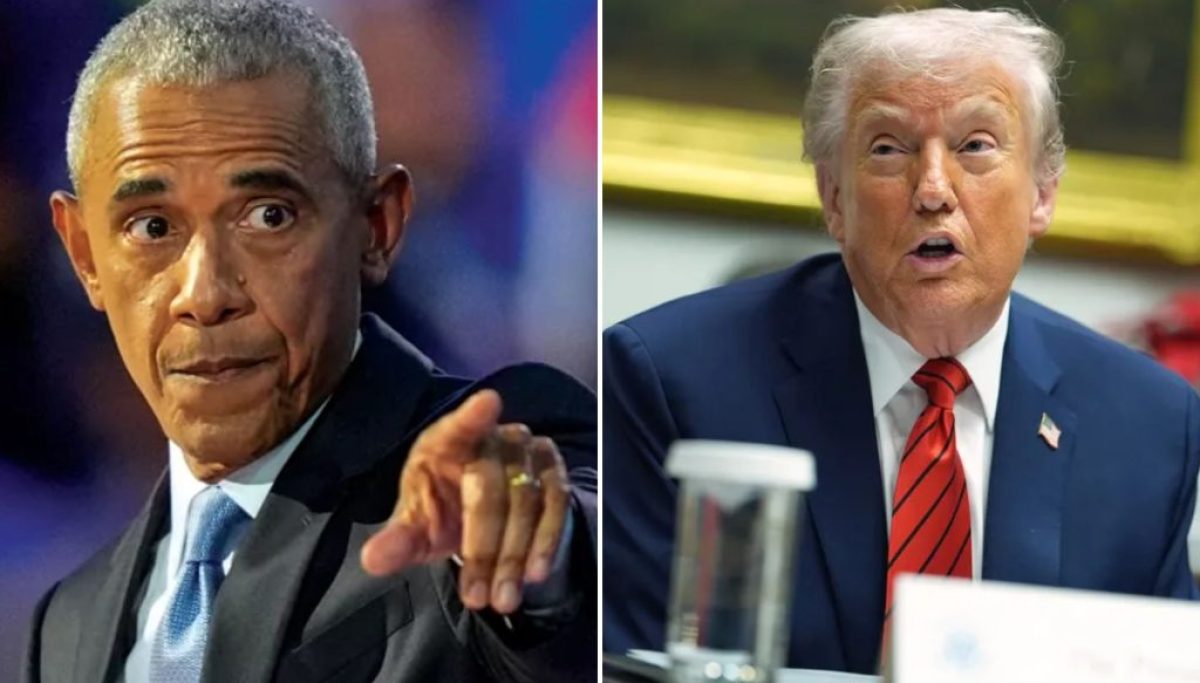
President Donald Trump has dominated Republican Party politics for a decade, but, being term-limited, the big question in 2026 and beyond is who can step out of his huge shadow and assume leadership of the movement.
The Democrats have suffered from this particular problem ever since former President Barack Obama left office in 2017. Former President Joe Biden gave the party some direction, but his physical and mental decline, coupled with a mad dash, ultimately doomed 107-day presidential campaign from then-Vice President Kamala Harris, has left the party leaderless and rudderless.
Trump has been so singularly dominant, even when not in office, that it is inevitable that questions have arisen over who comes next.
“It’s going to be a challenge,” Republican Strategist John Feehery told the Washington Examiner. “There is only one Trump. Whoever takes his place has to carve his or her own path and stay true [to] their own vision. And by the end of his term, Republican voters will most likely be ready to move on from the Trump era anyway.”
Right now, the winds seem to be blowing toward Vice President JD Vance, but the die has yet to be cast on who will be the next GOP nominee and if they have the personality and gravitas to lead a post-Trump Republican Party.
“Yeah, it can be an issue, but I think the difference between our party as Republicans and Democrats is that our principles and our issue sets that we support are pretty consistent over time,” Rep. Byron Donalds (R-FL), one of Trump’s close allies on Capitol Hill, told the Washington Examiner.
“I think that transition will probably be a little bit easier for us, but there’s no replacing Donald Trump. He’s one of one.”
Democrats are also still grappling to answer who will lead them going forward.
“Just to be blunt, we don’t have anyone else [like Obama],” Democratic operative Jon Reinish told the Washington Examiner. “Democrats have not won, and winning is all that matters in politics, there’s no such thing as moral victories, we haven’t won, quite frankly, since 2008 and 2012.”
Reinish went on to say both Obama and Trump have had such success in their efforts because the two tapped into “both frustration and the desire for aspiration.” Obama shattered voter turnout in 2008, with over 130 million voters turning out for the first-term senator at the time. The 2020 election now holds the record for the highest voter turnout between Trump and Biden.
Other political operatives believe the parallel that could come from a post-Trump world for the party still lies in the outcome of the 2026 midterm elections.
“If Republicans under Trump and Vance’s leadership can do well, then that parallel won’t play out,” Republican operative Dennis Lennox told the Washington Examiner, adding that 2026 is starting to feel like it will be a “bad year for Republicans.”
“If the election were anytime soon, it would end up somewhere between 2006 and 2018 — that would hurt the ability of Trump and Vance to influence the party in 2028 and beyond,” he said.
The Michigan-based Republican strategist pushed back on the sentiment that Obama is still, in some respects, the leader of the Democratic Party: “I’m convinced he’s lost his touch if you look at his record of picking winners.”
“Obama ended his presidency with Trump winning, which has hindered his ability to lead Democrats,” Lennox explained. “Trump needs Republicans to at least maintain the status quo in 2026 if he wants to avoid Obama’s irrelevance.”
While some believe Obama has lost his touch, the Democratic Party has continued to use the former president when campaigning, signaling that he still has some pull within the party. Obama helped campaign in the 2025 elections, where the party saw many wins following its dramatic loss in 2024, one of those being the redistricting effort led by Gov. Gavin Newsom (D-CA) to redistrict the state, aiming to counter the redistricting effort backed by the Trump administration in Texas.
“[Obama is] an exciting person, and he’s a part of history: first black president, an incredible communicator, and people want to see that and be part of it,” Rep. Greg Landsman (D-OH) told the Washington Examiner. “It’s why he attracts big crowds.”
Rachel Schilke contributed to this article.