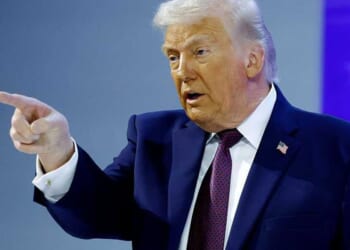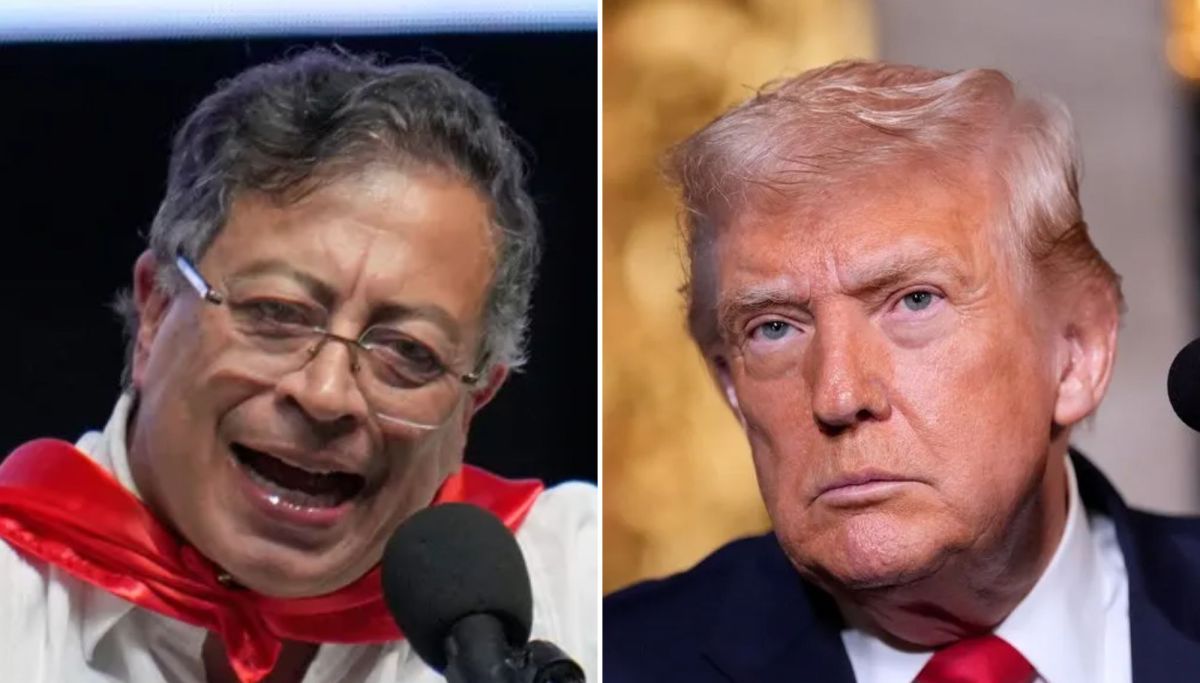
President Donald Trump warned that Colombian President Gustavo Petro “better watch his a**” after the latter questioned the legitimacy of the United States’s possession of southwest states, including Texas.
Over the weekend, Petro made comments echoing left-wing criticism of the U.S., questioning its legitimacy in Texas, California, and other southwest states due to their acquisition after a war with Mexico between 1846 and 1848. When asked about the comments by a reporter on Monday, Trump voiced his anger against the left-wing president.
“He has to watch it because he’s got drug factories. They make cocaine in Colombia,” Trump said. “He better watch his a** because he makes cocaine and they send it into the United States from Colombia.”
“We love the Colombian people. I love the Colombian people,” he added. “But their new leader is a troublemaker, and he better watch it. He better close up those cocaine factories. There are at least three major cocaine factories. We know where they are.”
Petro’s comments about the U.S.’s legitimacy came in response to Trump’s demand that Venezuela return the assets it seized from U.S. oil companies in the past, arguing that Mexico could make a similar demand over territory it lost in 1848.
“Texas is a territory that was invaded. It wasn’t sold. So was California and all of the southern U.S.,” Petro said.
Earlier, Petro peddled conspiracy theories about the U.S.’s hostility toward Venezuela, claiming it was really about oil.
“So, that’s a negotiation about oil. I believe that is Trump’s logic. He’s not thinking about the democratization of Venezuela, let alone the narco-trafficking,” he said.
Petro enjoys one of the worst relationships as a head of state with the U.S. in the Western Hemisphere, behind only the leaders of Venezuela, Cuba, and Nicaragua. His left-wing policies and rhetoric have clashed with the right-wing Trump administration, with relations only worsening throughout the year.
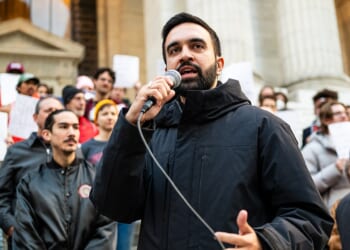
In September, Petro joined pro-Palestinian protesters during his visit to the U.S., but took things a step further by directly calling on U.S. soldiers to engage in insubordination.
“I ask all of the soldiers of the army of the U.S. not to point their guns at humanity. Disobey the orders of Trump. Obey the orders of humanity,” he yelled at U.S. troops through a megaphone.
Washington was angered over the stunt and revoked his visa. In response, Petro said, “I don’t care.”
Sanctions were levied against Petro and his family the following month, under the justification that he had emboldened drug cartels in the country. In an October press release, the Department of the Treasury outlined the United States’s long list of grievances against the Colombian president, describing him as a “former guerrilla member” who has “provided narco-terrorist organizations with benefits under the auspices of his ‘total peace’ plan.”
It blamed his “erratic behavior” for driving Colombia away from its longtime partners, highlighting an incident in 2024 when he shared confidential information obtained “via secure anti-money laundering communication channels, threatening the integrity of the international financial system and leading to the suspension of Colombia’s Financial Intelligence Unit from The Egmont Group.”
The statement also claimed Petro had “allied himself with the narco-terrorist regime of Nicolas Maduro Moros and the Cartel de Los Soles.”
TRUMP SANCTIONS ‘ILLEGAL DRUG DEALER’ COLOMBIAN PRESIDENT GUSTAVO PETRO IN ESCALATION OF THEIR FEUD
Colombia now produces six times as much cocaine as it did in 1993, the height of the U.S.’s public interest in the drug production of the country, when infamous drug lord Pablo Escobar was killed. The country now surpasses the cocaine production of South American countries Peru and Bolivia combined. It provides 90% of the cocaine sold in the U.S. every year, according to the Associated Press.
The United Nations found that cocaine cultivation in Colombia increased every year from 2013 to 2023. This includes massive increases, such as a 40% increase from 2020 to 2021 and 53% increase from 2022 to 2023. It grew again 10% last year, according to Bloomberg.