Order Michael Finch’s new book, A Time to Stand: HERE. Prof. Jason Hill calls it “an aesthetic and political tour de force.”
In 2025, Texas and Florida took the notable step of naming the Council on American-Islamic Relations (CAIR) and the Muslim Brotherhood as terrorist organizations under state authority. Governors Greg Abbott and Ron DeSantis issued executive orders banning these groups from such things as access to state contracts, benefits, and property, citing alleged links between CAIR, the Muslim Brotherhood, and Hamas – a group designated by the U.S. government as a Foreign Terrorist Organization (FTO).
CAIR has strongly denied any ties to Hamas or terrorism, calling these designations unconstitutional and defamatory and has filed federal lawsuits challenging them. Upon investigation, however, CAIR’s denials cannot refute the facts.
This article explores the historical and documented allegations that federal and state officials and national security policy makers should use when assessing CAIR and its state chapters’ relationships to Hamas.
Dot #1: The Muslim Brotherhood and the “Palestine Committee” Network
The Muslim Brotherhood is a transnational Islamist movement founded in Egypt in 1928. It established branches and affiliated networks globally, including in the United States, each given the title “Palestine Committee.” The committees were aligned with Hamas – itself a Gaza offshoot of the Brotherhood – and their purpose was to support Palestinian resistance narratives and causes.
In an FBI memorandum obtained by the Investigative Project on Terrorism (IPT), the Palestine Committee was described as the Brotherhood’s “largest and most powerful nationalistic committee” during the late 1980s and early 1990s, with components directly reporting to international Brotherhood leadership.
Dot #2: The U.S. Palestine Committee and Mousa Abu Marzook
At the center of these connections is Mousa Abu Marzook (Marzouk), a senior leader from Hamas and first Chairman of the Hamas Political Bureau. In 1989, while Hamas founder Ahmed Yassin was languishing in an Israeli prison, Marzook, who at the time was located in the United States, effectively assumed leadership of the group.
Marzook lived in the U.S. from 1982 until his deportation to Jordan in 1997. Today, Marzook, much like his fellow Hamas associate Khaled Mashal, is a billionaire residing in Qatar.
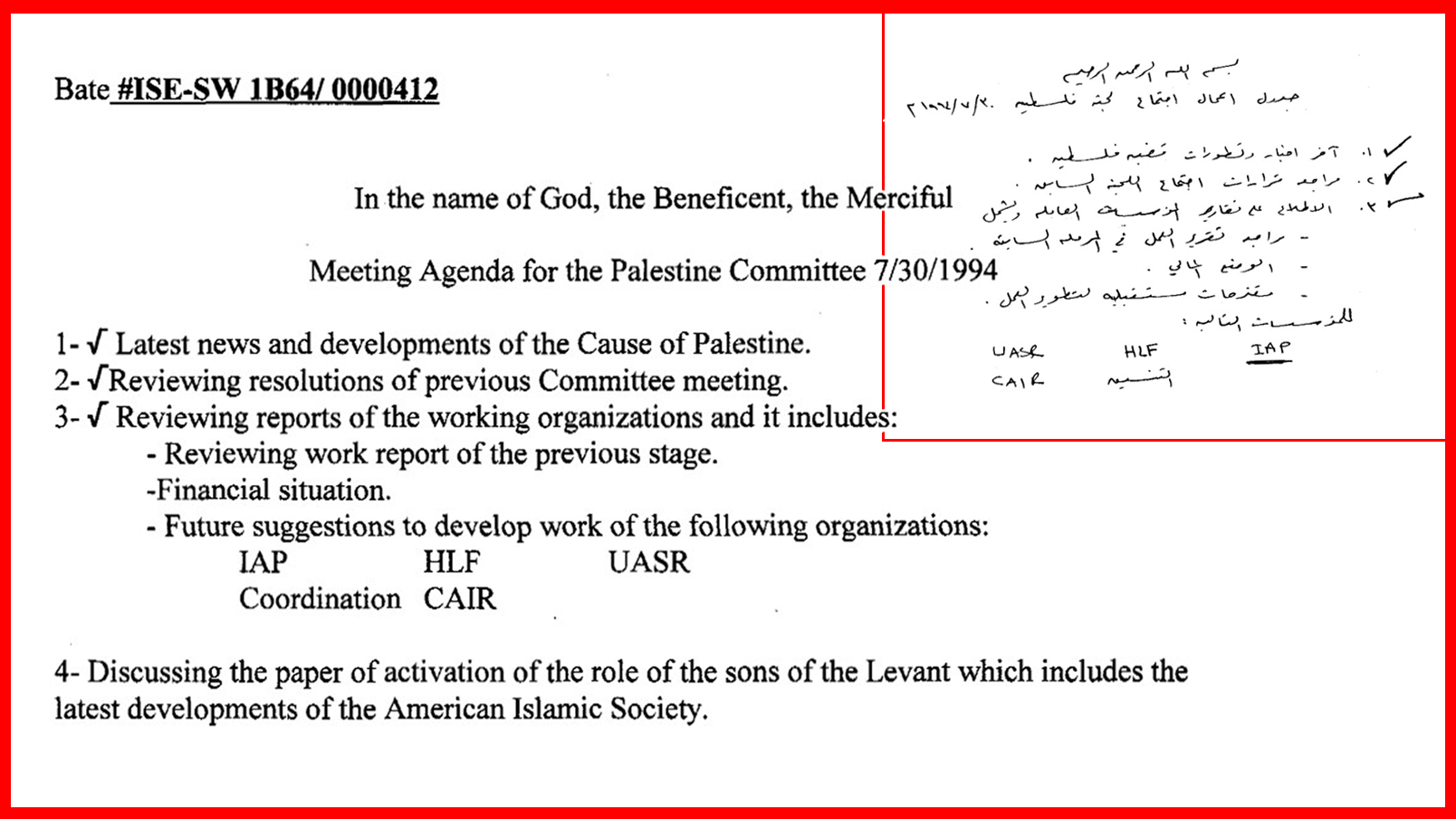
Marzook headed the U.S. Palestine Committee from its inception and played a key role in establishing its affiliated organizations. These included the United Association for Studies and Research (UASR), the Islamic Association for Palestine (IAP), the Holy Land Foundation for Relief and Development (HLF), and later the Council on American-Islamic Relations (CAIR).
Dot #3: IAP, Philadelphia, and the Founding of CAIR
IAP functioned as a propaganda arm for Hamas, publishing Hamas-related materials, including the Hamas charter calling for Israel’s destruction. Both Marzook and Mashal were involved in IAP’s mission and activities.
IAP’s senior leadership consisted of figures who later became the founders of CAIR in 1994. They were Nihad Awad, Omar Ahmad, and Rafeeq Jaber. Awad, who championed the October 7 massacre in Israel, began his tenure with CAIR as its national Executive Director and continues to hold the position.
In 1993, a meeting in Philadelphia brought together leaders from IAP, the Occupied Land Fund (later the Holy Land Foundation), and UASR. According to trial exhibits and reporting, participants discussed strategies to undermine the Oslo Accords, expand fundraising for Hamas, and organize politically within the U.S. Muslim community. This meeting is frequently cited in analyses of CAIR’s Hamas-related origins and challenges CAIR’s portrayal of itself as a conventional civil rights organization.
Dot #4: Holy Land Foundation, Seed Funding, and Organizational Links
HLF was established in 1988 under the name Occupied Land Fund. Initially, it shared the mailing address of the Islamic Society of North America (ISNA), another U.S.-based Muslim Brotherhood-related entity. HLF later would become the largest Muslim charity in the U.S., before its closure in 2001.
U.S. authorities designated HLF a Specially Designated Terrorist entity after determining it had raised money and routed funds to Hamas-affiliated institutions. In 2008, HLF executives were convicted in the largest terrorism-financing prosecution in U.S. history, involving more than $12 million directed to Hamas causes.
CAIR received early seed funding from HLF, and CAIR’s Texas chapter was co-founded by one of the main defendants in the federal HLF trial, Ghassan Elashi.
Dot #5: CAIR and the Holy Land Foundation Prosecution
In United States v. Holy Land Foundation, federal prosecutors named CAIR an “unindicted co-conspirator.” While CAIR was neither charged nor convicted, the designation reflected prosecutors’ assessment that CAIR was part of the broader conspiracy to support Hamas.
In addition to the other links CAIR had with HLF, following the September 11 attacks, CAIR publicly solicited donations for HLF via the homepage of its official website. CAIR insidiously masked the donations as ones going to a “NY/DC Emergency Relief Fund.”
Dot #6: “We are Hamas”
In July 2014, CAIR’s Florida chapter co-sponsored a pro-Hamas rally in Downtown Miami, where rally goers repeatedly shouted, “We are Hamas” and “Let’s go Hamas.” After the rally, the event organizer, Sofian Zakkout, wrote in Arabic, “Thank God, every day, we conquer the American Jews like our conquests over the Jews of Israel!”
The following month, then-CAIR-Florida Executive Director Hassan Shibly tweeted, “God as my witness, Israel & its supporters are enemies of God and humanity…” In November 2019, Shibly posted on his social media a “demand” for the convicted HLF defendants to be released, praising them as “leaders and pillars of their communities.”
Today, CAIR-Florida is a member of the South Florida Muslim Federation (SFMF), an umbrella group for many of South Florida’s radical Muslim institutions and an organizer of annual pro-Hamas conferences.
Conclusion
The proof that CAIR is tied to Hamas operatives and ideology rests on a sequence of documented organizational associations:
- The Muslim Brotherhood set up worldwide “Palestine Committees” aligned with Hamas support.
- Global Hamas leader Mousa Abu Marzook heads up the U.S. division of the Palestine Committee.
- CAIR’s founders emerge from Palestine Committee member IAP, an organization tied to Hamas propaganda efforts.
- Early financial and leadership connections arise between CAIR and Hamas financier HLF.
- The U.S. government’s designation of CAIR as a co-conspirator in the HLF terrorism-financing prosecution.
- Repeated public expressions by CAIR-affiliated leaders and chapters endorsing or defending Hamas and Hamas-linked actors.
Taken together, these documented associations present a deeply troubling pattern that warrants heightened scrutiny by federal, state and local officials charged with safeguarding public funds, public safety, and the integrity of civic institutions. While CAIR portrays itself as a conventional civil rights organization, the historical record reflects persistent ideological, financial, and operational overlaps with Hamas-linked networks that cannot be responsibly ignored.
Accordingly, national and state authorities should undertake a complete review of CAIR’s tax-exempt status, donor base, and eligibility for public grants. Where the facts and applicable law support such action, governments must be prepared to suspend funding, freeze assets, criminally prosecute leadership, and shutter CAIR’s doors to ensure that taxpayer resources and public institutions are not exploited by organizations connected – directly or indirectly – to foreign terrorist movements.
Beila Rabinowitz, Director of Militant Islam Monitor, contributed to this report.