Days before Russian tanks rolled into Ukraine in February 2022, Chinese President Xi Jinping and Russian President Vladimir Putin announced a “no-limits partnership.” At the time, few imagined it would become central to sustaining Russia’s war effort. Nearly four years later, some in Washington still cling to the notion that this alignment is shallow or reversible. But Beijing and Moscow understand themselves to be engaged in a common struggle against the U.S.-led democratic international order.
Ukraine is a critical theater for that effort.
Since Russia launched its full-scale invasion, no country has done more to sustain Putin’s war than China. Cut off from European energy markets, Moscow has redirected its oil and gas exports eastward, selling to China at steep discounts. The revenue has helped stabilize Russia’s economy and finance its war effort. At the same time, China has become indispensable to Russia’s military-industrial base. Nearly 80% of the sanctioned dual-use items Russia requires now come from China.
NETANYAHU SAYS HE WARNED AUSTRALIA OF POLICIES FUELING ‘ANTISEMITIC FIRE’ MONTHS BEFORE SHOOTING
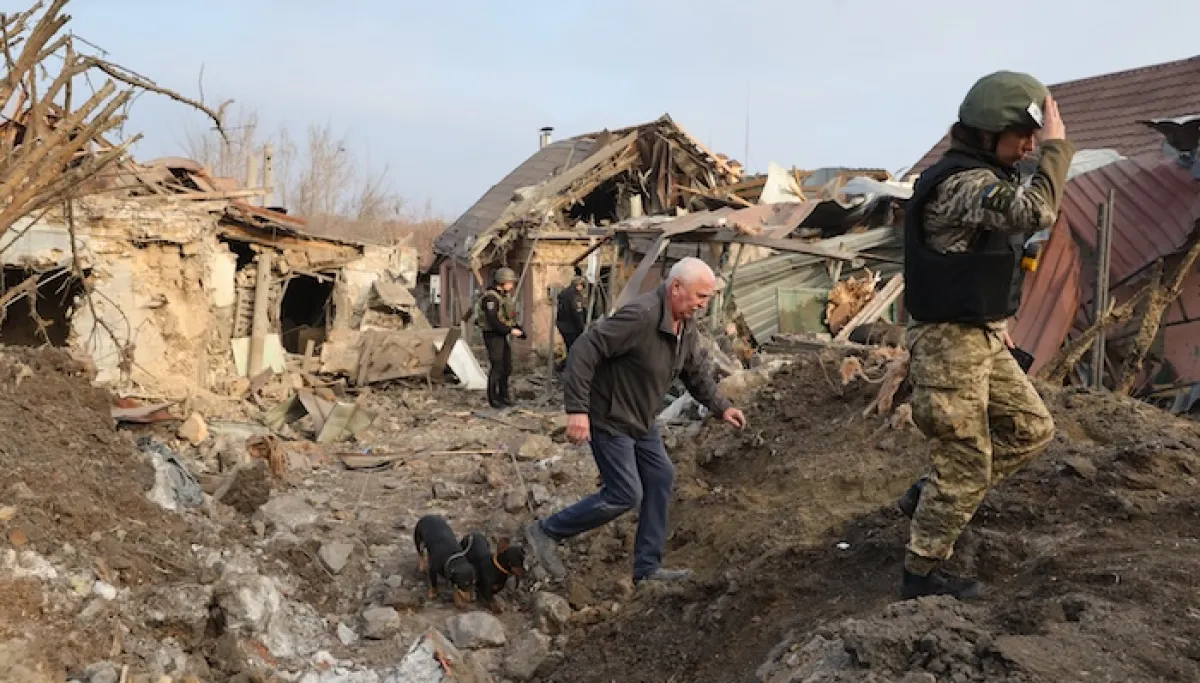
Chinese exports of fiber-optic cables and lithium-ion batteries, essential components for drones, have surged. Those drones now form the backbone of Russia’s campaign against Ukrainian cities and civilian infrastructure. Yes, China does sell necessary components to Ukraine, too, but the volumes are not comparable. Ukrainian and Western officials have also accused Beijing of supplying satellite imagery to aid Russian targeting, and the United States has sanctions against Chinese firms for providing high-resolution imagery to Moscow.
Military cooperation has expanded alongside this material support. Russian and Chinese forces have conducted joint naval, air-defense, and anti-missile drills across the Pacific and the Arctic. China’s coast guard entered the Arctic for the first time last year to conduct joint patrols with Russia.
Yet despite this evidence, parts of Washington continue to indulge the idea that Russia might eventually be peeled away from China. They are willing to sacrifice Ukrainian interests in that pursuit. This is very wishful thinking. Russia is not a potential American partner trapped in Beijing’s orbit. It is a willing participant in a shared project to weaken American power and the West. A Russian victory in Ukraine would not loosen that bond, it would strengthen it.
The consequences of a Russian victory would be far-reaching. Moscow, with a reconstructed military, will be emboldened to press its advantage across Europe. China, watching Western resolve falter, would draw its own conclusions. If the U.S. cannot sustain support for Ukraine, Beijing will reasonably question whether Washington would endure the far higher costs of defending Taiwan.
In a future Taiwan crisis, Russia would be positioned to support China materially and strategically while simultaneously threatening Europe. That might pin the U.S. to the European continent at precisely the moment its forces would be needed in the Indo-Pacific. We will then look back at the Ukraine war not as an isolated conflict, but as the opening phase of a wider contest.
To be clear, Europeans must spend much more on defense, more quickly. Still, deprioritizing Ukraine does not free American resources for Asia. It creates the conditions for a two-front challenge from an emboldened China and a reconstituted Russia.
TRUMP NATIONAL SECURITY STRATEGY PUTS ENDING RUSSIA-UKRAINE WAR AS ‘CORE INTEREST’
Conversely, weakening Russia in Ukraine weakens China. Moscow is Beijing’s only major great-power ally, and their objectives overlap. Anything that degrades Russia’s power degrades the strength of the China-Russia axis.
What happens in Ukraine will shape what happens in the Indo-Pacific. If the U.S. wants to deter China tomorrow, it must help defeat Russia today.