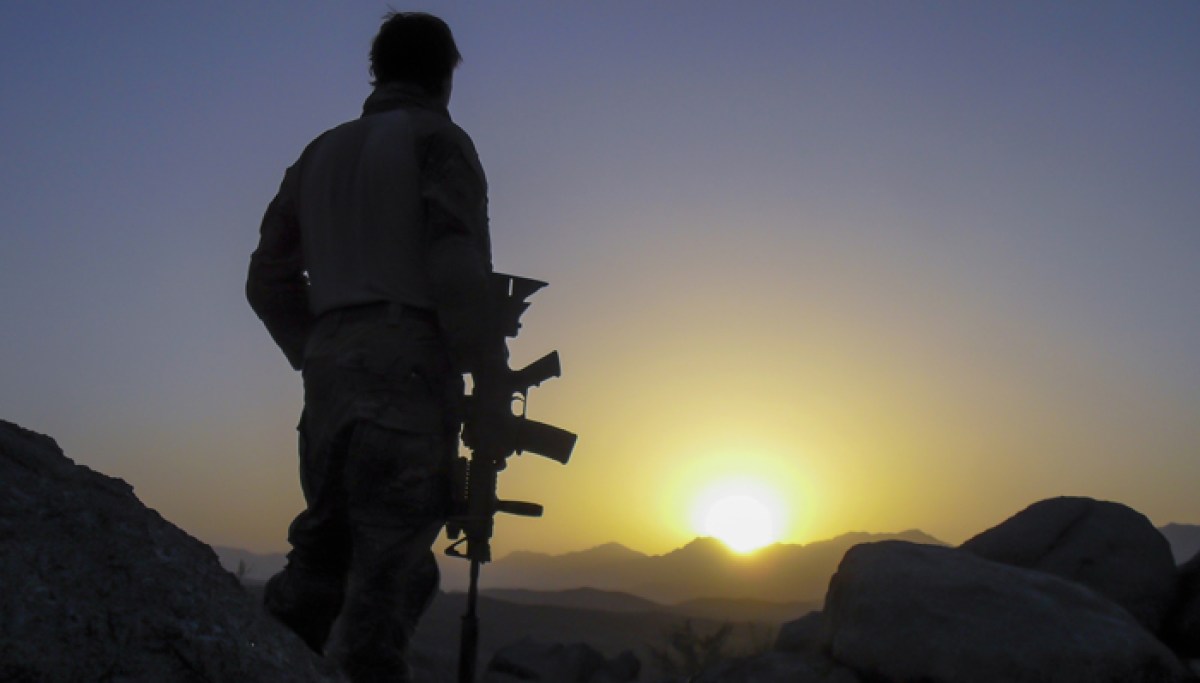
In 2005, my Army unit searched an Afghan village for an enemy weapons cache. Our convoy consisted of a lead Humvee with a .50 caliber machine gun, a center civilian pickup, and my team’s trail Humvee, in which I manned the Mk 19 grenade-launching machine gun. It was a pretty average day.
Then our convoy suddenly stopped. An old Afghan man with a long gray beard had walked out in front of us. We all readied our weapons, fearing an ambush.
“You cannot go that way,” the old man said through our interpreter.
“We are Americans. We’ll go wherever we want,” we responded.
“You must not go that way,” the man said. “The Soviets left a minefield on that side of the village.”
We thanked the man and chose a different route. Why did this Afghan save our lives? He gained nothing by helping us. No one would have blamed him for letting us drive to our deaths. But he risked being shot by a scared soldier with a loose trigger finger when he halted us. We were loud foreigners, often bungling things in our interactions with the Afghans, doubtlessly offending many. But he connected with our shared humanity and saw us for the scared children we were.
He was Muslim, and my entire squad owes him our lives. He was one of many Afghan Muslims who helped us in our shared fight against our common enemy, the Taliban and other terrorist monsters who threaten Muslims and non-Muslims alike.
Recently, an Afghan named Rahmanullah Lakanwal was alleged to have shot Army Spc. Sarah Beckstrom and Air Force Staff Sgt. Andrew Wolfe, two members of the West Virginia National Guard, while they were on duty in Washington, D.C. As of this writing, Beckstrom has died, and Wolfe remains in critical condition. I passionately condemn the shooter and join others in prayer for these service members and their families.
But I’m concerned about the reaction to this horrific act. President Donald Trump has paused processing of all Afghan immigration applications and ordered a reexamination of the immigration status for all Afghans admitted to America under former President Joe Biden.
This might sound troubling to those concerned about helping Afghan allies with whom Americans served in the war. However, it’s important to remember that Biden’s evacuation effort in Kabul during his betrayal of Afghanistan was random chaos. Good Afghans who served with Americans were abandoned while thousands of Afghans were loaded onto evacuation aircraft simply because they were able to push into the airport early. America doesn’t owe immigration protection to all Afghans.
But neither do all Afghans deserve condemnation.
I hope Trump’s administration carefully evaluates Biden-era Afghan immigration cases. I also hope it will resume advancing the cases of deserving Afghans, to whom our military owes so much. I have written about the proposed Afghan Adjustment Act, which would both increase security scrutiny and help deserving Afghans finally find safety in America.
And I hope Americans everywhere will join me in resisting broad-stroke anti-Afghan and anti-Muslim prejudice. I have seen talk online suggesting people have forgotten 9/11 because of New York Mayor-elect Zohran Mandani. His many stupid political ideas, not his religion, deserve criticism. I have seen a lot of tough talk, usually from men who have never served in the military, about what should be done or what they would do to Muslims in general and Afghans in particular. This is an injustice to so many brave Afghans who served, often for years, alongside American troops in the Afghanistan War.
Again, my prayers are with Wolfe and his family, and with the family of Beckstrom, and I hope harsh justice is delivered to the man who shot those two service members. But I also remember an old Muslim man in Afghanistan, as well as many other great Afghans to whom my fellow soldiers and I owe our lives. My prayers are with them as well.
Trent Reedy, author of several books, including Enduring Freedom, served as a combat engineer in the Iowa Army National Guard from 1999 to 2005, including a tour of duty in Afghanistan.
*Some names and call signs in this story may have been changed due to operational security or privacy concerns.