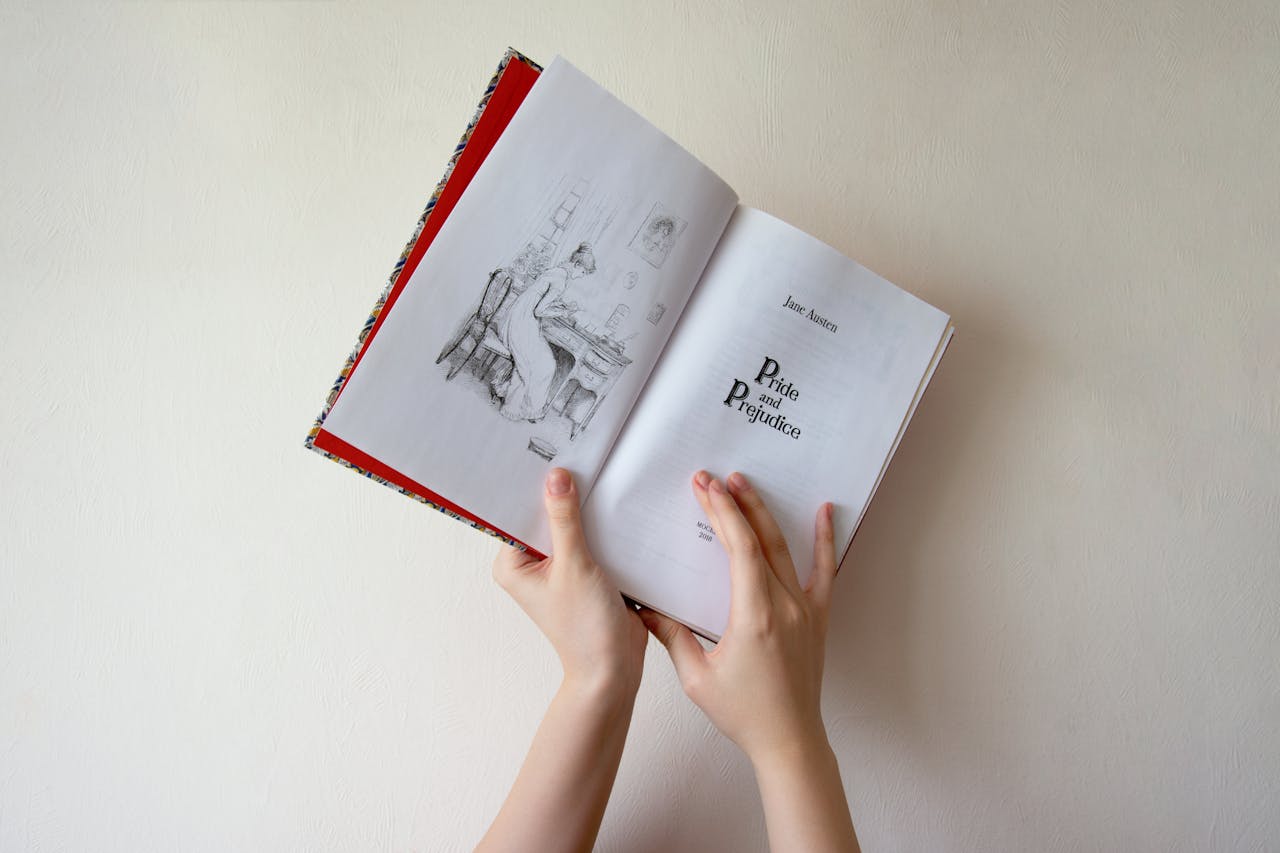
Jane Austen is far from universally loved. Mark Twain, arguably the greatest author America has ever produced, caustically declared: “Every time I read Pride and Prejudice I want to dig her up and beat her over the skull with her own shin-bone.” Nor would Cormac McCarthy, arguably the greatest American fictionalist of the last 40 years, likely disagree — in a famous 1992 interview he told The New York Times that his list of “good writers” are those who “deal with issues of life and death.” In Pride and Prejudice, no one dies; in Sense and Sensibility, there is a single death, not even described on-scene, that sets the entire plot in motion.
Perhaps many men, uninterested in non-violent, actionless tales of romance set in a highly stratified and decorous society, are sympathetic to Twain’s and McCarthy’s analysis. Yet as we mark this 250th anniversary of Austen’s birthday, I must admit an uncomfortable fact. The 19th-century English writer isn’t just a great storyteller; Pride and Prejudice in many respects promotes an American vision of the good life. In a society in which men and women increasingly divide over politics, Austen is an author we should encourage more women to embrace.
How I Came To Love Jane Austen
Like many men, I never would have bothered with Jane Austen if not for a love interest — namely, my wife. As far as I knew, Austen’s novels were nothing but romances, simply older and probably better written. Then, my wife finally goaded me into watching Pride and Prejudice, both the 2005 Keira Knightley version, and the 1995 BBC version. I had to admit, they were good stories, and well told. My wife told me to read the book. It took me more than a decade.
I confess part of my motivation to finally read Austen was as much my wife’s goading as it was something I read by the great philosopher Alasdair MacIntyre. In his influential work After Virtue — which in part inspired Rod Dreher’s popular The Benedict Option — MacIntyre calls Austen “in a crucial way the last representative of the classical tradition” because of her sophisticated presentation and analysis of the virtuous life. If you want to understand how to be a virtuous person, says MacIntyre, you better read Austen. He’s not wrong, though Austen is even more than virtue — her stories point to the very kind of society America was already becoming at the beginning of the 19th century.
The American Character of Austen
At first reading, an American might find the rigid hierarchical structure of turn-of-the-century England as described in Austen’s fiction to be frustrating, with its complicated social decorum between classes, and even sub-classes of people. Everyone is constantly evaluating where they stand socially in relation to others, and thus who they can socialize with, and even marry. Can a woman of the lesser gentry marry a far wealthier man? Who will get stuck marrying the vicar? No wonder immigration rates from Great Britain to North America remained high after the American Revolution, into the 1890s! If the choice is between stifling levels of class consciousness and social propriety, or a free nation of promise whose founding principles protect liberty and equality while rewarding ambition and virtue, I know which one I’d choose.
Yet the more of Austen I read, the less persuaded I was that she found her own social arrangement the optimal one, either. Certainly, Pride and Prejudice seems to celebrate certain forms of decorum as necessary for social preservation. The protagonist Elizabeth Bennet’s younger sister Lydia, who in her oblivious superficiality and immaturity could have very well ruined the reputation of the entire Bennet family by running off with a scoundrel, is a good example of the dangers of social impropriety. Yet the story also comically ridicules those who obsess over etiquette, such as the insufferable sycophant and Anglican vicar Mr. Collins. Collins’ benefactress Lady Catherine de Bourgh, who according to the dictates of noblesse oblige is supposed to embody aristocratic generosity and humility, is in truth the vainest character in the entire novel, the villainness foil to the virtuous (and modest) Elizabeth.
Moreover, the tension at the heart of Pride and Prejudice, the romance of Elizabeth and Mr. Darcy, is to many members of elite English society an affront precisely because of the disparity between the wealth and respectability of their two families. When Lady Catherine confronts Elizabeth about the possibility of her engagement to Darcy, the former declares: “Because honour, decorum, prudence, nay, interest, forbid it.” Elizabeth, says Lady Catherine, is simply not of the right social status to marry her nephew. In response, Elizabeth, channeling Austen’s own opinions, asserts: “Neither duty, nor honour, nor gratitude… have any possible claim on me, in the present instance. No principle of either would be violated by my marriage with Mr. Darcy.” It’s almost as if Austen was channeling Federalist No. 39 and its prohibition of nobility!
Austen’s Conservative Vision of the Good Life
As much as Pride and Prejudice is (rightly) pegged as a traditional book promoting traditional mores, there is also a modern character to it, with the elevation of (virtue-informed) romantic love over-and-above the opinions of family and aristocratic decorum. As English scholar Vivien Jones writes in the introduction to the Penguin edition of my copy of the book: “This plot formula seems to give women, and the values they represent, a lot of power and responsibility. But it is a power of a carefully circumscribed kind. The social order has been modified, not radically altered.” That sounds like a pretty good definition of a conservative take on “social progress!”
Thus does Austen offer a deeply conservative perspective, while directing her readers to a carefully-worded criticism of a stuffy English society that one cannot help but read as evincing a certain sympathy for the freedom enjoyed by her “American cousins.” In Austen’s novels — not only Pride and Prejudice but Sense and Sensibility, Persuasion, and Emma — we are given stories that celebrate a classically and Christian-informed understanding of goodness, truth, and beauty. Undoubtedly, it is one deeply imbued with religious piety (Austen’s beloved father was after all an Anglican clergyman) and an appreciation for differences between the sexes.
But we are also given a vision of the good life that ultimately places love and virtue above social proprieties and expectations. What is good is good, regardless of what other people think. In the end, a properly formed conception of the truth must inform our decisions, not social expectations. In that, Austen reads very much like an American.
Casey Chalk is a senior contributor at The Federalist and an editor and columnist at The New Oxford Review. He is a regular contributor at many publications and the author of three books, including the upcoming “Wisdom From the Cross: How Jesus’ Seven Last Words Teach Us How to Live (and Die)” (Sophia Institute Press, 2026).