Order Robert Spencer’s new book, Holy Hell: Islam’s Abuse of Women and the Infidels Who Enable It: HERE.
Leftists like to call themselves “progressives” because they believe that history is progressing inexorably toward exactly the kind of society for which they advocate. That is also why they like to claim that their opponents are on the “wrong side” of history and will sooner or later be consigned to its “dustbin.” One early Communist, however, saw clearly that the whole thing was on the verge of crashing down. Modern-day Marxists, so pervasive all over the West, would do well to heed his analysis.
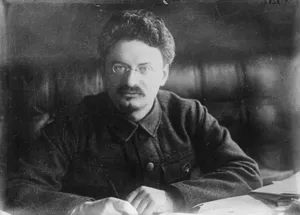
To say that Leon Trotsky was right about the looming failure of Communism, however, is not to exonerate him for the many crimes he committed in laboring to impose that same foredoomed system upon the world. Trotsky remains one of the most curious figures of the bloody and oppressive history of Soviet Communism. One of the pioneering leaders of the Soviet Union, Trotsky demonstrated an extraordinary capacity for brutality as he whipped the Red Army into shape by means of threats, hostage-taking, and outright murder. Yet in his protracted power struggle with Stalin, he displayed a bland complacency that caused him to be outmaneuvered at every turn.
This was because Trotsky was certain, like contemporary leftists, that history was on his side, and moving inexorably in his direction. Even after Stalin had made him the scapegoat for everything that was going wrong in the Soviet Union and exiled him from the cruel political entity he had done so much to construct, Trotsky remained secure in the knowledge that events would before too long turn his way, and that Stalinism, which Trotsky regarded as a corruption of true Communism, would give way to the real thing.
Trotsky believed that the Second World War would bring about this great transformation. “The disintegration of capitalism,” he wrote in September 1939, just after the war broke out, “has reached extreme limits, likewise the disintegration of the old ruling class. The further existence of this system is impossible.” He referred to Stalinism as “the bureaucratization of the Soviet State” and asserted that it was “the consequence of the ‘incapacity’ of the proletariat itself to regulate society through the democratic mechanism.”
Trotsky was confident, however, that the new war would bring about the triumph of the proletariat, or at very least give the workers the opportunity to seize power. If they failed to do so, they would have no one to blame but themselves: “The second world war has begun. It attests incontrovertibly to the fact that society can no longer live on the basis of capitalism. Thereby it subjects the proletariat to a new and perhaps decisive test.”
That test would bring about the long-delayed victory of the true Communism that Trotsky believed he represented: “If this war provokes, as we firmly believe, a proletarian revolution, it must inevitably lead to the overthrow of the bureaucracy in the USSR and regeneration of Soviet democracy on a far higher economic and cultural basis than in 1918.… To every single person it will become clear that in the process of the development of the world revolution the Soviet bureaucracy was only an episodic relapse.”
Yet that test could also be failed: “If, however, it is conceded that the present war will provoke not revolution but a decline of the proletariat, then there remains another alternative: the further decay of monopoly capitalism, its further fusion with the state and the replacement of democracy wherever it still remained by a totalitarian regime.” That was exactly what was happening in Stalinist Russia, which Trotsky saw as a dictatorship of bureaucrats. “The inability of the proletariat,” he continued, “to take into its hands the leadership of society could actually lead under these conditions to the growth of a new exploiting class from the Bonapartist fascist bureaucracy. This would be, according to all indications, a regime of decline, signalizing the eclipse of civilization.”
Trotsky warned that “the proletariat of advanced capitalist countries, having conquered power,” might “should prove incapable of holding it and surrender it, as in the USSR, to a privileged bureaucracy.” This, he asserted, would demonstrate “the congenital incapacity of the proletariat to become a ruling class.” He concluded: “If the world proletariat should actually prove incapable of fulfilling the mission placed upon it by the course of development, nothing else would remain except openly to recognize that the socialist program based on the internal contradictions of capitalist society, ended as a Utopia.”
That is, if World War II did not result in the creation of a true Communist state, as opposed to the dictatorship of a bureaucratic ruling class, Communism would have failed. It would remain just an idea, incapable of being transformed into a reality.
And indeed, everywhere Communism has been applied, it has resulted not in actual justice for workers, but in the creation of an oppressive and totalitarian ruling bureaucracy. Do today’s leftists really think that if they attain all that they have ever dreamed of attaining, that their new workers’ paradise will turn out any different?