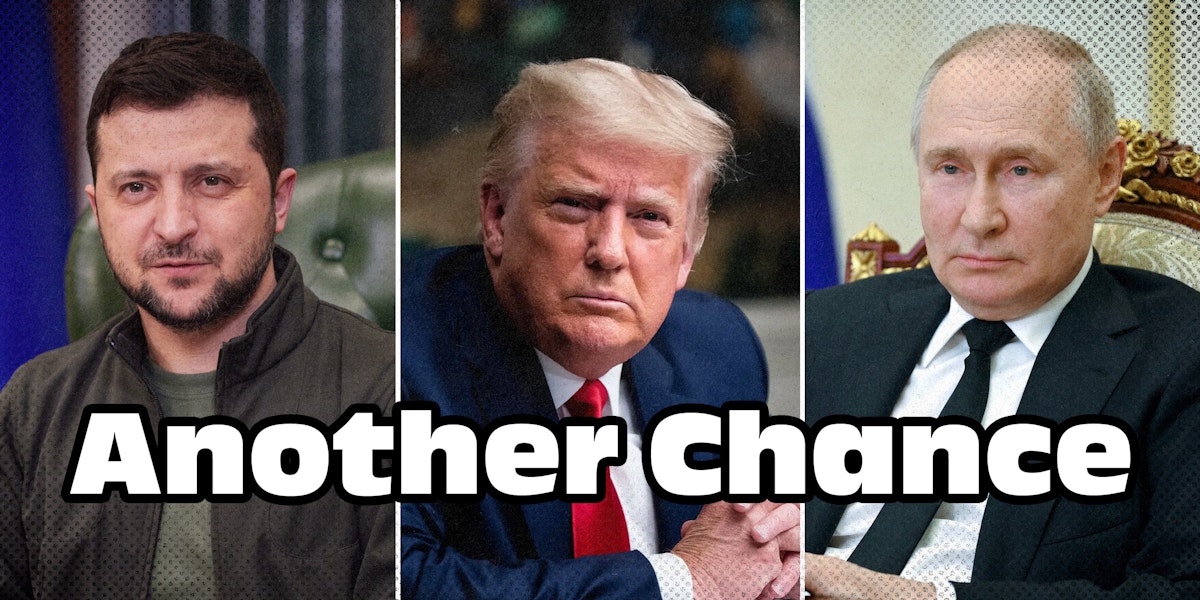
Ending the war in Ukraine has eluded President Donald Trump for the better part of his first year in his second term. Despite his successes in ending conflicts and getting peace deals done, the most significant being the negotiated deal to end the Israel/Hamas war, the ongoing conflagration in Ukraine continues to stick in his craw.
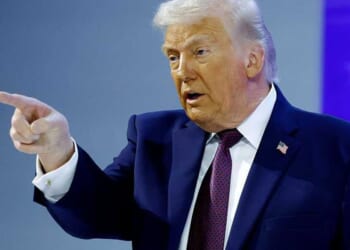
Indeed, on the campaign trail, Trump repeatedly and explicitly boasted that he would end the war by day one of his presidency. At least 53 times, Trump touted this claim. For example, in June 2024, he said, “I will have that war settled between Putin and Zelensky as president-elect before I take office on January 20. I’ll have that war settled. People being killed so needlessly, so stupidly. And I will get it settled, and I’ll get it settled fast before I take office.”
Here we are, nearly a year and a half since Trump uttered those words, and people are still being killed on the battlefields of Ukraine.
Trump’s lack of success in ending the war is not due to a lack of effort. He and his administration have engaged in multiple diplomatic actions, raised sanctions, paused weapons deals, increased weapons supplies, issued threats, offered promises, and made proposals. But thus far, to no avail.
Russian strongman Vladimir Putin rejects any deal that yields territory, and an admirably defiant Ukrainian President Volodymyr Zelensky refuses to capitulate. Therefore, this war of attrition continues to grind on, as the Russian war machine slowly but surely gains ground even as the bodies pile up.
Given this reality, and despite repeated failed efforts to reach a peace deal, the Trump administration has not given up. Last week, Team Trump proposed a new 28-point plan.
On first glance, the plan appears favorable to Putin. It includes territorial concessions to Russia, including land that is still under Ukrainian control. It would cap Ukraine’s military at 600,000 troops, roughly 280,000 fewer than its current force. It would eliminate any future opportunity for Ukraine to join NATO. It would also require Ukraine to hold elections within 100 days of a peace deal and the end of fighting.
What Ukraine would get is an agreement from the U.S. to provide intelligence and logistical support, as well as other appropriate steps to be determined, in case Russia relaunches hostilities. It would not, however, guarantee any military assistance from the U.S. Ukraine would also receive a recovery plan that includes economic investment with $100 billion in frozen Russian assets to be invested in Ukraine. Furthermore, Europe would invest another $100 billion.
U.S. sanctions against Russia would be lifted, and Russia, NATO, and the U.S. would engage in a joint security dialogue to develop a nonaggression pact among Europe, Russia, and Ukraine.
It’s an ambitious plan, but it also takes into account the complex reality of the situation. The fact of the matter is, Ukraine is slowly losing. Zelensky, who has staunchly refused to concede any Ukrainian territory to Russia, is facing a corruption scandal implicating members of his own cabinet. While 71% of Ukrainians stand with Zelensky in opposing any land concession, getting out of this quagmire without a loss of some territory appears nearly impossible.
Zelensky’s response to the plan also appears to tacitly admit this reality. In a video address to his people, he said, “Now is one of the most difficult moments in our history. Now, Ukraine may find itself facing a very difficult choice. Either loss of dignity, or the risk of losing a key partner.” Zelensky added, “I will present arguments, I will convince, I will offer alternatives, but we will definitely not give the enemy a reason to say that Ukraine does not want peace. We are counting on European friends who understand that Russia is not far away, that it is near the borders of the EU, that Ukraine is now the only shield separating comfortable European life from Putin’s plans.”
Trump expects an answer from Zelensky by Thanksgiving. It will be interesting to see how much Ukraine is willing to accept; if Zelensky agrees to most of it, Russia’s response will indicate whether Putin is willing to actually end the war.